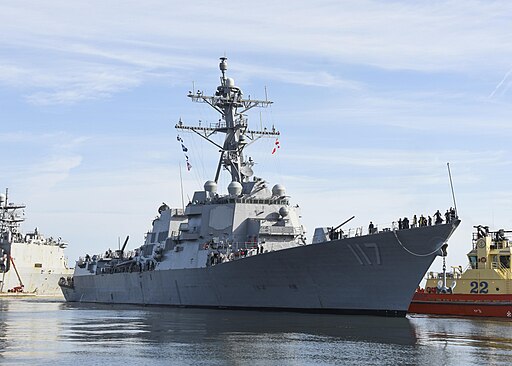
USS Paul Ignatius (DDG-117)
USS Paul Ignatius (DDG-117) is a Flight IIA Arleigh Burke–class guided-missile destroyer commissioned in July 2019. Homeported in Rota, Spain, she carries the name of Paul Ignatius, the 59th Secretary of the U.S. Navy and a World War II naval officer. With advanced Aegis air and missile defense capabilities, potent strike weapons, robust anti-submarine systems, and full helicopter support, DDG-117 delivers multi-domain naval power anywhere in the world.
Design and Construction
Namesake and Commissioning
Paul Ignatius served aboard escort carriers during World War II before leading the Navy as Secretary under President Johnson. The ship’s keel was laid in October 2015 at Huntington Ingalls Ingalls Shipbuilding in Pascagoula, Mississippi. She was launched in November 2016, christened in April 2017, and officially entered fleet service in July 2019.
Hull and Structural Features
The hull measures 510 feet in length and is built from high-strength steel with stealth-shaped surfaces and reduced infrared signatures. Longitudinal framing and resilient machinery mounts suppress acoustic noise. A double-deck hangar and hangar door integrate seamlessly into the superstructure, supporting two MH-60R Seahawk helicopters.
General Characteristics
| Characteristic | Specification |
|---|---|
| Class & Type | Arleigh Burke–class destroyer, Flight IIA |
| Displacement (full load) | 9,200 long tons |
| Length overall | 510 ft (155.3 m) |
| Beam | 66 ft (20 m) |
| Draft | 33 ft (10 m) |
| Propulsion | 4 × GE LM2500 gas turbines, 2 shafts |
| Power output | 100,000 shp (75,000 kW) |
| Maximum speed | > 30 knots |
| Range | 4,400 nmi at 20 knots |
| Complement | 380 officers and enlisted |
| Homeport | Rota, Spain |
Propulsion and Performance
Engineering Plant
Four GE LM2500-30 gas turbines drive two controllable-pitch propellers via reduction gear. A diesel generator set provides electrical power for hotel loads, combat systems, and auxiliary propulsion motors during low-noise operations.
Speed and Endurance
Her maximum speed exceeds 30 knots, allowing rapid repositioning. At a sustained 20 knots, DDG-117 can steam approximately 4,400 nautical miles without refueling. The gas-turbine plant provides high availability and fast start-up in demanding scenarios.
Combat Systems and Armament
Aegis Combat System
At the heart of Paul Ignatius is the AN/SPY-1D(V) multi-function radar, linked with Mk 99 fire-control illuminators and an open-architecture command suite. This network processes thousands of tracks simultaneously, enabling defense against aircraft, anti-ship missiles, and ballistic threats.
Vertical Launch System and Missiles
The ship carries ninety-six Mk 41 VLS cells split between forward (32) and aft (64) modules. Load-outs include SM-2 and SM-6 for air defense, RIM-161 Standard Missile 3 for ballistic missile intercept, RUM-139A VL-ASROC for anti-submarine warfare, and BGM-109 Tomahawk for land-attack strike.
Naval Gun, CIWS, and Secondary Weapons
A single 5-inch/62 Mk 45 mod 4 gun delivers naval fire support with extended-range guided munitions. Close-in defense comprises a SeaRAM launcher, two 20 mm Phalanx CIWS, two 25 mm Mk 38 machine-gun stations, and multiple .50 cal machine guns.
Anti-Submarine Warfare
Hull-mounted AN/SQS-53C sonar and towed AN/SQR-19 tactical array feed the SQQ-89 ASW combat system. Two triple Mk 32 torpedo tubes deploy Mk 54 lightweight torpedoes. MH-60R Seahawks augment ASW reach with dipping sonar, sonobuoys, and torpedoes.
Sensors and Electronics
Radar Suite
- AN/SPY-1D(V) phased-array 3D air and surface surveillance
- AN/SPQ-9B high-resolution fire-control radar for fast targets
- AN/SPS-67(V)3 surface-search and navigation radar
Sonar and Undersea Warfare Systems
- AN/SQS-53C active/passive hull-mounted sonar
- AN/SQR-19 tactical towed passive array
- Ship-to-helicopter SQQ-28 interface for airborne ASW sensors
Electronic Warfare and Decoys
The AN/SLQ-32(V)6 SEWIP Block 2 suite detects and jams hostile radars. NULKA rocket decoys and Mk 36 SRBOC chaff/flare launchers create layered protection against anti-ship missiles. AN/SLQ-25 Nixie tows a torpedo-decoy acoustically.
Navigation and Communications
Integrated GPS-aided inertial navigation provides precise positioning during complex littoral and ballistic-defense operations. Data links (Link 16 and Cooperative Engagement Capability) and multi-band SATCOM maintain continuous connectivity with joint and allied forces.
Aviation Facilities
A recessed flight deck and twin-bay hangar support two MH-60R Seahawks for anti-submarine, surface-search, logistics, and rescue missions. Hangar-mounted refuel and weapons-handling systems expedite sortie generation and maintenance.
Crew and Habitability
Complement and Roles
The ship carries approximately 380 personnel, including aviators and air-crew. Departments cover operations (combat systems), engineering, weapons, supply, and air. Watch rotations ensure continuous 24/7 readiness.
Habitability Upgrades
Modern berthing units feature improved noise insulation and personal storage. The galley offers expanded meal options, and the medical bay includes tele-medicine support. Climate control and air filtration systems enhance comfort during extended deployments.
Operational History
Shakedown and Trials
Following commissioning in July 2019, Paul Ignatius completed builder’s trials, combat system qualifications, and missile firing tests. A composite training unit exercise validated her integration into a carrier strike group.
Forward-Deployed Forces
In mid-2022, she shifted homeport from Mayport to Rota, Spain, joining the Forward Deployed Naval Forces-Europe. This posting enables rapid response across the Mediterranean, Atlantic, and Baltic theaters.
Recent Patrols and Exercises
Paul Ignatius has conducted ballistic missile defense patrols under NATO aegis, participated in multinational exercises such as Formidable Shield and Steadfast Defender, and supported freedom-of-navigation operations in contested waters.
Future Upgrades
Combat System Enhancements
An Aegis Baseline 10 upgrade will integrate enhanced radar processing and advanced ballistic missile defense algorithms. Cooperative Engagement Capability expansion will enable sensor-to-shooter links with allied units in real time.
Unmanned Systems Integration
Plans call for deploying unmanned aerial, surface, and underwater vehicles to extend surveillance and strike reach. Open-architecture controls will allow rapid integration of emerging robotic platforms and swarming tactics.
Strategic Significance
As a Flight IIA “technology insertion” destroyer, USS Paul Ignatius bridges current capabilities with next-generation naval demands. Her layered defenses, precision strike weapons, and multirole flexibility make her a cornerstone of allied maritime security, deterrence, and power projection across global hotspots.
_prepares_to_moor_at_Naval_Station_Mayport_on_31_July_2019_-_2.jpg)