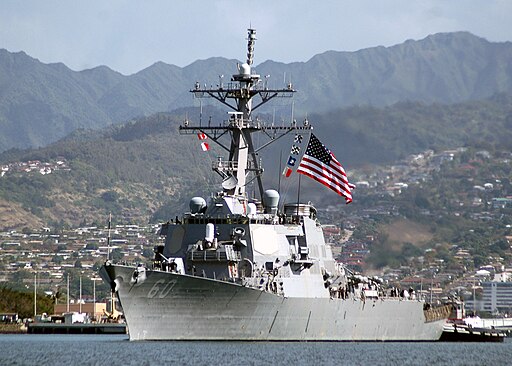
USS Paul Hamilton (DDG-60)
USS Paul Hamilton (DDG-60) is a Flight I Arleigh Burke–class guided-missile destroyer in active service with the United States Navy. Named for Paul Hamilton, the third U.S. Secretary of the Navy, she embodies multi-mission capability from air defense to land-attack and anti-submarine warfare. Since her commissioning in 1995, she has operated primarily in the Pacific, supporting carrier strike groups and participating in ballistic missile defense patrols.
Design and Construction
Hull and Structure
Her rugged steel hull features a bulbous bow and stealth-optimized superstructure to reduce radar cross-section. Longitudinal framing and sound-dampening materials minimize acoustic signature, enhancing survivability against submarine threats. All critical machinery is raft-mounted to suppress vibration and noise transmission into the water.
Shipbuilding Milestones
- Ordered: 22 February 1990 at Bath Iron Works, Bath, Maine
- Keel laid: 24 August 1992
- Launched: 24 July 1993
- Commissioned: 27 May 1995 at Naval Station Charleston, South Carolina
General Characteristics
| Characteristic | Specification |
|---|---|
| Class & Type | Arleigh Burke–class destroyer (Flight I) |
| Displacement (light/full) | 6,800 long tons / 8,900 long tons |
| Length | 505 ft (154 m) |
| Beam | 59 ft (18 m) |
| Draft | 31 ft (9.4 m) |
| Complement | Approx. 280 personnel |
| Homeport | Naval Base San Diego, California |
Propulsion and Performance
Propulsion Plant
Paul Hamilton is powered by four General Electric LM2500 gas turbines driving two shafts with controllable-pitch propellers. The combined output exceeds 100,000 shaft horsepower, delivering rapid acceleration and high reliability for extended deployments.
Speed and Range
She can exceed 30 knots for high-speed maneuvering and sustain 20 knots to achieve a range of 4,400 nautical miles without replenishment. The gas-turbine arrangement balances fuel efficiency with the ability to surge in response to emergent threats.
Combat Systems
Aegis Combat System
Central to her mission is the Aegis Combat System, featuring the AN/SPY-1D phased-array radar for simultaneous tracking of hundreds of air and surface contacts. Mk 99 fire-control radars and the command-and-decision suite enable rapid engagement against aircraft, missiles, and surface ships.
Sonar and ASW Suite
Underwater threat detection relies on the AN/SQS-53C hull-mounted sonar and the AN/SQR-19 tactical towed array. Integrated with the AN/SQQ-89 undersea warfare combat system, Paul Hamilton conducts active/passive submarine hunts and controls ASROC missile launches for standoff U-boat engagement.
Armament
Surface and Air Defense
- 1 × 5-inch/54 Mk 45 lightweight gun
- 2 × 29-cell and 1 × 61-cell Mk 41 VLS (90 cells total) for SM-2, SM-6, Tomahawk, VL-ASROC, SM-3
Strike and Anti-Ship Missiles
- BGM-109 Tomahawk land-attack cruise missiles
- RGM-84 Harpoon anti-ship missiles (8 rounds) in Mk 141 launchers
Close-In and Secondary Weapons
- 2 × 20 mm Phalanx CIWS (Block 1B)
- 2 × 25 mm Mk 38 remote-weapon stations
- 4 × .50 cal machine guns
- 2 × Mk 32 triple lightweight torpedo tubes for Mk 46/Mk 50/Mk 54 torpedoes
Aviation Facilities
Flight deck and hangar support one MH-60R Seahawk helicopter for over-the-horizon targeting, anti-submarine patrols, and search-and-rescue missions.
Sensors and Electronics
Electronic Warfare and Decoys
Her AN/SLQ-32(V)3 electronic warfare suite detects and jams hostile radar and missile seekers. Mk 36 SRBOC and Mk 53 Nulka decoy launchers provide layered protection against anti-ship missiles.
Navigation and Communications
Paul Hamilton navigates with GPS-aided inertial systems, AN/SPS-67(V)3 surface search radar, and gyrocompass. Data links (Link 16) and satellite communications integrate her with carrier strike groups and joint task forces.
Operational History
Early Deployments
Shortly after commissioning, she joined USS John C. Stennis Carrier Strike Group for Pacific exercises, including Composite Training Unit Exercise (COMPTUEX) in 2001 and Maritime Interdiction Operations supporting Enduring Freedom in 2002.
Operation Iraqi Freedom
In March 2003, Paul Hamilton launched her first Tomahawk missiles in the opening salvo of Operation Iraqi Freedom, firing from the Northern Arabian Gulf before returning home after a nine-month deployment.
Multinational Exercises
She has participated in RIMPAC (2006, 2008, 2012), Joint Task Force Exercise (JTFEX 06-2 in 2005), Talisman Saber 07, Valiant Shield, and regular ballistic missile defense patrols in the Western Pacific.
Future Upgrades
To extend her service life into the 2030s, planned enhancements include Cooperative Engagement Capability integration, Aegis Baseline 9 combat system upgrades for enhanced missile defense, and installation of unmanned vehicle interfaces for remote sensing operations.
Conclusion
USS Paul Hamilton (DDG-60) stands as a testament to modern destroyer design: a stealth-shaped hull, potent propulsion, layered sensors, and a versatile weapons suite. Her blend of air defense, precision strike, and anti-submarine warfare capabilities ensures she remains a keystone of U.S. naval power projection worldwide.
_departs_from_her_homeport_of_Pearl_Harbor,_as_part_of_USS_Ronald_Reagan%27s_Strike_Group_(CSG).jpg)