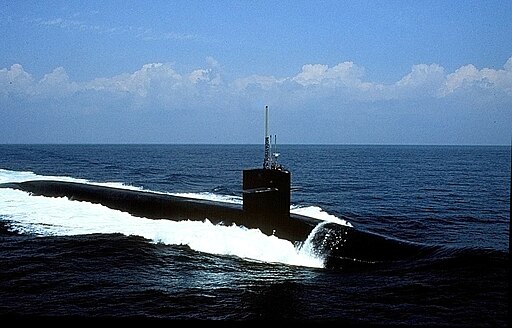
USS Pennsylvania (SSBN-735)
USS Pennsylvania (SSBN-735) is an Ohio-class nuclear-powered ballistic missile submarine serving as a key pillar of the United States strategic deterrent force. Commissioned in September 1989, she operates under a dual-crew (Blue and Gold) concept, maintaining near-constant at-sea deterrence patrols. Her combination of stealth, endurance, and firepower enables covert presence anywhere in the world’s oceans.
Design and Construction
Namesake and Shipbuilding
The contract to build Pennsylvania was awarded to General Dynamics Electric Boat in Groton, Connecticut, on 29 November 1982. Her keel was laid on 10 January 1984, followed by a launch on 23 April 1988. After final outfitting and trials, SSBN-735 was commissioned on 9 September 1989 with Captains Richard M. Camp (Blue Crew) and A. Lee Edwards (Gold Crew) in command.
Hull and Structure
Pennsylvania’s pressure hull is built from high-yield steel sections welded into a 560-foot frame that supports operations down to test depths exceeding 800 feet. The outer hydrodynamic fairing reduces flow noise, while machinery is raft-mounted to suppress vibrations and acoustic signature.
General Characteristics
Dimensions and Displacement
| Characteristic | Value |
|---|---|
| Displacement (surfaced) | 16,764 long tons |
| Displacement (submerged) | 18,750 long tons |
| Length overall | 562 ft (171 m) |
| Beam | 42 ft (13 m) |
| Draft | 38 ft (12 m) |
These dimensions balance internal volume for strategic weapons and crew accommodation with a streamlined hull for stealthy transit.
Propulsion and Performance
Pennsylvania is powered by a single S8G pressurized-water reactor that drives two geared steam turbines and one auxiliary motor to a single shaft rated at 60,000 shaft horsepower. She can exceed 25 knots submerged and sustain patrol speeds for thousands of nautical miles without refueling. Her reactor core requires no refueling for decades, granting effectively unlimited endurance limited only by food and maintenance requirements.
Armament and Strategic Payload
Ballistic Missile System
The submarine carries 20 Trident II D-5 submarine-launched ballistic missiles in vertical launch tubes. Each missile can deliver multiple independently targetable reentry vehicles (MIRVs) over intercontinental ranges, forming the backbone of the sea-based leg of the nuclear triad.
Torpedo Defense
For self-defense against undersea threats, Pennsylvania is equipped with four 21-inch torpedo tubes firing Mk 48 heavy torpedoes. This capability enables the submarine to counter hostile submarines or surface ships encountered during patrols.
Sensors and Combat Systems
Sonar Suite
A multi-element sonar suite provides advanced undersea detection. Passive and active bow arrays detect contacts at long ranges, while flank and towed arrays enhance passive sensitivity to quiet targets. Hull-mounted ranging sonar supports navigation in littoral or ice-infested waters.
Electronic Warfare and Navigation
An integrated inertial navigation system, aided by GPS when surfaced, ensures precise positioning on clandestine patrols. Surface search and warning radars are used sparingly to preserve stealth, while electronic support measures detect and classify potential threats before they can target the submarine.
Operational History
Commissioning and Early Patrols
Shortly after commissioning, Pennsylvania conducted initial deterrent patrols from her first homeport at Kings Bay, Georgia. During her first visit to Port Canaveral she ran aground but suffered no damage; Tug assistance freed her within two hours. She then completed an 82-day first patrol, setting the pattern of continuous at-sea deterrence that defines SSBN operations.
Homeport Shift and Awards
In October 2002 Pennsylvania transitioned her homeport to Bangor, Washington. Over her career she has earned the Marjorie Sterrett Battleship Fund Award in 2001 and the Navy Battle “E” in 2022, reflecting excellence in readiness and operations.
Midlife Overhaul and Record Patrol
Pennsylvania entered Puget Sound Naval Shipyard in mid-2010 for a 32-month engineered refueling overhaul. She completed sea trials on 19 September 2012 and rejoined Submarine Squadron 17 on 17 November 2012. In June 2014 she concluded a record-setting 140‐day strategic deterrent patrol, the longest such patrol since the Poseidon era.
Crew and Habitability
Pennsylvania operates with a complement of 15 officers and 140 enlisted across two alternating crews. Berthing and mess facilities support up to 155 personnel per patrol. Modern habitability features include climate-controlled living spaces, improved acoustical insulation, and telemedicine-capable medical bay to sustain high morale and health on extended missions.
Future Modernizations
To extend her deterrent relevance into the 2040s, planned upgrades include digital control systems for reactor monitoring, enhanced communication links to joint command networks, and incorporation of next-generation sonar processing. These improvements will streamline maintenance, reduce signature further, and sharpen undersea situational awareness.
Strategic Role and Legacy
As one of 14 Ohio-class SSBNs, USS Pennsylvania is a silent sentinel under the sea. Her unbroken cycle of patrols ensures assured second-strike capability, deterring aggression through guaranteed retaliation. Decades of global presence underscore the submarine’s role not just as a warfighting platform, but as a stabilizing factor in international security.
.jpg)