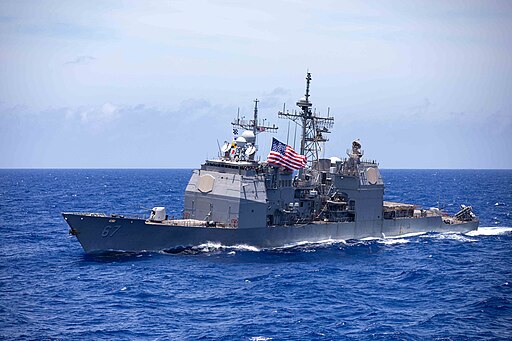
USS Shiloh (CG-67)
USS Shiloh (CG-67) is a Ticonderoga-class guided-missile cruiser that entered service in 1992. Designed for multi-mission warfare, she combines advanced Aegis combat systems, robust air-defense capabilities, and powerful land-attack options. Throughout her career, Shiloh has safeguarded carrier strike groups, escorted amphibious forces, and conducted ballistic missile defense patrols. Her versatility and endurance exemplify the U.S. Navy’s shift toward networked, layered defense in high-intensity maritime environments.
Design and Construction
Hull and Structural Layout
Shiloh’s hull follows the proven Ticonderoga profile, featuring a flared bow for enhanced seakeeping and a continuous deckhouse that accommodates radar arrays without obstruction. Built with high-strength, low-magnetic steel, her structure balances survivability with weight efficiency. Compartmentalized internal bulkheads and double-bottom tanks support damage control, while shock-mounted equipment racks help the ship withstand near-miss explosions.
Modular Construction and Assembly
Constructed at Ingalls Shipbuilding in Pascagoula, Mississippi, Shiloh employed modular block construction to accelerate delivery. Five major hull modules—fore, mid, aft, superstructure, and mast—were assembled in parallel before final marriage on the building ways. This approach minimized alignment errors and facilitated mid-life upgrades by allowing discrete section replacements rather than full-hull overhauls.
Propulsion and Power Generation
Gas Turbine Propulsion Plant
Shiloh is propelled by four General Electric LM2500 gas turbines arranged in a combined gas and gas (COGAG) configuration. Each turbine produces roughly 25,000 shaft horsepower, driving two controllable-pitch propellers for a combined output exceeding 100,000 shp. This arrangement yields a maximum speed over 30 knots and rapid acceleration for fleet maneuvers.
Electrical Distribution and Auxiliary Systems
Electric power is supplied by four 1,500 kW diesel-driven generators, supplemented by emergency 300 kW units. A smart load-management system balances hotel loads, combat systems, and propulsion auxiliaries to prevent brown-outs during peak demand. Redundant bus ties and automated switchgear ensure critical systems—radars, fire-control computers, and missile launchers—remain powered in casualty conditions.
Sensors and Combat Systems
Aegis Combat System
At the core of Shiloh’s warfare suite is the AN/SPY-1D(V) phased-array radar, integrated into the Aegis Combat System architecture. Four fixed arrays provide 360-degree air surveillance and tracking, supporting simultaneous engagement of dozens of targets. An advanced Weapon Control System computes intercept solutions in under two seconds, coordinating Standard Missile defenses and shipboard guns.
Sonar and Undersea Warfare
Shiloh’s AN/SQS-53C hull-mounted sonar and towed AN/SQR-19 tactical array deliver layered undersea awareness. The hull array searches shallow waters for enemy submarines and mines, while the towed array extends detection ranges beyond 100 kilometers in deep water. Sonar consoles in the Combat Information Center fuse acoustic data with tactical displays for rapid threat evaluation.
Armament
Vertical Launch System
Shiloh carries 122 Mk 41 Vertical Launch System cells—61 forward and 61 aft—capable of firing a mix of Standard Missiles, Tomahawk cruise missiles, and ASROC anti-submarine rockets. This capacity allows layered air defense, precision land-attack strikes, and anti-submarine warfare from a single platform, providing commanders flexible options during fast-moving operations.
Gun and Close-In Weapon Systems
Forward of the bridge sits an Mk 45 5-inch/54 caliber naval gun able to deliver guided projectiles for shore bombardment or surface targets. Close-in defense relies on two Phalanx CIWS mounts and two Mk 38 Mod 2 25 mm chain guns to intercept incoming missiles and small craft. Integrated fire-control radars and electro-optical sensors provide automatic engagement with minimal human intervention.
Electronic Warfare and Countermeasures
Electronic Support Measures
Shiloh’s AN/SLQ-32(V)5 electronic support measures suite scans the electromagnetic spectrum to detect, classify, and geo-locate radar and communication emissions. Digital signal processors filter clutter and provide threat warnings to the Combat Information Center, enabling preemptive defensive actions.
Decoys and Soft-Kill Systems
For missile defense, Shiloh deploys the Mk 216 decoy launchers for chaff and infrared flares, along with the AN/SLQ-25N Nixie torpedo countermeasure system. Automated threat libraries and sequencers coordinate decoy patterns to lure away guided weapons, preserving the ship’s stealth and survivability.
Aviation Facilities
Shiloh features a flight deck and hangar accommodating two SH-60 Seahawk helicopters. These embarked aircraft extend the cruiser’s anti-submarine and surface-surveillance reach, dropping sonobuoys or conducting dipping-sonar operations. A unified boat handling system supports rapid launch and recovery of unmanned surface and underwater vehicles for mine detection, surveillance, and special-operations support.
Crew and Habitability
Shiloh’s complement consists of 30 officers and 300 enlisted sailors. Habitability improvements include private two-person staterooms for officers and modular berthing units for enlisted personnel. Ergonomic workstations, a centralized galley, and a fitness center sustain crew performance during deployments averaging six months. Integrated ventilation and noise-dampening measures reduce fatigue in high-tempo scenarios.
Operational History
Commissioned in November 1992, Shiloh initially supported Operation Southern Watch in the Persian Gulf before participating in multinational exercises in the Pacific Rim. In 2003, she provided air-defense umbrella for amphibious landings during Operation Iraqi Freedom. More recently, Shiloh has undertaken ballistic missile defense patrols in the Western Pacific, proving the Ticonderoga class’s adaptability to evolving threats.
Modernization and Upgrades
Under the DDG Modernization Program, Shiloh has received:
- SPY-6 radar upgrade for improved littoral and ballistic-missile detection
- Aegis Baseline 9 for integrated air and missile defense
- Joint Tactical Radio System for secure, high-bandwidth communications
- Composite deck replacement and upgraded HVAC for extended service life
These enhancements ensure Shiloh remains mission-capable well into the 2040s.
Technical Specifications
| Specification | Value |
|---|---|
| Displacement (full load) | 9,600 long tons |
| Length | 567 ft (172.8 m) |
| Beam | 55 ft (16.8 m) |
| Draft | 34 ft (10.4 m) |
| Propulsion | 4 × GE LM2500 gas turbines; COGAG arrangement |
| Speed | >30 knots |
| Range | 6,000 nmi at 20 knots |
| Electrical Power | 4 × 1,500 kW diesel generators; 2 × 300 kW emergency |
| Combat System | Aegis Baseline 9; SPY-1D(V)/SPY-6 radar arrays |
| Missile Loadout | 122 × Mk 41 VLS cells |
| Guns | 1 × 5-inch/54 cal Mk 45; 2 × Phalanx CIWS; 2 × 25 mm |
| Electronic Warfare | AN/SLQ-32(V)5; Mk 216 decoy launchers |
| Aviation Facilities | Flight deck and hangar for 2 × SH-60 Seahawks |
| Crew | 30 officers; 300 enlisted |
Conclusion
USS Shiloh (CG-67) stands as a testament to modular design, networked firepower, and enduring adaptability. Her fusion of Aegis radar, versatile missile arrays, and undersea sensors enables simultaneous air-defense, land-attack, and anti-submarine missions. Through successive upgrades, Shiloh continues to embody the Navy’s layered-defense doctrine, safeguarding maritime interests across the globe.
