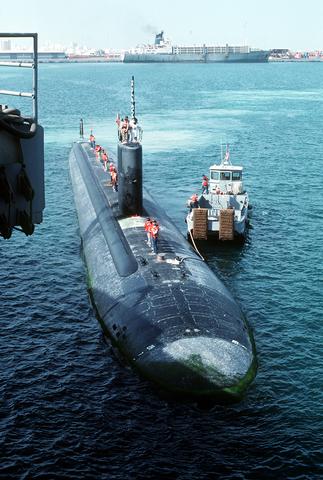
USS Topeka (SSN-754)
USS Topeka (SSN-754) is a Los Angeles-class nuclear-powered attack submarine commissioned in October 1989. As the third Navy vessel named for Topeka, Kansas, she embodies the “688i” Flight II design, blending proven undersea warfare capabilities with quieter operation and vertical-launch firepower. Throughout her career, Topeka has carried out surveillance, strike, anti-submarine and special-operations support missions across the Pacific and beyond.
Design and Construction
Hull Architecture and Materials
Topeka features a dual-hull configuration: a robust inner pressure hull welded from HY-80 steel and a hydrodynamic outer shell shaped for minimal flow noise. Internal framing uses high-tensile alloys to withstand deep-water pressures while allowing a slender silhouette that reduces acoustic signature. Critical compartments around the reactor and torpedo magazine have reinforced bulkheads for enhanced damage resilience.
Stealth Treatments
Vibration isolation mounts decouple the reactor, steam turbines and auxiliary machinery from the hull, damping structure-borne noise. The outer shell is coated with anechoic tiles that absorb incoming active-sonar pulses, and the seven-blade propeller and skewed control surfaces minimize cavitation. Exhaust from the reactor’s steam plant is cooled and mixed with seawater to shrink the thermal plume.
Dimensions and Displacement
| Parameter | Specification |
|---|---|
| Displacement (surfaced) | 5,726 long tons |
| Displacement (submerged) | 6,131 long tons |
| Length overall | 110.3 m (361 ft 11 in) |
| Beam overall | 10.0 m (32 ft 10 in) |
| Draft | 9.4 m (30 ft 10 in) |
| Test depth | 400 m (1,312 ft) |
These dimensions accommodate a 12-cell Tomahawk vertical-launch system, four forward torpedo tubes, and room for a deployable towed-array sonar.
Propulsion Plant
Nuclear Reactor
A single S6G pressurized-water reactor provides steam to two steam turbines. The reactor’s HEU core is designed to operate for the submarine’s entire 30-year service life without refueling, enabling virtually unlimited endurance limited only by onboard provisions.
Machinery and Performance
- Propulsion turbines rated at 33,500 shaft horsepower
- Single-shaft configuration driving a seven-blade skewed screw
- Maximum submerged speed: over 25 knots
- Standard patrol duration: up to 90 days without external support
Sensors and Combat Systems
Sonar Arrays
A bow-mounted, spherical active/passive array (AN/BQQ-5) provides long-range detection, while a towed linear array (AN/BQR-15) extends passive listening capability. Sophisticated onboard processing lets operators track multiple contacts concurrently and classify threats under diverse acoustic conditions.
Electronic Warfare and Communications
The SLQ-25 Nixie system tows an acoustic decoy that lures inbound torpedoes away from the hull. Tactical data-links (Link 11 and Link 16) and satellite communications terminals ensure real-time information sharing with carrier strike groups, shore commands and allied units.
Weapon Systems
Torpedoes
Four 533 mm bow tubes launch Mk 48 ADCAP heavyweight torpedoes. The Mk 117 fire-control system offers automated target tracking and optimized firing solutions for both offensive strikes and defensive countermeasures.
Vertical-Launch Cruise Missiles
A 12-cell Mk 41 vertical-launch system amidships carries Tomahawk Block III/IV land-attack missiles. Precision guidance and sub-100-meter accuracy enable strikes against high-value inland targets without surfacing.
Mine Warfare and Countermeasures
Topeka can deploy anti-ship mines through her torpedo tubes for covert sea-denial operations. Hull-mounted and towed-array sensors combined with decoys and jammers create layered defenses against sonar and torpedo threats.
Crew and Habitability
Personnel and Living Quarters
The standard complement includes 12 officers and 98 enlisted sailors. Modular berthing compartments feature improved rack designs, personal storage, and climate control. Cross-training ensures every watch station remains fully manned during extended patrols.
Support Facilities
A galley delivers three fresh meals daily, supplemented by refrigerated stores. Crew morale is sustained through a small fitness area, multimedia lounge and library. Medical and damage-control stations use automated monitoring to lighten workload and accelerate response to onboard emergencies.
Operational History
Since her commissioning, Topeka has completed numerous Western Pacific deployments. She has supported carrier-strike-group operations, conducted freedom-of-navigation transits, and participated in multinational exercises such as RIMPAC. In 2000, she famously straddled the International Date Line on New Year’s Eve, operating in two millennia at once.
Modernization and Upgrades
During periodic overhauls, Topeka has received:
- Digital upgrade of fire-control and sonar processing units
- Enhanced navigation suite integrating inertial sensors with GPS
- New satellite communications antennas for greater bandwidth
- Hull-mounted acoustic measurement sensors to refine anechoic coatings
Future refits may include structural provisions for directed-energy weapon mounts and expanded data-link capacity for unmanned undersea vehicle control.
Conclusion
USS Topeka (SSN-754) remains a potent undersea combatant, combining deep-rated endurance, stealthy operation and versatile firepower. Her continual modernization sustains relevance against evolving threats, ensuring she will serve as a silent sentinel of freedom beneath the waves for decades to come.
.jpg)