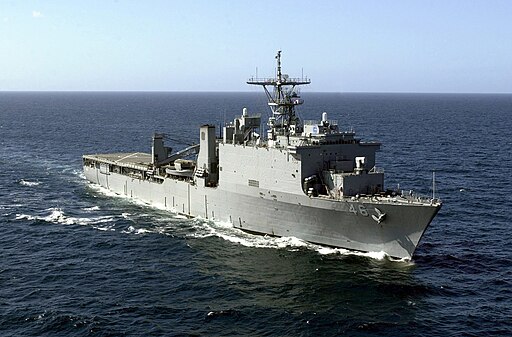
USS Tortuga (LSD-46)
USS Tortuga (LSD-46) is a Whidbey Island-class dock landing ship in active service with the United States Navy. Commissioned in November 1990, she provides critical amphibious lift capabilities for Marine expeditionary forces. With a well deck able to launch landing craft air cushion (LCAC) vehicles and conventional landing craft, Tortuga bridges the gap between sea and shore during joint operations.
Namesake and Construction
Namesake
Tortuga takes her name from the Dry Tortugas, a cluster of small coral islands situated roughly 60 miles west of Key West, Florida. Those remote islets have long served as navigational landmarks in the Gulf of Mexico and inspired the ship’s motto: Tough, Tall, Tenacious.
Building and Commissioning
Laid down on 23 March 1987 at Avondale Shipyards in New Orleans, Louisiana, Tortuga was launched on 15 September 1988. Early launch preparations were driven by an approaching hurricane, underscoring shipbuilders’ adaptability. After final outfitting and sea trials, she was formally commissioned on 17 November 1990 and assigned to Naval Amphibious Base Little Creek in Virginia.
Design and Architecture
Hull and Superstructure
Tortuga’s hull is constructed from high-strength steel plating, reinforced around machinery spaces and critical bulkheads. The flared bow and stepped topside reduce wave impact and spray in rough seas. A streamlined superstructure houses command centers, hangar facilities for helicopters, and communications suites while minimizing radar cross-section.
Stealth and Damage Control
Noise-dampening mounts isolate diesel engines and auxiliary systems to limit acoustic signature. Compartmentalized fire-main and automated sensor networks accelerate damage control during onboard emergencies. Double-closure hatches and remotely operated valves enhance survivability in hostile environments.
Dimensions and Displacement
| Characteristic | Specification |
|---|---|
| Light displacement | 11,471 tons |
| Full-load displacement | 16,568 tons |
| Length overall | 610 ft (190 m) |
| Beam overall | 84 ft (26 m) |
| Draft | 21 ft (6.4 m) |
| Test depth | Restricted by port facilities |
Propulsion and Performance
Diesel Engines and Shafts
Four 16-cylinder Colt Industries diesel engines deliver a combined 33,000 shaft horsepower to two propeller shafts. Each shaft drives a controllable-pitch screw designed to balance top-end speed with fuel efficiency during long transits.
Speed and Range
Tortuga is capable of just over 20 knots at full power. At an economical cruising speed of 18 knots, her fuel stores support transoceanic voyages exceeding 9,500 nautical miles without replenishment, granting global reach for expeditionary missions.
Well Deck and Aviation Facilities
The ship’s 330-foot well deck accommodates up to five LCACs or a mix of conventional landing craft. Bow-to-stern flooding and dewatering pumps enable rapid launch and recovery of amphibious vehicles. Above deck, a flight deck and hangar support two medium-lift helicopters, providing over-the-horizon troop insertion and casualty evacuation.
Armament and Defensive Systems
Gun Systems
Two Mk 38 25 mm autocannon mounts offer close-in surface defense against small craft. Six .50 caliber machine gun positions deliver additional coverage across the ship’s perimeter.
Missile Defense
Dual Phalanx CIWS installations and two Rolling Airframe Missile launchers safeguard against anti-ship missiles. Integrated combat systems provide rapid target acquisition and engagement in high-threat scenarios.
Landing Craft and Amphibious Assets
The well deck can deploy up to 21 LCM-6 utility landing craft in place of LCACs. Embarked marines and their equipment embark directly onto landing craft for shore operations under the ship’s protective umbrella.
Sensors and Communications
A surface search radar and air-search array provide situational awareness around the clock. Electronic support measures detect hostile emitters at long range. Shipboard data-links (Link 11/16) maintain connectivity with carrier strike groups, amphibious ready groups, and joint task forces.
Crew and Habitability
Tortuga carries a ship’s company of 22 officers and 391 enlisted personnel, plus room for up to 504 embarked troops. Living quarters feature modular staterooms, climate control, and improved rack systems for increased personal space. Recreational areas include a fitness zone, media lounge, and library to support morale during extended deployments.
Modernization and Upgrades
Periodic maintenance availabilities have introduced:
- Upgraded command-and-control consoles with digital displays
- Enhanced satellite communication antennas for higher bandwidth
- Refreshed habitability spaces with energy-efficient lighting
- Improved damage-control sensors integrated into a consolidated network
Future refits may incorporate laser-based countermeasure systems and autonomous vehicle control suites.
Operational History
Since her commissioning, USS Tortuga has participated in humanitarian relief after natural disasters, supported multinational exercises in the Pacific and Mediterranean, and executed forward-deployed rotations from Sasebo, Japan. In April 2006, she relieved an older dock landing ship as a forward-stationed unit, demonstrating strategic flexibility.
Conclusion
USS Tortuga (LSD-46) remains a workhorse of amphibious warfare, blending robust well-deck operations, aviation support, and self-defense capabilities. Her combination of endurance, modular design, and ongoing modernization ensures she will continue projecting power from the sea for decades to come.
.jpg)