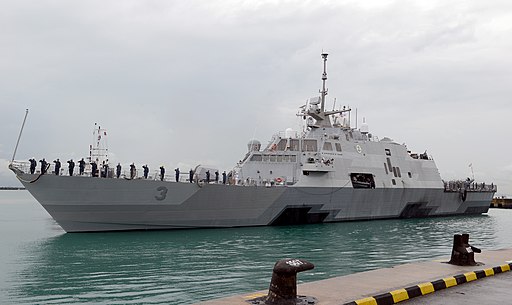
USS Fort Worth (LCS-3)
USS Fort Worth (LCS-3): A Versatile Littoral Combat Ship in the U.S. Navy Fleet
The USS Fort Worth (LCS-3) is a Freedom-class littoral combat ship (LCS) that has played an important role in advancing the U.S. Navy’s capabilities in shallow-water and near-shore operations. Commissioned on September 22, 2012, the vessel is the second ship in the Freedom-class and the first to bear the name Fort Worth, honoring the city of Fort Worth, Texas, and its historic ties to the U.S. military.
Designed to operate in littoral (coastal) regions, the USS Fort Worth is a fast, agile, and modular vessel capable of performing a wide range of missions, including anti-submarine warfare, mine countermeasures, and surface warfare. Its advanced technology and mission flexibility make it a key asset in modern naval operations, particularly in contested maritime environments.
Development and Construction
The Freedom-class design, including the USS Fort Worth, was developed as part of the Navy’s Littoral Combat Ship program, which sought to create smaller, highly maneuverable vessels capable of operating in environments where traditional large warships face challenges. The program emphasized speed, modularity, and affordability.
The USS Fort Worth was built by Lockheed Martin and its shipbuilding partner, Marinette Marine, in Marinette, Wisconsin. Construction began with the keel-laying ceremony on July 11, 2009, and the ship was launched on December 4, 2010. After extensive sea trials to test its systems and performance, the ship was delivered to the Navy in June 2012 and commissioned later that year in a ceremony held in Galveston, Texas.
Design and Specifications
The USS Fort Worth incorporates advanced design features aimed at maximizing speed, agility, and modularity. As a Freedom-class LCS, it features a monohull design that distinguishes it from its trimaran-hulled Independence-class counterparts.
Key Specifications:
- Length: 387 feet (118 meters)
- Beam: 57 feet (17.4 meters)
- Draft: 13 feet (4 meters)
- Displacement: Approximately 3,500 tons
- Speed: Over 40 knots (46 mph; 74 km/h)
- Crew: 40 core crew members, with room for mission module and aviation detachments
- Range: 3,500 nautical miles (at 18 knots)
Propulsion:
The ship uses a combined diesel and gas (CODAG) propulsion system, which includes two Rolls-Royce MT30 gas turbines and two Colt-Pielstick diesel engines, driving four steerable waterjets. This configuration provides the speed and maneuverability necessary for operations in shallow and confined waters.
Modularity:
One of the defining features of the USS Fort Worth is its mission module capability. The ship can be configured for specific tasks by swapping out mission packages, which include specialized equipment and personnel for:
- Surface Warfare (SUW): Focused on fast attack threats, using systems like the Longbow Hellfire missiles and 57mm Mk 110 naval gun.
- Mine Countermeasures (MCM): Equipped with unmanned systems and sensors to detect and neutralize underwater mines.
- Anti-Submarine Warfare (ASW): Includes advanced sonar systems and torpedoes to counter submarine threats.
The modular approach allows the ship to be quickly reconfigured for different missions, reducing operational costs and increasing versatility.
Capabilities and Armament
Weapons and Defensive Systems:
The USS Fort Worth is equipped with a variety of weapons systems designed to address threats in littoral zones:
- 57mm Mk 110 Gun: A versatile naval gun capable of engaging air, surface, and shore-based targets.
- Rolling Airframe Missile (RAM) System: Provides short-range defense against incoming missiles.
- .50-Caliber Machine Guns: Positioned for close-range engagements.
- Longbow Hellfire Missiles: Integrated as part of the surface warfare module to counter fast attack craft.
Aviation:
The ship features a large flight deck and hangar, capable of supporting one MH-60R Seahawk helicopter and a Vertical Take-Off and Landing Unmanned Aerial Vehicle (VTUAV), such as the MQ-8 Fire Scout. These assets enhance the ship’s surveillance, reconnaissance, and strike capabilities.
Unmanned Systems:
To support its mine countermeasures and anti-submarine warfare roles, the USS Fort Worth can deploy a range of unmanned surface and underwater vehicles, adding a layer of versatility and reducing risks to personnel.
Operational History
Deployment to the Indo-Pacific:
The USS Fort Worth’s most notable deployment began in November 2014, when it was sent to the Indo-Pacific region as part of the Navy’s rotational presence. Stationed in Singapore, the ship participated in numerous exercises and patrols, highlighting its flexibility and endurance.
During this 16-month deployment—double the duration of standard deployments—the ship demonstrated the operational potential of the LCS platform. Its modularity and high speed allowed it to respond to various missions, from freedom of navigation operations in the South China Sea to joint exercises with allies like Singapore, Malaysia, and Indonesia.
Mechanical Challenges:
While the USS Fort Worth showcased many of the strengths of the LCS program, it also faced mechanical challenges. In early 2016, the ship suffered damage to its propulsion system due to procedural errors during maintenance in Singapore. This incident highlighted some of the vulnerabilities of the LCS class and led to revisions in training and maintenance protocols.
Significance and Role in the Fleet
The USS Fort Worth serves as a proof-of-concept for the LCS program’s ambitions to provide a highly adaptable, fast, and cost-effective solution for littoral warfare. While the program has faced criticism for cost overruns and design limitations, the Fort Worth has demonstrated the value of modularity and speed in real-world operations.
The ship’s ability to integrate with allied navies and operate effectively in complex maritime environments has strengthened U.S. partnerships in the Indo-Pacific region. It has also served as a testbed for emerging technologies, including unmanned systems and advanced sensors.
Decommissioning Plans and Legacy
In 2023, the U.S. Navy announced plans to decommission several LCS vessels, including the USS Fort Worth, as part of a broader effort to optimize fleet composition. The decision reflects evolving priorities within the Navy, which is shifting resources toward larger, multi-mission platforms like the Constellation-class frigates.
While its operational life may be relatively short, the USS Fort Worth’s contributions to the Navy’s understanding of littoral combat operations and modular design will have a lasting impact. Lessons learned from its deployments have informed the development of future vessels and strategies.
Conclusion
The USS Fort Worth (LCS-3) represents a bold experiment in naval design and operational flexibility. As one of the first Freedom-class littoral combat ships, it has showcased the strengths and challenges of the LCS program. Despite facing criticism and mechanical setbacks, the ship has proven its worth in key deployments, particularly in the Indo-Pacific, where its speed, modularity, and adaptability have been vital.
As the Navy continues to evolve its fleet to meet the demands of modern warfare, the USS Fort Worth’s legacy will endure as a critical stepping stone in the development of next-generation naval capabilities.
.jpg)