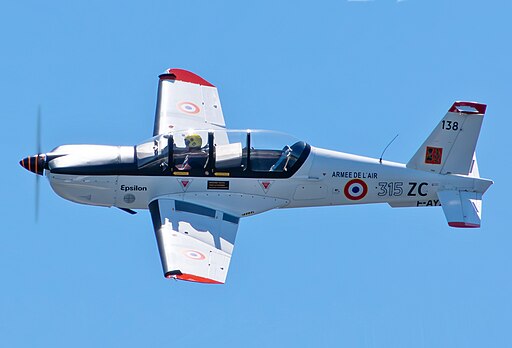
Socata TB 30 Epsilon
Socata TB 30 Epsilon: The French Military Trainer with Fighter-Like Performance
The Socata TB 30 Epsilon is a two-seat military trainer aircraft developed in France in the late 1970s and early 1980s. Built by Socata, a subsidiary of Aérospatiale, this aircraft was designed to serve as a primary flight trainer for military pilots, bridging the gap between basic training aircraft and more advanced jet trainers.
With a robust airframe, responsive handling, and fighter-like agility, the TB 30 Epsilon became a popular training platform, primarily used by the French Air Force (Armée de l’Air et de l’Espace). Even decades after its introduction, the aircraft remains an important part of pilot training and is valued by private owners and aviation enthusiasts worldwide.
Development and History
The Need for a Modern Trainer
By the 1970s, the French Air Force needed a modern, economical, and easy-to-maintain training aircraft to replace aging models like the Fouga Magister. The goal was to provide new pilots with a stepping stone before transitioning to jet-powered trainers and eventually front-line combat aircraft.
Socata, already known for its TB series of light aircraft, developed the TB 30 Epsilon as a cost-effective yet high-performance solution.
Design and First Flight
- The first prototype of the TB 30 Epsilon took to the skies on December 22, 1979.
- After a series of successful flight tests, the aircraft entered production in 1983.
- The French Air Force ordered 150 units, making it the primary trainer for military pilots in the 1980s and 1990s.
While originally designed for the French military, the TB 30 Epsilon was also exported to Portugal, where it served in the Portuguese Air Force as a primary training aircraft.
Technical Specifications of the TB 30 Epsilon
Engine and Performance
The Socata TB 30 Epsilon is powered by a single piston engine, giving it performance characteristics similar to a military jet trainer but with the efficiency of a propeller-driven aircraft.
Key Engine Specifications:
- Engine: Lycoming AEIO-540-L1B5D (6-cylinder, air-cooled, fuel-injected)
- Horsepower: 300 hp (224 kW)
- Propeller: Three-blade variable-pitch Hartzell propeller
- Maximum Speed: 520 km/h (323 mph)
- Cruising Speed: 380 km/h (236 mph)
- Range: 1,250 km (776 miles)
- Service Ceiling: 7,600 meters (25,000 feet)
- Climb Rate: 7.5 m/s (1,480 ft/min)
The powerful engine and lightweight airframe allow the TB 30 Epsilon to perform aerobatic maneuvers, making it an ideal training platform for future fighter pilots.
Airframe and Design
The TB 30 Epsilon features a low-wing monoplane design, emphasizing stability and maneuverability. The aircraft is built using all-metal construction, ensuring durability for frequent training operations.
Structural Features:
- Tandem cockpit seating (instructor in the rear, student in the front)
- Bubble canopy for excellent visibility
- Fixed landing gear with a tailwheel configuration
- Wingspan: 7.92 m (26 ft)
- Length: 7.59 m (24 ft 11 in)
- Height: 2.72 m (8 ft 11 in)
- Empty weight: 940 kg (2,072 lbs)
- Maximum takeoff weight: 1,250 kg (2,756 lbs)
The aircraft’s design allows for high-G aerobatic maneuvers, making it perfect for training military pilots in advanced handling techniques.
Cockpit and Avionics
The TB 30 Epsilon features a modernized cockpit that closely resembles that of fighter jets, giving trainees an authentic military flight experience.
Avionics and Equipment:
- Dual flight controls (for instructor and student)
- Head-Up Display (HUD) capability (on some versions)
- VHF communication and navigation systems
- Basic radar and IFR (Instrument Flight Rules) capabilities
- Ejection seats (on some military variants) for safety in case of emergency
The cockpit layout is designed to prepare pilots for advanced jet trainers, ensuring a smooth transition to more complex military aircraft.
Flight Characteristics and Training Role
Exceptional Handling and Agility
One of the standout features of the TB 30 Epsilon is its fighter-like handling, despite being a piston-engine aircraft.
Key Handling Features:
✅ Highly responsive controls – ideal for aerobatic and combat maneuver training
✅ Stable flight characteristics – suitable for beginner and advanced pilots
✅ High roll rate – mimicking jet trainer response
✅ G-force endurance – allows pilots to experience high-G turns safely
Training Capabilities
The TB 30 Epsilon is designed for basic and intermediate pilot training, helping students develop the skills necessary for combat aircraft operation.
Training Applications:
- Basic flight training – takeoffs, landings, and navigation
- Aerobatics and combat maneuvers – barrel rolls, loops, and split-S turns
- Instrument flying – IFR flight preparation for complex missions
- Formation flying – essential for military operations
Operational History and Export Users
French Air Force Service
The French Air Force (Armée de l’Air et de l’Espace) was the primary operator of the TB 30 Epsilon. It was used extensively for training new cadets at the École de Pilotage de l’Armée de l’Air (EPAA).
- The aircraft played a crucial role in pilot preparation before transitioning to jet trainers like the Alpha Jet.
- Over time, some aircraft were modified for aerobatic display teams.
- In recent years, the TB 30 Epsilon has been gradually replaced by more modern trainers, such as the Pilatus PC-21.
Portuguese Air Force Service
In the 1990s, the Portuguese Air Force purchased several TB 30 Epsilons to serve as their primary flight training aircraft.
- They were used to train pilots before transitioning to the Dassault/Dornier Alpha Jet.
- These aircraft remained in service for more than 20 years, proving their reliability.
Private and Civilian Use
Due to its exceptional aerobatic capabilities and military heritage, the TB 30 Epsilon has become popular among private owners and warbird collectors. Some decommissioned aircraft have been sold to civilian operators, where they continue to be used for flight training and airshows.
Conclusion: A Legacy of Excellence in Pilot Training
The Socata TB 30 Epsilon stands as a remarkable example of a well-engineered, reliable, and highly effective military trainer aircraft. With its fighter-like agility, excellent avionics, and durable construction, it has successfully trained generations of military pilots in France, Portugal, and beyond.
Although it has been gradually phased out by more modern aircraft, the TB 30 Epsilon remains a highly respected and sought-after aircraft, cherished by aviation enthusiasts and former military pilots alike. Whether in military service or private hands, this aircraft continues to demonstrate its legacy as one of the finest piston-engine trainers ever built.
