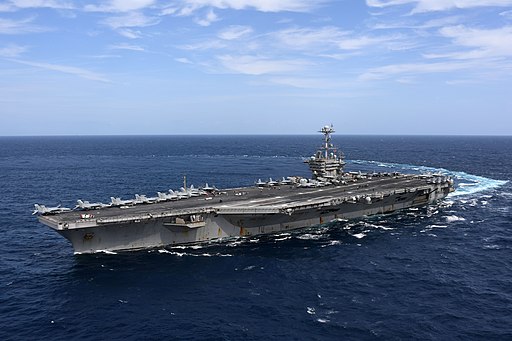
USS Harry S. Truman (CVN-75)
The USS Harry S. Truman (CVN-75) stands as one of the most formidable symbols of American naval power. As a Nimitz-class nuclear-powered aircraft carrier, she represents a unique blend of advanced engineering, cutting-edge technology, and a storied operational history that continues to define U.S. military prowess on the world stage.
Historical Overview
Commissioned in 1998 and named after the 33rd President of the United States, Harry S. Truman, CVN-75 carries forward a proud legacy of leadership and service. Built at Newport News Shipbuilding, the carrier was designed to meet the evolving needs of modern warfare, providing a versatile platform capable of power projection, rapid deployment, and sustained operations in a variety of environments. Over the years, the USS Harry S. Truman has participated in numerous operations, ranging from humanitarian missions to full-scale combat deployments, cementing her reputation as a reliable asset for the U.S. Navy.
Design and Construction
The design of the USS Harry S. Truman is a testament to decades of naval innovation. As part of the Nimitz-class, she benefits from a proven design that has been continuously refined since the class’s inception. With a robust steel hull, an expansive flight deck, and a distinctive island superstructure, the carrier is built not only for strength but also for optimal efficiency in operations. Advanced safety features, redundant systems, and modern combat management technologies ensure that she remains at the forefront of naval capabilities.
Technical Specifications
Dimensions and Displacement
- Length: Approximately 1,092 feet (333 meters)
- Beam: About 252 feet (77 meters) across the flight deck; the waterline beam is significantly narrower, contributing to her sleek profile.
- Draft: Roughly 39 feet (12 meters)
- Full Load Displacement: Around 97,000 tons
These dimensions provide the necessary stability and expansive operational space required for launching and recovering a large complement of aircraft.
Propulsion and Performance
At the heart of the USS Harry S. Truman are two nuclear reactors that provide virtually limitless range and remarkable power output. Key features include:
- Propulsion System: Two A4W nuclear reactors that generate steam to power four propeller shafts.
- Power Output: Approximately 260,000 shaft horsepower.
- Maximum Speed: Capable of exceeding 30 knots, ensuring rapid response capabilities across the globe.
- Endurance: Nuclear propulsion enables extended deployments without the need for conventional refueling, a strategic advantage in prolonged missions.
Flight Deck and Aircraft Operations
The carrier’s flight deck is a marvel of modern naval architecture:
- Deck Area: Spanning nearly 4.5 acres, the expansive flight deck allows simultaneous launch and recovery operations.
- Catapults and Arresting Gear: Equipped with four steam-powered catapults and four arresting gear systems, the deck is engineered for the safe and efficient handling of a wide variety of aircraft.
- Air Wing Capacity: Designed to support an embarked air wing that typically includes F/A-18 Hornets/Super Hornets, EA-18G Growlers, and assorted support aircraft. In total, the carrier can accommodate roughly 60 aircraft, depending on the mission and configuration.
Armament and Defensive Systems
Though the primary offensive capability of the USS Harry S. Truman lies in her air wing, she is also outfitted with an array of defensive systems to protect against incoming threats:
- Close-In Weapon Systems (CIWS): Multiple Phalanx CIWS units are installed to intercept anti-ship missiles and other fast-approaching threats.
- Missile Defense: Over the years, the carrier has seen upgrades to its missile defense suite, incorporating modern radar and electronic warfare technologies to enhance situational awareness and target engagement.
- Electronic Countermeasures: Advanced electronic systems provide additional layers of protection by detecting, tracking, and neutralizing potential threats in the electromagnetic spectrum.
Crew and Operational Capacity
The operational efficiency of the USS Harry S. Truman is also a product of her well-trained and sizeable crew:
- Ship’s Company: Approximately 3,000 personnel, including sailors responsible for navigation, engineering, and daily operations.
- Air Wing Personnel: An additional 2,400 or more, supporting flight operations, maintenance, and combat readiness.
- Total Complement: When fully embarked, the carrier can host upwards of 5,000 men and women, creating a mobile base capable of executing complex missions in any theater of operation.
Advanced Systems and Modernization
To maintain her operational edge, the USS Harry S. Truman has undergone several modernization programs throughout her service life. These upgrades have focused on enhancing:
- Radar and Sensor Suites: State-of-the-art radars, communication systems, and combat management networks ensure that the carrier remains integrated within the broader battle space.
- Maintenance and Efficiency: Modern engineering systems and automated diagnostics contribute to improved maintenance cycles, reliability, and reduced downtime.
- Flight Deck Enhancements: Upgrades to catapult systems and arresting gear have been implemented to safely accommodate newer, more advanced aircraft while increasing sortie rates.
Operational Role and Strategic Impact
The USS Harry S. Truman plays a central role in the U.S. Navy’s global strategy. As a mobile airbase, she projects power, facilitates rapid response, and supports joint operations with allied forces. Her ability to operate independently in distant theaters is enhanced by her nuclear propulsion, extensive aircraft complement, and integrated command and control systems. Whether deployed for humanitarian assistance, maritime security, or combat operations, the carrier’s presence acts as a powerful deterrent and a symbol of national resolve.
Conclusion
In the realm of modern naval warfare, the USS Harry S. Truman (CVN-75) stands as a beacon of innovation, resilience, and power. Her impressive technical specifications, ranging from nuclear propulsion to a versatile flight deck, ensure that she remains a critical asset for the U.S. Navy. Through continuous modernization and an enduring legacy of excellence, the carrier exemplifies the strategic vision and technological prowess that keep American naval forces at the forefront of global maritime security. As new challenges emerge on the international stage, the USS Harry S. Truman will undoubtedly continue to serve as a cornerstone of U.S. naval capability for years to come.
_underway_in_the_Atlantic_Ocean_on_11_September_2018_(180911-N-EA818-2106).JPG)