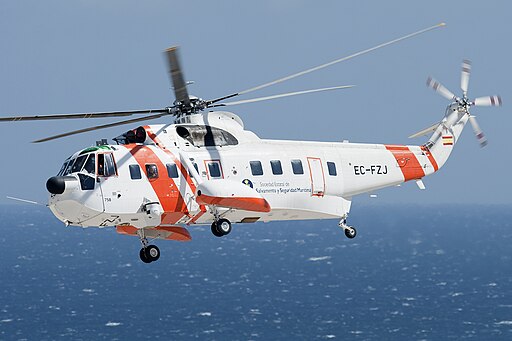
Sikorsky S-61
Sikorsky S-61: The Twin-Engine Amphibious Helicopter That Spanned Civil and Military Frontiers
The Sikorsky S-61 stands as one of the most influential helicopters in aviation history, bridging the gap between military versatility and civil utility. Developed by Sikorsky Aircraft Corporation in the late 1950s, the S-61 was initially conceived as a military platform, but its success soon led to the development of a highly adaptable civilian version. Known for its amphibious design, long-range capability, and twin-engine reliability, the S-61 has served roles ranging from search and rescue (SAR) to offshore oil transport, passenger services, and even VIP operations.
As a civilian derivative of the SH-3 Sea King, the S-61 shares much of its DNA with one of the U.S. Navy’s most enduring anti-submarine warfare platforms, but was customized for commercial and non-combat use. Its adaptability, proven design, and longevity have allowed the S-61 to remain in service well into the 21st century.
This article explores the design, technical specifications, operational history, and continued legacy of the Sikorsky S-61 helicopter.
Origins and Development
The Sikorsky S-61 first took to the skies in March 1959, marking a significant technological leap in helicopter development. Designed initially as the HSS-2 Sea King for the U.S. Navy (later redesignated SH-3A), its civilian counterpart, the S-61, was developed to serve commercial operators that required a reliable, twin-engine helicopter for long-distance overwater missions.
In 1961, Sikorsky introduced the S-61L, a land-based version without amphibious hull, followed by the S-61N, which retained the boat-like fuselage and was optimized for overwater operations. These became the primary civilian versions and were widely adopted by operators worldwide.
Airframe and Design Features
The S-61 is a medium-lift helicopter with a five-blade main rotor and a boat-shaped fuselage, particularly in the S-61N variant. The aircraft’s size, structure, and stability made it well-suited for a wide variety of missions.
Airframe Structure
- Construction: All-metal semi-monocoque fuselage with corrosion-resistant alloys
- Design: Conventional layout with main rotor, tail rotor, and twin turbine engines mounted above the fuselage
- Rotor System: Five-bladed main rotor and four-bladed tail rotor
- Landing Gear:
- S-61N: Retractable tricycle landing gear for amphibious operations
- S-61L: Fixed gear without water landing capability
Dimensions
- Overall length (with rotors turning): 22.15 meters (72 ft 8 in)
- Fuselage length: 17.02 meters (55 ft 10 in)
- Rotor diameter: 18.90 meters (62 ft)
- Height: 5.13 meters (16 ft 10 in)
- Rotor disc area: 280.7 m² (3,022 ft²)
- Cabin length: 6.5 meters (21.3 ft)
- Cabin width: 1.98 meters (6.5 ft)
- Cabin height: 1.83 meters (6.0 ft)
The cabin was designed to be highly configurable and could accommodate up to 28 passengers in high-density layout or 12 to 15 stretchers in medical evacuation roles.
Propulsion and Performance
The S-61 series is powered by two General Electric T58 turboshaft engines, the same family used in the SH-3 military versions, though some commercial models were later retrofitted with other engines for improved performance and efficiency.
Engine Configuration
- Model: General Electric CT58-140 (civilian designation for T58)
- Type: Twin turboshaft engines
- Power Output: Approximately 1,500 shp (1,120 kW) each
- Total Installed Power: ~3,000 shp (2,240 kW)
These engines are mounted above the fuselage in streamlined nacelles, feeding power into a single main gearbox that drives the main and tail rotors.
Performance Characteristics
- Max Speed: 267 km/h (166 mph)
- Cruising Speed: 222 km/h (138 mph)
- Range: Approximately 1,000 km (621 miles) with internal fuel
- Service Ceiling: 4,000 meters (13,120 ft)
- Rate of Climb: 7.6 m/s (1,500 ft/min)
- Endurance: Up to 4.5 hours
- Maximum Takeoff Weight: 9,707 kg (21,400 lb)
- Useful Load: Up to 3,600 kg (7,937 lb)
The S-61’s amphibious capabilities made it particularly valuable in overwater operations where water landings could be used in emergencies or for rescue missions.
Avionics and Equipment
Though avionics vary by operator and mission, standard S-61 installations included:
- Autopilot with hover-hold capability
- Doppler navigation system
- VOR/ILS and ADF navigation aids
- HF and VHF communication radios
- Weather radar
- Radar altimeter
- Flight data recorder (FDR) and cockpit voice recorder (CVR)
Later models and upgrades included glass cockpits, GPS systems, and digital avionics for better mission planning and flight management.
Operational Roles
The versatility of the S-61 led to widespread adoption across civil, paramilitary, and even some military services around the world.
Primary Roles
- Offshore Oil Support: Transporting crew and cargo to oil platforms in the North Sea, Gulf of Mexico, and other remote maritime locations
- Search and Rescue (SAR): Deployed by coast guards and emergency services for long-range maritime rescue
- Passenger Transport: Used by commercial airlines for short-haul and inter-island transport
- Aerial Firefighting: Configured with water buckets or tanks for forest fire suppression
- VIP and Executive Transport: Utilized by governments and corporations for secure personnel movement
- Medical Evacuation (MEDEVAC): Transport of patients from remote areas with onboard medical personnel and stretchers
- Heavy Cargo and Utility Missions: External sling operations and logistics support in rugged or isolated environments
Civilian and Global Use
Numerous operators have employed the S-61 globally, including:
- British Airways Helicopters and Brintel Helicopters for offshore transport in the UK
- CHC Helicopter and Cougar Helicopters in Canada
- Carson Helicopters in the U.S., especially for firefighting and utility support
- Japanese Maritime Safety Agency and Icelandic Coast Guard for SAR
- Presidential and governmental VIP fleets in countries such as Brazil, Iran, and others
Notable Variants
- S-61L: Land-based version without flotation sponsons; used primarily for passenger transport
- S-61N: Amphibious version with water landing capability; widely used offshore
- S-61 Shortsky: Modified version with shortened fuselage for enhanced utility
- Carson S-61T: Modernized upgrade with composite rotor blades, advanced avionics, and improved engines
- H-3: U.S. military designation encompassing SH-3 Sea King and related derivatives
Technical Specifications (S-61N)
| Parameter | Value |
|---|---|
| Crew | 2 (pilot and co-pilot) |
| Capacity | Up to 28 passengers or 12 stretchers |
| Length (rotors turning) | 22.15 m (72 ft 8 in) |
| Main Rotor Diameter | 18.90 m (62 ft) |
| Height | 5.13 m (16 ft 10 in) |
| Empty Weight | 5,820 kg (12,833 lb) |
| Max Takeoff Weight | 9,707 kg (21,400 lb) |
| Powerplant | 2 × GE CT58-140 turboshafts |
| Engine Output | 1,500 shp (1,120 kW) each |
| Max Speed | 267 km/h (166 mph) |
| Cruise Speed | 222 km/h (138 mph) |
| Range | 1,000 km (621 mi) |
| Endurance | 4.5 hours |
| Service Ceiling | 4,000 m (13,120 ft) |
Legacy and Modernization
Despite being a design from the 1950s, the S-61 remains in limited service thanks to retrofit programs and life extension upgrades. Several companies, including Carson Helicopters and Rotorcraft Support Inc., have developed composite rotor blades, digital cockpits, and engine upgrades to modernize the aircraft.
The S-61’s legacy is cemented in its role as a pioneering twin-engine, amphibious, commercial helicopter — a design that served as a blueprint for future helicopters in both the military and civilian sectors.
Conclusion
The Sikorsky S-61 is a legend in rotary-wing aviation, combining reliability, range, and versatility in a way few other helicopters have achieved. Its service across oceans, battlefields, disaster zones, and oil rigs is a testament to the ingenuity of its design and the robustness of its engineering. Though its production has long since ceased, the S-61 continues to fly, proving that in aviation, a well-designed machine can transcend generations.
