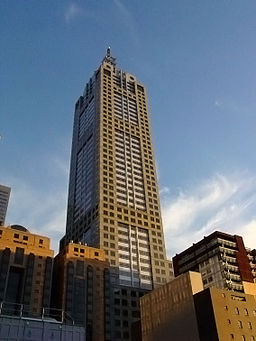
120 Collins Street
120 Collins Street: Melbourne’s Postmodern Skyscraper Icon
Situated in the prestigious “Paris End” of Melbourne’s Collins Street, 120 Collins Street stands as one of Australia’s most distinguished skyscrapers. Completed in 1991, it remains a benchmark for commercial office towers across the nation. Blending postmodern architectural style with advanced engineering, 120 Collins Street not only elevates the Melbourne skyline but also sets a high standard for corporate prestige, technical innovation, and structural elegance.
Architectural Vision
120 Collins Street was designed by Hassell architects in association with New York-based firm I. M. Pei & Partners (now Pei Cobb Freed & Partners). Inspired by the classic lines of New York’s Art Deco masterpieces such as the Chrysler Building and the Empire State Building, the building’s tiered setbacks and slender spire create a dynamic silhouette, emphasizing verticality and grandeur.
The external cladding of glass, granite, and steel emphasizes timeless strength and stability, qualities that were particularly attractive to the financial and corporate tenants the building was designed to serve.
Technical Specifications
- Height to spire tip: 265 meters (869 feet)
- Roof height: 220 meters (722 feet)
- Number of floors: 52 above ground, 4 basement levels
- Construction period: 1989 – 1991
- Primary use: Commercial office space
- Total floor area: Approximately 65,000 square meters (700,000 square feet)
- Elevators: 30 elevators in total, including high-speed lifts
- Architects: Hassell in association with I. M. Pei & Partners
- Developer: Mainstay Australia
- Main contractor: Grocon
- Structural engineer: Connell Wagner
Upon completion, 120 Collins Street was Australia’s tallest building and retained this title until it was overtaken by the nearby Rialto Towers (depending on measuring criteria) and later Eureka Tower.
Structural Engineering and Materials
Structural design for 120 Collins Street had to ensure exceptional stability against Melbourne’s wind conditions while accommodating the building’s slender, stepped profile.
The building’s structure features:
- Central reinforced concrete core: Housing elevators, stairs, and mechanical systems, providing torsional resistance and rigidity
- Perimeter columns: Supporting gravity loads and contributing to lateral stability
- Outrigger and belt truss systems: Installed at mechanical plant levels to tie the core and the perimeter frame, helping redistribute loads during high wind events
- Foundation system: Deep pile foundations anchored into bedrock to prevent settlement and withstand seismic activity
The materials used combine durability and aesthetics:
- Façade: Polished grey and pink granite panels combined with glass curtain walls
- Steel spire: Weighing several tonnes and constructed in sections to facilitate installation at high altitude
120 Collins Street is a product of complex engineering coordination, where construction sequencing had to factor in both the aesthetic tapering design and the technical necessities of the tall structure.
Design Features
Aesthetically, the building’s vertical emphasis is accentuated by narrow vertical window bands and granite piers that stretch uninterrupted from base to crown. The stepped setbacks at higher levels are traditional Art Deco moves reinterpreted for a late 20th-century skyscraper.
The lobby of 120 Collins Street is finished with luxurious materials, including marble flooring, wood paneling, and intricate metalwork, reflecting the building’s high-end aspirations and the elite tenant base it sought to attract.
Building Services and Amenities
Designed to provide premium office space, 120 Collins Street is equipped with modern services that have been continually updated to meet contemporary standards:
- Air conditioning: Energy-efficient central chilled water system
- Lighting: Intelligent lighting systems for common areas and tenant spaces
- Power supply: Redundant power systems to support critical business operations
- Security: 24-hour on-site security and electronic access control systems
- End-of-trip facilities: Showers, lockers, and secure bicycle storage to support sustainable commuting
The tower also features large, column-free floor plates that provide flexible office layouts highly desirable to corporate tenants.
Sustainability Upgrades
While 120 Collins Street was built before the era of mandatory green design standards, the building has undergone significant upgrades to improve energy efficiency and sustainability, including:
- High-efficiency chillers and HVAC plant upgrades
- Installation of LED lighting throughout common areas
- Building management system (BMS) improvements for real-time energy monitoring
- Water-saving fixtures and sustainable operational practices
These upgrades have helped 120 Collins Street achieve a NABERS Energy rating that aligns with modern expectations for premium commercial buildings.
Construction Highlights
Constructed by Grocon, one of Australia’s leading construction companies, 120 Collins Street represented one of the most complex and ambitious projects of its era in Melbourne.
Construction techniques included:
- Slip-forming technology: Used for rapid core construction
- Top-down construction for basements: To accelerate project delivery in the restricted CBD environment
- High-strength concrete: Used to minimize column sizes and maximize usable floor space
The installation of the steel spire was a particularly notable achievement, requiring precise lifting and assembly over 200 meters above the ground, often under challenging weather conditions.
Cultural and Commercial Significance
120 Collins Street quickly became one of Melbourne’s most prestigious business addresses, attracting major law firms, banks, and multinational corporations. Its location at the east end of Collins Street, surrounded by leafy boulevards, boutique hotels, and heritage architecture, adds to its desirability.
The tower also marked a shift in Melbourne’s corporate skyline towards New York-style verticality, influencing many commercial developments that followed.
Today, 120 Collins Street remains a symbol of success, stability, and architectural refinement — a testament to Melbourne’s maturity as a global business city.
Conclusion
120 Collins Street is a skyscraper that marries classic design ideals with advanced structural engineering. It remains an enduring icon of Melbourne’s skyline and a landmark in Australia’s commercial real estate history. Its attention to form, detail, and technical innovation ensures that it continues to be one of the most respected and sought-after office towers in the Southern Hemisphere.
