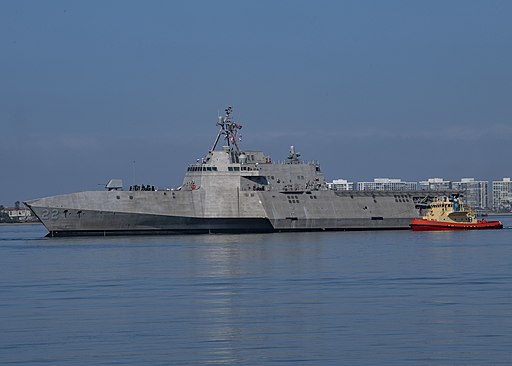
USS Kansas City (LCS-22)
The USS Kansas City (LCS-22) stands as a modern symbol of United States naval ingenuity. As an Independence-class littoral combat ship, she embodies a strategic pivot toward agile, versatile maritime platforms that can operate effectively in coastal (littoral) environments. Named in honor of Kansas City—the vibrant metropolis with a rich history—the vessel carries a proud legacy, serving as both a technological marvel and a functional workhorse of the U.S. Navy. Commissioned in June 2020 and homeported in San Diego, the ship reflects the ongoing evolution in naval warfare where speed, modularity, and advanced technology intersect to meet modern challenges .
Design and Construction
Origin of Littoral Combat Ships
The concept for Littoral Combat Ships (LCS) emerged in the early 2000s as part of an initiative to develop ships that could meet the demands of modern, asymmetric warfare and rapid deployment in coastal regions. The program aimed to produce vessels that not only provided high-speed performance but also allowed flexible missions through modular configurations. Even-numbered ships, such as the USS Kansas City (LCS-22), embraced the innovative Independence-class design, showcasing a unique trimaran hull that has redefined traditional naval architecture .
Independence-Class Design and Architecture
USS Kansas City’s design is defined by its trimaran hull—a radical approach that contributes to exceptional stability, a wider beam, and a superior degree of maneuverability in both calm and rough waters. The wide, multihull configuration minimizes the vessel’s overall drag, contributing to higher speeds and improved fuel efficiency. Modern exterior elements, such as sleek composite panels combined with aluminum superstructures, not only enhance performance through better thermal insulation and low aerodynamic resistance but also give the ship a visually striking and modern appearance .
Technical Specifications in Detail
Before examining each segment of the vessel’s performance in depth, the following table presents an overall summary of its technical specifications:
| Specification | Value |
|---|---|
| Class | Independence-class Littoral Combat Ship |
| Displacement | ~3,104 metric tons (full load) |
| Length | 127.4 meters (418 feet) |
| Beam | 31.6 meters (104 feet) |
| Draft | Approximately 4–4.3 meters (13–14 feet) |
| Propulsion | 2 × LM2500 gas turbines, 2 × diesel engines, 4 × waterjets, retractable azimuth thruster, 4 × diesel generators |
| Maximum Speed | 40 knots continuous; up to 47 knots in sprint mode |
| Range | Up to 4,300 nautical miles at 20 knots (with alternative configurations reporting ranges closer to 2,700 nautical miles in some cases) |
| Armament | 1 × Mk 110 57mm gun, multiple .50 caliber machine guns, SeaRAM CIWS, and missile launcher systems (e.g., 11-cell SeaRAM launcher) |
| Crew | 41 core crew (9 officers, 32 enlisted) plus an additional 35 personnel when mission-specific modules are installed |
| Aircraft Capability | Can embark 2 × MH-60R/S Seahawks helicopters |
The above table condenses critical aspects of the USS Kansas City’s technical capabilities .
Dimensions and Displacement
The vessel’s dimensions are engineered for optimal performance in coastal operations. With a length of approximately 127 meters and a beam stretching around 31.6 meters, the ship’s trimaran shape promotes an expansive deck area while preserving agility. Its full-load displacement of over 3,000 metric tons provides the necessary mass for stability during high-speed maneuvers, even in turbulent conditions. The relatively shallow draft enables operations in littoral zones where deeper-draft vessels might be restricted .
Propulsion and Performance
A key highlight of the USS Kansas City is its sophisticated propulsion system. It is powered by a dual-fuel approach featuring a combination of two LM2500 gas turbine engines and two diesel engines. This hybrid setup, supplemented by four waterjets and a retractable azimuth thruster, affords exceptional acceleration and turning capabilities—especially crucial in confined coastal regions. The ship is designed not only for sustained cruising at high speeds (approximately 40 knots) but also for impressive sprint speeds that can reach up to 47 knots when rapid tactical response is required .
Range and Endurance
Operational endurance is a critical factor in modern naval engagements, and USS Kansas City meets this challenge head-on. With an economical cruising range of up to 4,300 nautical miles at 20 knots, she is well-suited for extended missions that demand persistence. It is noteworthy, however, that some configurations tailored to specific operational requirements report slightly reduced ranges (around 2,700 nautical miles). This flexibility in range characteristics ensures that the LCS can be optimized for varying mission profiles—from short, high-intensity engagements to long-duration patrols .
Armament and Defensive Systems
The combat systems onboard the USS Kansas City are an exemplar of modern naval firepower integrated into a sleek platform. Primary weaponry includes the BAE Systems Mk 110 57mm gun—a versatile naval artillery system capable of engaging multiple target types. Additionally, the ship is equipped with .50 caliber machine guns and an 11-cell SeaRAM CIWS (Close-In Weapon System) designed to counter incoming missiles and hostile fire with rapid response measures. The modular design philosophy also allows for the integration of additional or alternate mission-specific weapons systems, enabling the vessel to transition quickly between roles such as anti-submarine warfare, anti-surface operations, or electronic warfare .
Sensors, Avionics, and Communication Systems
A modern combat ship must excel not only in sheer physical performance but also in situational awareness. USS Kansas City is outfitted with state-of-the-art sensor suites, including a Sea Giraffe 3D Surface/Air radar, which affords comprehensive coverage of both aerial and surface targets. Complementing this are navigational radars, EO/IR sensors, and advanced electronic warfare systems that provide real-time intelligence and threat detection. Integrated communication suites facilitate seamless coordination with allied forces and shore command centers, ensuring that the ship remains an integral node in the broader network-centric warfare architecture of today’s U.S. Navy .
Crew and Mission Modules
The vessel’s operational flexibility is further enhanced by its modular mission systems. While the standard crew comprises 41 personnel (including 9 officers and 32 enlisted members), the ship can accommodate up to 35 additional mission specialists depending on the configuration. This expandable design allows USS Kansas City to rapidly swap and integrate specialized modules tailored for particular operational needs—whether it’s mine countermeasures, anti-submarine warfare, or surface combat tasks. This adaptability ensures that the ship remains relevant in a rapidly evolving tactical environment, ready to undertake a diverse range of missions at short notice .
Operational Capabilities and Future Role
The USS Kansas City (LCS-22) represents a new era in naval operations. Its high-speed performance paired with proven stability allows it to navigate both narrow coastal waterways and expansive open seas. The modular architecture and reconfigurable mission spaces mean the ship can be re-tasked almost instantaneously as strategic needs change. In today’s geopolitical climate—where threats can emerge suddenly and unpredictably—the ability to pivot between roles without compromising combat readiness is invaluable. Furthermore, by incorporating advanced sensor and communication systems, this littoral combat ship serves as a critical forward-deployed asset capable of rapid decision-making and precise, coordinated action in joint operations .
Looking forward, the USS Kansas City is expected to play a pivotal role not only as a standalone asset but as part of a larger network of agile, multi-role platforms. As naval warfare increasingly relies on speed, connectivity, and versatility, platforms like LCS-22 will continue to drive innovation in both hardware and operational tactics, ensuring that the U.S. Navy remains at the cutting edge of maritime defense strategy .
Conclusion
The USS Kansas City (LCS-22) is much more than a ship—it’s a demonstration of how modern engineering, advanced propulsion technology, and modular design principles can redefine naval warfare. With its advanced armament, cutting-edge sensors, and rapid reconfigurability, the vessel is well-poised to address the multifaceted challenges of modern maritime operations. As the U.S. Navy continues to adapt to an evolving strategic landscape, the technical prowess and innovative design of USS Kansas City offer an inspiring look at the future of naval power.
_arrives_at_Naval_Base_San_Diego_for_the_first_time_-_2.jpg)