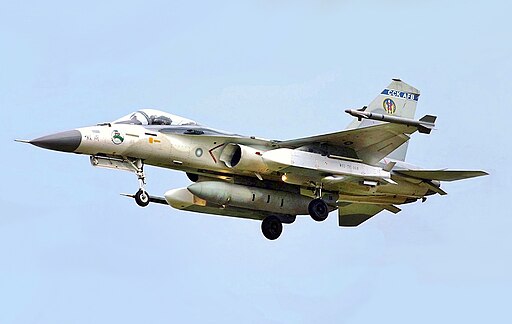
AIDC F-CK-1 Ching-kuo
The AIDC F-CK-1 Ching-kuo represents a milestone in Taiwan’s pursuit of self-reliant defense capabilities. Conceived during a period when regional threats were rapidly evolving, this fighter was designed to be agile, versatile, and teeming with advanced avionics—all hallmarks of a modern multirole aircraft. Named after a former leader of Taiwan, the Ching-kuo not only reflects national pride but also embodies the technological strides made by the Aerospace Industrial Development Corporation (AIDC) in the late 20th century.
By integrating indigenous technologies with selective advanced components from established sources, the F-CK-1 set out to meet the dual demands of air-to-air superiority and robust ground-attack capability. Its design process was marked by an unwavering focus on maneuverability, survivability, and flexibility—a balance that continues to influence Taiwan’s fighter development philosophy.
Development and Design Philosophy
Historical Context and Requirements
In the latter decades of the Cold War, Taiwan faced the pressing need to defend its airspace against evolving regional threats. At a time when dependency on foreign military hardware carried both financial and strategic risks, developing a domestic fighter became imperative. The F-CK-1 project was envisioned as a solution to these challenges, aiming to combine high performance with cost-effective production and maintainability.
During its formative years, engineers and defense planners recognized the need for a fighter that could execute rapid interceptions, perform precision ground attacks, and adapt to a dynamic aerial combat environment. This led to an ambitious design brief that called for a single-seat, multirole aircraft with advanced electronic warfare capabilities and a digital flight control system.
Design and Engineering Innovations
AIDC’s approach to the F-CK-1 incorporated several innovative design elements:
- Digital Fly-by-Wire System: The integration of a fly-by-wire system ensured precise handling and stability throughout high-G maneuvers, which enhanced pilot control and survivability in combat engagements.
- Modular Avionics Architecture: A modular design allowed for upgrades and rapid integration of new sensors, communication gear, and defensive countermeasures.
- Aerodynamic Efficiency: The airframe was sculpted with a compact fuselage and blended wing-body configuration to optimize lift-to-drag ratios, facilitating high speed and agility even at low altitudes.
- Optimized Maintenance and Production: Emphasis was placed on simplifying maintenance procedures and streamlining the supply chain—a critical factor for Taiwan’s strategic objective of self-sufficiency.
These pioneering design choices not only ensured that the Ching-kuo could meet its performance goals but also laid the groundwork for future indigenous fighter programs.
Technical Specifications
Understanding the Ching-kuo’s technical specifications offers insight into how its performance capabilities were realized through meticulous engineering.
Airframe and Dimensions
The dimensions of the F-CK-1 were carefully calculated to provide a balance between agility, payload capacity, and low observability. Below is an overview of its key airframe parameters:
| Parameter | Specification | Comments |
|---|---|---|
| Crew | 1 (Single-seat) | Emphasizes pilot-centric control and situational awareness |
| Length | ~13.4 m (44 ft) | Designed to optimize aerodynamic performance |
| Wingspan | ~8.3 m (27 ft) | A compact wing profile enhances maneuverability |
| Height | ~4.5 m (14.8 ft) | Low-profile design reduces radar cross-section |
| Empty Weight | ~8,200 kg (18,100 lbs) | Lightweight construction using advanced composite materials |
| Maximum Takeoff Weight | ~12,300 kg (27,121 lbs) | Balances fuel capacity, payload, and structural limits |
The sleek yet robust airframe enabled the Ching-kuo to perform at high speeds while maintaining exceptional agility during combat maneuvers.
Engine and Propulsion
At the heart of the F-CK-1 is a single, high-performance turbofan engine. Engine choice and layout were pivotal in achieving the fighter’s supersonic capabilities:
| Parameter | Specification | Comments |
|---|---|---|
| Engine Type | Single afterburning turbofan | Designed for an optimum thrust-to-weight ratio |
| Thrust | ~10,300 lbf (45.8 kN) in afterburner | Provides rapid acceleration and sustained supersonic performance |
| Propulsion | Optimized intake and exhaust design to minimize drag | Enhances fuel efficiency and overall agility |
This engine configuration, paired with aerodynamic refinements, ensures that the F-CK-1 can execute both high-speed intercept missions and precise ground attack runs.
Performance Characteristics
The performance envelope of the Ching-kuo highlights its multirole capabilities. The following table summarizes its estimated operational parameters:
| Parameter | Specification | Comments |
|---|---|---|
| Maximum Speed | ~Mach 1.8 (approx. 1,900 km/h) | Achieved with afterburner at high altitude |
| Service Ceiling | ~15,200 m (50,000 ft) | Allows for high-altitude interception and evasion tactics |
| Combat Range | ~1,480 km | Extended further by external fuel tanks when necessary |
| Rate of Climb | ~250 m/s | Superior climb rates facilitate rapid response and maneuvering |
| G Limits | Approximately +8 / -3 G | Robust airframe designed for high-G combat maneuvers |
These performance metrics underscore the fighter’s ability to engage in both short-range dogfights and long-range interception missions while maneuvering under rigorous combat conditions.
Armament and Avionics
The F-CK-1 Ching-kuo is outfitted with a versatile suite of armaments and advanced avionics that empower it in various combat scenarios.
Armament
A combination of internal and external weaponry allows the Ching-kuo to transition seamlessly between air-to-air and air-to-ground roles.
| Parameter | Specification | Comments |
|---|---|---|
| Main Gun | 20 mm cannon | Provides high rate-of-fire for close-range engagements |
| Hardpoints | Up to 8 hardpoints | Capable of carrying air-to-air missiles, air-to-ground munitions, bombs, and rockets |
| Missile Options | Options typically include AIM-9 Sidewinder and indigenous missile systems | Enhances flexibility in combat engagements |
Avionics
The cockpit and sensor package reflect modern digital integration essential for situational awareness and combat efficiency.
- Radar and Sensor Systems: The fighter is equipped with a multi-mode radar that balances target tracking, acquisition, and ground mapping capabilities.
- Digital Fly-by-Wire Controls: This system ensures precise handling during extreme maneuvers, reducing pilot workload and improving response times.
- Cockpit Displays: A modular layout with multi-function displays delivers real-time information on weapon status, enemy positions, and navigational data.
- Defensive Aids Suite: Includes electronic countermeasures (ECM) and missile warning systems to safeguard the aircraft against modern threats.
Together, these systems provide the F-CK-1 with a significant edge in rapidly evolving combat environments, allowing for precision engagement and effective self-defense.
Operational Role and Capabilities
Multirole Combat Operations
The F-CK-1 Ching-kuo was designed as a true multirole fighter. Its ability to switch between air superiority missions and ground-attack roles makes it a formidable asset in any battle scenario. In air-to-air combat, its agile maneuvering and radar capabilities allow it to engage enemy fighters effectively. Conversely, its precision weapons systems and advanced targeting enable it to execute close air support and interdiction missions with accuracy.
The strategic flexibility of the Ching-kuo has allowed the Taiwanese military to optimize its force composition, ensuring that a single platform can fulfill a variety of operational roles. This versatility is especially critical for nations that must maximize the utility of limited resources.
Advanced Avionics and Tactical Systems
Central to the Ching-kuo’s success is the integration of advanced avionics. By leveraging sensor fusion and digital control systems, pilots benefit from unparalleled situational awareness. Key tactical advantages include:
- Data Link Integration: Real-time communications with command centers and other aircraft provide a cohesive picture of the battlefield.
- Targeting Suite: Advanced targeting algorithms enable faster lock-on and engagement, elevating the effectiveness of both air-to-air and air-to-ground munitions.
- Adaptive Flight Controls: The digital fly-by-wire system adjusts control surfaces in real time, ensuring stability even in adverse conditions.
Such systems not only improve mission success rates but also enhance pilot survivability in complex combat operations.
Legacy and Impact
Contribution to Taiwan’s Defense
The F-CK-1 Ching-kuo is more than just an aircraft—it is a national achievement. Developing an indigenous fighter has allowed Taiwan to reduce its reliance on foreign systems, ensuring greater control over production, maintenance, and upgrades. The fighter’s operational success has reinforced Taiwan’s ability to safeguard its airspace and serve as a deterrent against potential adversaries.
Moreover, the experience gained from designing and manufacturing the F-CK-1 has spurred advancements in local aerospace technology. These innovations have not only improved military aviation but also influenced commercial and research applications within Taiwan’s growing technology sector.
Influence on Subsequent Designs
The design philosophies proven in the F-CK-1 have paved the way for subsequent indigenous fighter programs. Lessons learned about modular avionics, aerodynamic efficiency, and cost-effective production have been incorporated into newer projects, strengthening Taiwan’s overall defense posture. The success of the Ching-kuo has also inspired similar efforts across the region, as nations seek to balance technological innovation with strategic self-determination.
Conclusion
The AIDC F-CK-1 Ching-kuo stands as a testament to Taiwan’s commitment to self-reliant defense engineering. With its sophisticated blend of advanced avionics, a high-performance engine, and a versatile multirole design, the Ching-kuo continues to be a cornerstone of Taiwanese air power. Its technical specifications—ranging from precision airframe dimensions to its dynamic engine and integrated weapons systems—reveal the meticulous engineering that has made it a resilient and adaptable combat platform.
This fighter not only highlights the ingenuity of Taiwan’s indigenous development programs but also serves as a continuing inspiration for future aerospace innovations. As air combat evolves, the legacy of the F-CK-1 Ching-kuo endures, reminding us that innovation in technology and design is the bedrock upon which national security is built.
