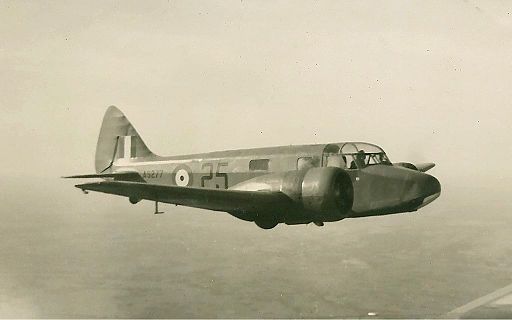
Airspeed Oxford: Britain’s Versatile Twin-Engine Trainer
The Airspeed Oxford stands as one of the most significant multi‐role trainers of World War II. Built by Airspeed Ltd. in Hampshire, England, more than 8,500 Oxfords were produced between 1937 and 1945. Its sturdy twin-engine layout, forgiving handling and adaptable interior enabled the Royal Air Force and Commonwealth air forces to train thousands of pilots, navigators, bomb aimers, wireless operators and gunners under one airframe program.
Design & Development
Origins & Specification
In 1936 the Royal Air Force issued Specification T.23/36 for an advanced twin-engine trainer capable of preparing crews for modern bombers. Airspeed’s response—initially known as the Envoy II—was reworked into a military trainer with dual controls, space for navigation tables, bombing equipment racks and a dorsal gun turret.[1]
Airframe & Structure
- Fuselage: A semi-monocoque structure using spruce longerons and plywood formers, skinned in durable birch plywood and doped fabric.
- Wings: Two-spar construction with plywood covering; foldable outer panels on later marks eased hangar storage.
- Empennage: Tailplane and fin built with spruce and plywood, removable for transport or repair.
The plywood airframe provided an excellent strength-to-weight ratio and simplicity of repair—even in forward airfields lacking extensive metalworking facilities.
Powerplant & Propulsion
Standard Oxfords were powered by a pair of 350 hp Armstrong Siddeley Cheetah X radial engines, each driving a two-bladed fixed-pitch propeller. Later marks used the more powerful Cheetah XV, uprated to 375 hp, improving climb rate and cruise speed. Dual engine controls, cross-feed fuel valves and separate oil systems trained crews in multi-engine management.
Cockpit & Training Stations
Pilot/Instructor Cockpit
- Dual Controls: Conventional yoke, rudder pedals and throttle quadrant duplicated front and rear.
- Instrumentation: Basic flight instruments (airspeed, altimeter, turn-and-bank, compass), engine gauges for each powerplant, DG and drift meter.
- Communication: Two VHF/UHF radios and voice-fade intercom to link instructor and trainee.
Navigation & Bombing Bay
Behind the cockpit lay a navigation table with chart light, prominent wind-drift calculator and space for sextant shots through overhead windows. A simple Winchester Mk II bombsight mounted on a pivoting rack taught basic bombing techniques.
Wireless & Gunnery Positions
- Wireless Station: Located on the starboard side with Marconi transmitter/receiver, Morse key and headphones.
- Dorsal Turret: Flux-parabolic turret with a single .303 in Vickers K machine gun trained through 360°, introducing air-to-air gunnery skills.
Performance & Specifications
Dimensions & Weights
| Parameter | Value |
|---|---|
| Wingspan | 16.65 m |
| Length | 10.97 m |
| Height | 3.81 m |
| Wing Area | 50.4 m² |
| Empty Weight | 2,380 kg |
| Maximum Takeoff Weight | 3,300 kg |
| Fuel Capacity | 760 L |
Flight Performance
| Parameter | Value |
|---|---|
| Engines | 2 × Armstrong Siddeley Cheetah X (350 hp) |
| Maximum Speed (Vne) | 355 km/h @ 3,048 m |
| Cruise Speed (75% Power) | 310 km/h |
| Stall Speed (Landing Config) | 120 km/h |
| Rate of Climb | 6.1 m/s |
| Service Ceiling | 6,400 m |
| Range (Standard Tanks) | 1,260 km |
| Takeoff Distance (ground) | 350 m |
| Landing Distance (over 15 m) | 600 m |
Operational Roles & Training Missions
Pilot Conversion & Multi-Engine Training
Trainees learned engine-failure drills, asymmetric-power handling and advanced navigation in realistic bomber-like conditions. Instructors could simulate emergencies—such as engine fire or feathered prop—to test decision-making under stress.
Bombing & Navigation Courses
Oxford crews practiced formation-flying en route to bombing ranges, dropping inert bombs and tracking headings using radio beacons. The centrally mounted bombsight gave trainees immediate feedback on accuracy and timing.
Wireless Operator & Air Gunner Instruction
Operating the Marconi set, wireless cadets perfected Morse proficiency and long-range communications. Gunners gained experience in target tracking, lead-angle estimation and turret maintenance, honing skills transferable to frontline bombers.
Variants & Production
Oxford Marks
- Oxford I: Prototype with fixed main landing gear.
- Oxford II: Main production model; single dorsal hatch replaced with rotating turret.
- Oxford III: Dual-control gun trainer without bombing gear, for gunnery schools.
- Oxford V: Improved Cheetah XV engines and radius tanks for extended range.
Production & Assembly
Over 8,500 units were built by Airspeed, plus licensed production by de Havilland Canada and Percival Aircraft. Some Canadian-built Oxfords featured cold-weather adaptations—engine pre-heaters, heated cockpit ducting and reinforced landing gear for snow operations.
Maintenance & Serviceability
Inspection & Overhaul
- 50-hour checks: Oil and filter change, engine run-up, propeller inspection.
- 250-hour inspections: Wing-root bolt torque check, plywood skin integrity, control-surface hinge lubrication.
- 1,000-hour major: Engine overhaul or life-extension, full airframe inspection in a jacking cradle.
Field Repair Advantages
Plywood construction allowed teams to patch minor damage with wood and fabric rather than scarce aluminum alloys—critical in forward bases. Removable wing panels simplified replacement in remote locations.
Pilot’s Perspective: Handling & Feel
Stepping on board an Oxford, a trainee feels the solid yoke, the comforting whirr of twin radials and the glow of instrument lamps. The controls are intentionally mild, damping abrupt inputs to build confidence. With full flaps and power idle, the Oxford approaches slowly and steadily, giving ample time to judge flare. On climb-out, the sound of two Cheetah engines conjures the promise of transatlantic bomber partnerships to come.
Operators & Postwar Legacy
RAF & Commonwealth Usage
The RAF alone flew over 5,000 Oxfords, with training schools spread across the United Kingdom, Canada (as part of the British Commonwealth Air Training Plan), Australia, South Africa and New Zealand.
Civilian & Preservation
After the war, surplus Oxfords found roles as freighters, survey platforms and air-sea rescue aircraft. Today, around a dozen survive in airworthy condition, cherished by vintage-aircraft enthusiasts and museum collections around the world.
Legacy & Impact
The Airspeed Oxford’s success established key principles in multi-role training: adaptability, realism and maintainability. Its plywood-skinned airframe influenced postwar light-aircraft construction, and its integrated training stations inspired modern synthetic-trainer layouts.
Conclusion
The Oxford’s unwavering service during World War II forged thousands of aircrew destined for bombers and transports alike. Its blend of user-friendly handling, robust construction and multi-discipline stations earned it the nickname “Flying Classroom.” Even today, the few remaining airworthy Oxfords carry on that legacy, reminding us how one versatile design can train a generation and leave an indelible mark on aviation history.
