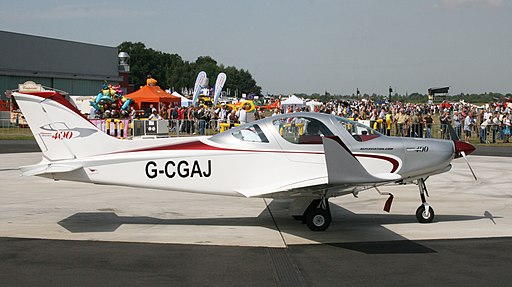
Alpi Pioneer 400
The Alpi Pioneer 400 is a four-seat, single-engine light aircraft designed and manufactured by Alpi Aviation in Pordenone, Italy. It emerged as the flagship of the Pioneer series, evolving from the two-seat Pioneer 200 and Pioneer 300 into a larger four-place configuration suitable for private, sport and cross-country roles.
Design and Structure
Airframe and Wing
The Pioneer 400 features a low-wing monoplane design with a trapezoidal planform and winglets at the tips. Its wing structure consists of a single wooden box spar covered with pre-preg carbon-fibre skins. Fabric-covered ailerons occupy about half the span, while slotted flaps fill the remainder, providing a stall speed as low as 67 km/h when fully deployed.
Fuselage and Empennage
The fuselage and tail assembly combine wooden framing with carbon-fibre exterior panels, achieving high stiffness and low weight. The empennage surfaces are straight-edged and swept, with fabric-covered rudder and elevators that incorporate trim tabs. Entry is through upward-opening gull-wing doors, granting easy access to the four-place cabin and baggage area behind the rear seats.
Development and Certification
First Flight and Approvals
The Pioneer 400 prototype first flew on 27 March 2009 and made its public debut at the AERO Friedrichshafen show in April 2010. It received type approval in late 2010 and full European CS-23 certification by August 2012. By October 2024, 54 airframes had been completed, either as factory-built or amateur-built experimental category aircraft.
Category and Configuration
Designed primarily for the Experimental category with an 850 kg maximum takeoff weight, the Pioneer 400 is also supplied as a kit for amateur construction or as a factory-ready-to-fly airplane. Its retractable tricycle landing gear is partially exposed when retracted, balancing aerodynamic cleanliness with ground-handling stability.
Powerplant and Propulsion
Engine Options
Two Rotax flat-four engines are offered: the Rotax 915 iS producing 140 hp and the higher-output Rotax 916 iS delivering 160 hp. Both powerplants feature liquid and air cooling, fuel injection, and drive a three-bladed variable-pitch propeller, enabling robust climb performance and efficient cruise economy.
Performance Benefits
The 916 iS version achieves a maximum speed of 300 km/h and a cruise speed of 277 km/h at 75 percent power. Both engine options support a service ceiling of 6 000 m and a best glide ratio of 13:1. The maximum rate of climb is 7.62 m/s at sea level, while takeoff and landing runs are approximately 150 m under standard conditions.
Variants
Pioneer 400 915 iS
Equipped with the 140 hp Rotax 915 iS, this variant shares the 850 kg MTOW and experimental certification. It balances performance and efficiency for pilots prioritizing economy and moderate power.
Pioneer 400 916 iS
Featuring the 160 hp Rotax 916 iS, this flagship model offers top cruise and maximum speeds within the series. It retains the same structural limits but delivers enhanced climb rates and higher cruise flexibility for long-range missions.
Technical Specifications
General Characteristics
| Parameter | Value |
|---|---|
| Crew | 1 pilot |
| Capacity | 3 passengers |
| Length | 7.00 m (23 ft 0 in) |
| Wingspan | 8.80 m (28 ft 10 in) |
| Wing Area | 11.20 m² (120.6 ft²) |
| Maximum Takeoff Weight | 850 kg (1 874 lb) |
| Load Limits | +4 g / –2 g |
Weights and Loading
| Parameter | Value |
|---|---|
| Empty Weight | 360 kg (794 lb) |
| Useful Load | 490 kg (1 080 lb) |
| Fuel Capacity | 80 L (17.6 Imp gal) |
| Baggage Allowance | 20 kg (44 lb) |
Performance
| Metric | 916 iS Version | 915 iS Version |
|---|---|---|
| Maximum Speed | 300 km/h (160 kt) | 280 km/h (151 kt) |
| Cruise Speed (75 % power) | 277 km/h (150 kt) | 260 km/h (140 kt) |
| Stall Speed (Flaps Down) | 67 km/h (36 kt) | 67 km/h (36 kt) |
| Rate of Climb | 7.62 m/s (1 500 ft/min) | 7.00 m/s (1 380 ft/min) |
| Service Ceiling | 6 000 m (20 000 ft) | 6 000 m (20 000 ft) |
| Range (150 ktas, FL100) | 1 444 km (780 nmi) | 1 300 km (702 nmi) |
| Best Glide Ratio | 13:1 | 13:1 |
| Takeoff Distance | 150 m (490 ft) | 150 m (490 ft) |
| Landing Distance | 150 m (490 ft) | 150 m (490 ft) |
(All performance figures at MTOW, sea level, ISA).
Avionics and Safety
The Pioneer 400’s factory fitment includes Garmin G3X or Dynon HDX glass-cockpit suites, with options for autopilot, ADS-B transponder, integrated engine monitoring and ballistic parachute systems. Analog backups comprise airspeed, altitude and attitude indicators, while underfloor wiring provisions facilitate custom instrument upgrades.
Operational Roles
Flight schools adopt the Pioneer 400 for advanced training and cross-country syllabus due to its retractable gear and IFR capabilities. Private owners value its high cruise speeds and comfortable four-place cabin for family travel. Sport aviators exploit its aerobatic load limits for occasional maneuvers within the +4/–2 g envelope.
Maintenance and Support
Annual inspections require approximately 60–80 man-hours, reflecting its wood-composite structure. Composite skins eliminate corrosion concerns, and the global Rotax service network ensures prompt engine parts availability. Alpi’s dealer network across Europe and North America provides technical bulletins and upgrade kits.
Conclusion
By merging advanced carbon-fibre construction with proven Rotax powerplants, the Alpi Pioneer 400 delivers four-place utility, high cruise performance and experimental-category flexibility. Its combination of speed, comfort and modern avionics makes it a standout choice for private pilots, training organizations and sport aviators seeking a capable four-seat light aircraft.
