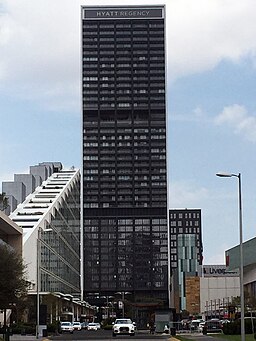
Hyatt Regency Andares Zapopan
Hyatt Regency Andares Zapopan rises prominently within the Andares mixed-use complex on the western edge of Guadalajara. At 41 stories and 173 meters tall, the hotel tower integrates luxury accommodations, conference facilities, dining venues, and wellness spaces atop a multifunctional podium. The following technical deep dive examines its structural systems, envelope performance, MEP integration, vertical transportation, fire safety, sustainability features, and construction methodology.
Site Context and Urban Integration
Location and Plot Characteristics
- Site area: 12,500 m² within Andares master plan
- Adjacencies: Retail mall to the south, office towers to the east, central plaza to the north
- Accessibility: Direct access from Avenida Patria, pedestrian links to light-rail stations
The hotel tower is oriented to frame views of the surrounding Sierra Madre Occidental foothills while activating the plaza with ground-level restaurants and landscaped terraces.
Podium and Public Realm
- Podium footprint: 3,200 m² over two levels
- Uses: Arrival lobby, event halls, fitness center, spa, rooftop bar
- Circulation: Column-free banquet hall achieved with 18-meter-long prestressed beams
A light-filtered canopy anchors the main entrance plaza, guiding guests from the public square into the soaring two-story lobby.
Architectural Design
Massing and Façade Articulation
- Tower plan: Rectangular core with 22 × 32 meter floor plate
- Setbacks: At levels 10 and 18 to form outdoor guest terraces
- Façade system: Unitized curtain wall with integrated sunshade fins
The sleek glass façade employs alternating vertical fins that rise three floors at a time, creating a rhythm that mitigates glare and animates the elevation.
Interior Zoning
- Floors 3–12: Standard guest rooms (8 rooms per floor)
- Floors 13–17: Club level suites and executive lounge
- Floors 18–26: Premium suites with panoramic glazing
- Floor 27: Sky bar, rooftop pool, fitness terrace
Public amenities—including ballrooms and breakout rooms—occupy the podium and first two tower levels to concentrate guest flow.
Structural Engineering
Primary Load-Bearing System
- Core: Cast-in-situ reinforced concrete shear walls, 600 mm thick
- Outriggers: Steel outrigger trusses connecting core to perimeter columns at levels 12 and 24
- Columns: Composite steel-concrete sections, 500 mm × 500 mm
The hybrid system couples concrete stiffness with steel’s tensile strength, controlling lateral sway while keeping column sizes compact.
Floor Slab Design
- Slab type: Post-tensioned flat plate, 200 mm thickness
- Span: Up to 8 meters between core and perimeter
- Deflection limit: L/400 under live load
Post-tensioning reduces slab depth and accelerates construction by minimizing formwork requirements.
Foundation System
Geotechnical Profile
- Subsurface: 5 m of fill over 20 m of alluvial clayey silt on volcanic tuff
- Groundwater level: 3 m below site grade
Pile-Raft Hybrid Foundation
- Raft slab: 1.0 m thick, covering the full podium footprint
- Piles: 160 bored piles, 0.9 m diameter, 25–35 m length
- Settlement control: Total estimated settlement < 35 mm
The raft-pile combination distributes loads while ensuring uniform settlement beneath the heavy core and service zones.
Building Envelope and Thermal Performance
Curtain Wall Specifications
- Glazing: 10 mm tempered low-iron glass both inner and outer leaves
- Cavity: 200 mm ventilated air gap for natural purge
- Sunshade fins: Powder-coated aluminum, 300 mm projection
Thermal performance meets a U-value of 0.28 W/m²·K, significantly exceeding local code requirements.
Air Tightness and Water Management
- Air leakage: 0.5 m³/h·m² at 150 Pa
- Drainage plane: Two-stage pressure-equalized channel behind glazing
- Flashing and sealants: Silicone gaskets with UV stabilization
Continuous weather barriers behind the curtain wall prevent moisture migration into the interior finish system.
Mechanical, Electrical, and Plumbing (MEP) Systems
HVAC Configuration
- Central plant: Two 2,500 kW chillers with variable-speed drives
- Distribution: Fan-coil units in guest rooms, variable-air-volume (VAV) boxes in public zones
- Heat recovery: Plate exchanger recovering 65% of exhaust enthalpy
CO₂ sensors in meeting rooms enable demand-controlled ventilation, cutting fan energy by 22%.
Electrical Infrastructure
- Main service: 2,500 kVA transformer supplying 480/277 V distribution
- Backup: 3 × 1,000 kVA diesel generators for critical loads
- Lighting: LED system with occupancy and daylight harvesting sensors
Power quality is maintained with automatic transfer switches and UPS units for IT and emergency systems.
Plumbing and Water Efficiency
- Domestic demand: 110 L/person/day
- Greywater reuse: 55% of wastewater treated for toilet flushing and landscaping
- Rainwater capture: 150 m³ storage for irrigation
Low-flow fixtures and sensor taps reduce potable water use by 30% compared to baseline.
Vertical Transportation
Elevator Banks
- Guest elevators: 6 units (2.5 m/s) divided into low-rise and high-rise banks
- Service elevators: 2 freight lifts (1,600 kg capacity) with direct kitchen access
- Firefighter elevator: Pressurized cabin conforming to NFPA standards
Sky lobbies streamline passenger flow and minimize waiting times during peak check-in periods.
Escalators and Conveyance
- Escalators: 3 units connecting lobby, podium mezzanine, and pool level
- Moving walkways: None
- Dumbwaiter: Automated pantry lift delivering room service from kitchen to guest floors
Automated routing within the BMS monitors elevator performance and triggers maintenance alerts.
Fire Protection and Safety
Egress and Pressurization
- Stairwells: 3 pressurized exit cores, each 2.2 m wide
- Occupant load: Designed for 1,400 occupants total
- Refuge area: Dedicated space on level 12 with fresh-air supply
Emergency lighting and photoluminescent egress path markings facilitate swift evacuation.
Detection and Suppression
- Smoke detectors: Addressable system with 400 devices integrated into BMS
- Sprinklers: Wet-pipe network at 0.75 L/min·m² density
- Standby pumps: Two 250 kW fire pumps delivering 600 L/min at 10 bar
Annual full-scale drills and flow tests verify system readiness and occupant training.
Sustainability and Energy Performance
Green Building Targets
- Certification: Aiming for LEED Gold and EarthCheck Platinum
- Energy Use Intensity: 72 kWh/m²·year (20% below baseline)
- Carbon footprint: Reduced by 18% through efficient MEP design
Renewable and Passive Strategies
- Photovoltaics: 210 kW array on rooftop and podium terraces
- Shading: Dynamic horizontal louvers on west façade
- Thermal mass: Exposed slab ceilings in public areas for diurnal buffering
Building automation optimizes setpoints and sequences based on occupancy patterns and weather forecasts.
Construction Methodology
Modular Prefabrication
- Bathroom pods: Prefinished modules installed via tower crane
- MEP racks: Skid-mounted plant rooms delivered just-in-time
- Façade panels: Preassembled off-site measuring 2.5 × 4.0 m
Modularization reduced on-site labor by 32% and improved schedule predictability.
Project Phasing and Logistics
- Phase 1: Substructure and podium (12 months)
- Phase 2: Tower superstructure with climbing formwork (18 months)
- Phase 3: Façade installation and fit-out (12 months, overlapping)
Just-in-time sequencing and BIM coordination maintained a 98% on-time material delivery record.
Technical Specifications Summary
| Category | Specification |
|---|---|
| Height | 173 meters |
| Floors | 41 above ground, 2 basement levels |
| Gross Floor Area | 53,510 m2 |
| Structural System | Concrete core + steel outriggers |
| Foundation | 160 bored piles, 0.9 m × 25–35 m |
| Curtain Wall U-Value | 0.28 W/m²·K |
| Chiller Capacity | 5,000 kW total |
| Backup Generator Capacity | 3,000 kVA |
| Elevator Count | 9 (6 guest, 2 service, 1 firefighter) |
| EUI | 72 kWh/m²·year |
| Rainwater Storage | 150 m³ |
| PV Peak Capacity | 210 kW |
Future Adaptability
Hyatt Regency Andares Zapopan is equipped to integrate emerging technologies such as adaptive electrochromic glazing, AI-driven predictive maintenance, and electric vehicle charging for valet fleets. The central BMS architecture allows the addition of new sensors and analytics to further optimize comfort, safety, and sustainability throughout the hotel’s lifecycle.
