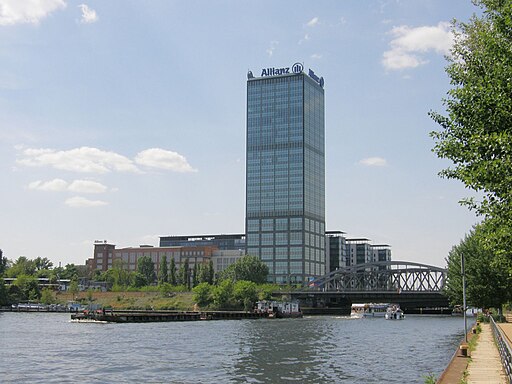
Treptowers
The Treptowers complex in Berlin stands as a symbol of architectural transformation and urban revitalization. Located in the Alt-Treptow district along the banks of the River Spree, this high-rise ensemble was completed in 1998 following an international design competition. The winning concept by architect Gerhard Spangenberg, in collaboration with Schweger & Partner and Reichel & Stauth, reimagined a former industrial site into a modern business hub with cultural significance.
Architectural Overview and Dimensions
General Specifications
- Main Tower Height: 125 meters
- Above-Ground Floors: 32
- Underground Levels: 5 (parking and technical infrastructure)
- Gross Floor Area: ~35,000 m²
- Façade Surface Area: ~75,000 m²
- Building Typology: Office complex with integrated public art and gallery spaces
Site History and Redevelopment
- Originally the site of an AEG electrical appliance factory (1926)
- Redeveloped after the fall of the Berlin Wall
- Construction period: 1995–1998
- Investment: ~190 million Deutsche Marks
Structural Engineering and Foundation
Load-Bearing System
- Foundation Type: 120 drilled piles reaching depths of up to 30 meters
- Base Slab Thickness: 1.5 meters of reinforced concrete
- Structural Frame: Reinforced concrete skeleton with shear walls and columns
- Wind and Seismic Resistance: Engineered for lateral stability in soft floodplain soil
Construction Materials
- Primary Materials: Concrete, steel, glass, and stone cladding
- Floor Load Capacity: Designed for 4–5 kN/m² to accommodate office use
Façade and Environmental Envelope
Double-Skin Façade System
- Outer Layer: Insulated double glazing with automated louvers
- Inner Layer: Transparent glass panels with operable sections
- Air Gap Functionality: Acts as a thermal buffer and acoustic barrier
Performance Metrics
- Solar Gain Control: Adjustable lamellae reduce overheating
- Ventilation Strategy: Passive airflow and exhaust air recirculation
- Energy Savings: Up to 20% reduction in heating and cooling demand
- Noise Reduction: Significant attenuation of traffic and river noise
Interior Layout and Vertical Circulation
Office Configuration
- Typical Floor Plate: ~1,100 m² of open-plan space
- Core Arrangement: Centralized shafts for elevators, stairs, and utilities
- Modular Design: Raised floors and ceiling channels allow flexible partitioning
Elevator System
- Passenger Elevators: 12 high-speed units with destination dispatch
- Freight Elevators: 2 units with 2,500 kg capacity
- Average Speed: 5–6 m/s
- Emergency Access: Dual stairwells and fire-rated lift cores
Sustainability and Technical Innovations
Exhaust Air Façade Concept
- Function: Captures waste air from interior spaces and channels it through the façade cavity
- Thermal Recovery: Transfers residual heat to incoming air
- Seasonal Efficiency: Reduces winter heat loss and summer overheating
Water Management
- Rainwater Harvesting: 200 m³ underground tanks for irrigation and toilet flushing
- Green Atriums: Internal courtyards with vegetation for microclimate regulation
HVAC and Climate Control
- Heat Pumps: Integrated into façade framework
- CO₂ Emissions: Minimized through low-energy systems
Cultural Integration and Public Engagement
Molecule Men Sculpture
- Artist: Jonathan Borofsky
- Height: 30 meters
- Symbolism: Represents unity of Treptow, Kreuzberg, and Friedrichshain districts
- Location: Positioned in the River Spree directly in front of Treptowers
Art and Exhibition Spaces
- Permanent Collection: Over 500 works by contemporary artists
- Public Access: Gallery areas on ground and first floors
- Community Impact: Enhances cultural value and visitor engagement
Urban Context and Accessibility
Location and Connectivity
- Address: An den Treptowers 3, Berlin
- Transit Links: Proximity to S-Bahn stations and riverboat lines
- Pedestrian Access: Promenades and cycle paths along the Spree
Integration with Surroundings
- Architectural Harmony: Stone cladding complements historic buildings
- Public Realm: Landscaped plazas and waterfront seating areas
Conclusion
The Treptowers complex is a masterclass in adaptive urban design, blending robust engineering with environmental consciousness and cultural enrichment. As Berlin’s tallest office building, it not only redefines the city’s skyline but also sets a precedent for sustainable redevelopment in post-industrial zones. With its innovative façade, flexible interiors, and artistic integration, Treptowers continues to be a beacon of modernity and resilience in the heart of Berlin.
