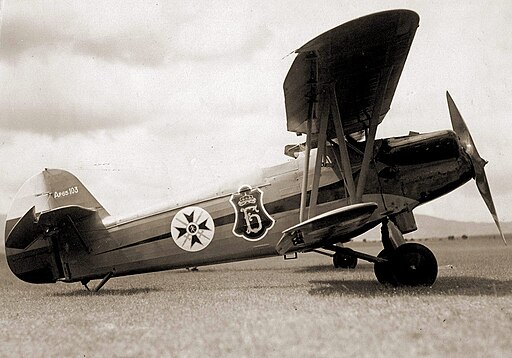
Arado Ar 65
The Arado Ar 65 represents one of the earliest purpose-built fighter biplanes of the re-emerging Luftwaffe in the early 1930s. Designed as the direct successor to the Ar 64, it blended the proven structural concepts of its predecessor with a powerful inline engine and refined aerodynamics. Entering service in 1933, the Ar 65 served both as a front-line fighter and, later, as an advanced trainer, laying groundwork for Germany’s mid-century combat aircraft.
Development History
Transition from Ar 64 to Ar 65
By 1930, Arado’s Ar 64 biplane had demonstrated solid handling but lacked high-speed capability. Engineers replaced the Jupiter radial engine with the more potent BMW VI 7.3Z V-12 inline powerplant and extended the wingspan. Early structural reinforcements ensured that the new machine could tolerate higher loads and speeds without sacrificing agility.
Prototypes and Refinements
Three prototype series—designated Ar 65a, Ar 65b and Ar 65c—underwent flight testing between 1931 and 1932. Each iteration featured incremental changes to wing stagger, fuselage decking and control-surface balancing. Lessons learned in prototype trials informed the production Ar 65D, which standardized cockpit layout, radiator positioning and structural fittings.
Design and Construction
Wing Structure and Aerodynamics
The Ar 65 employed a single-bay biplane layout with slight sweep on the upper wing and generous interplane struts. The wing spars used welded duralumin tubing covered by fabric and plywood panels. Aerodynamic balances on ailerons and elevators reduced control forces, while staggered wings enhanced pilot visibility and reduced interference drag between the wing planes.
Fuselage and Empennage
A welded tubular steel frame formed the core fuselage, skinned in fabric over wooden longerons. Engine mounts incorporated reinforced bulkheads to contain torque and vibration. The tailplane featured adjustable incidence for trim, and a broad fin-and-rudder assembly ensured directional stability during high-speed dives and coordinated maneuvers.
Powerplant and Propulsion
BMW VI 7.3Z V-12 Engine
Central to the Ar 65’s performance was the BMW VI 7.3Z liquid-cooled V-12, displacing 46.9 L. In take-off mode it delivered up to 551 kW (750 hp), dropping to a continuous 370 kW (500 hp) for cruise. Dual ignition and a full-pressure lubrication system permitted sustained high-angle climbs without oil starvation.
Cooling System and Radiators
Two streamlined radiators under the lower wing roots channeled glycol coolant, while a small chin radiator managed engine oil temperatures. Ducting modifications between the prototype and production models improved cooling efficiency at low airspeeds and during extended climb segments.
Performance Characteristics
Speed, Range and Ceiling
At 1 650 m altitude, the Ar 65 reached a maximum speed of 300 km/h. Cruise speed at 1 400 m settled at 246 km/h, enabling a combat radius near 280 km on internal fuel. Service ceiling topped out around 7 600 m, providing ample altitude margin for interception and gunnery practice.
Climb and Maneuverability
Thanks to its high power-to-weight ratio, the fighter climbed to 1 000 m in 1.5 minutes and to 5 000 m in approximately 10.6 minutes. Its roll rate and elevator authority remained crisp throughout the envelope, making it a formidable platform for low-level slashing attacks and tight defensive circles.
Armament and Equipment
Forward-Firing Guns
Standard armament consisted of two synchronized 7.92 mm MG 17 machine guns mounted atop the engine cowling. Each weapon carried 500 rounds, enabling short, high-rate-of-fire bursts against enemy aircraft.
Bomb Load Capacity
Early Ar 65D models featured an under-fuselage magazine capable of carrying six 10 kg light-bombs. Subsequent production subtypes (E and F) omitted the bomb racks to save weight and simplify logistics, reflecting a shift toward pure fighter and training roles.
Variants
Prototypes: Ar 65a, Ar 65b, Ar 65c
– Ar 65a: Original prototype with Bristol Jupiter engine license-built by Siemens. – Ar 65b/c: Inline-engine trials airframes with structural tweaks to wing stagger and cockpit coaming.
Production Series: D, E, F and G
– Ar 65D: First standardized production model equipped with BMW VI engine and light-bomb magazine. – Ar 65E: Removed bomb racks, added onboard radio and refined radiator fairings. – Ar 65F: Final Luftwaffe production version featuring modified lower-wing ailerons and enhanced engine cooling. – Ar 65G: License-built by Erla in larger numbers, serving until 1937 in both fighter and trainer roles.
Operational History
Luftwaffe Service
Upon entry into service in 1933, the Ar 65 equipped two primary Jagdgruppen before being relegated to advanced training after newer monoplanes entered the front line. Its robust airframe and predictable handling made it ideal for gunnery training and formation flying.
Export and Foreign Use
In 1937, twelve Ar 65D/E airframes were delivered to Bulgaria, where they formed the nucleus of the Royal Bulgarian Air Force’s fighter training wing. Several remained airworthy into the late 1930s before replacement by more modern types.
Technical Specifications
| Parameter | Value |
|---|---|
| Crew | 1 |
| Length | 8.40 m |
| Wingspan | 11.20 m |
| Height | 3.42 m |
| Wing area | 23.0 m² |
| Empty weight | 1 510 kg |
| Maximum takeoff weight | 1 930 kg |
| Fuel capacity | 218 L |
| Powerplant | BMW VI 7.3Z V-12, liquid-cooled |
| Maximum power (take-off) | 551 kW (750 hp) |
| Continuous power | 370 kW (500 hp) |
| Maximum speed | 300 km/h at 1 650 m altitude |
| Cruise speed | 246 km/h at 1 400 m altitude |
| Range | 560 km |
| Service ceiling | 7 600 m |
| Rate of climb | 10.6 m/s |
| Time to 1 000 m | 1.5 minutes |
| Armament | 2 × 7.92 mm MG 17 machine guns (500 rpg) |
Legacy and Impact
Although swiftly overtaken by monoplane fighters by the late 1930s, the Arado Ar 65 played a pivotal role in rebuilding Germany’s aerial combat capability. Its combination of inline-engine performance, sturdy biplane layout and versatility as both fighter and trainer provided essential pilot experience. Elements of its design—especially streamlined radiators and control-surface balances—echoed in later German fighters throughout the decade.
