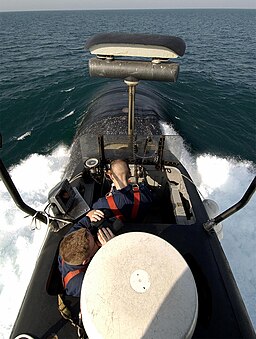
USS Toledo (SSN-769)
USS Toledo (SSN-769) is a Los Angeles-class nuclear-powered attack submarine commissioned in February 1995. As the third U.S. Navy vessel named for the city of Toledo, Ohio, she embodies the improved Flight II (688i) design, featuring enhanced acoustic quieting, a vertical launch system, and advanced sonar suites. Based at Joint Base Pearl Harbor-Hickam, Toledo operates across the Pacific and beyond, carrying out surveillance, anti-submarine warfare, intelligence gathering, and strike missions.
Design and Hull
Hull Form and Structure
The submarine’s double-hull construction combines an inner pressure hull with an outer hydrodynamic shell. Strategic framing and high-tensile steel deliver strength against undersea pressures while allowing a slender profile for reduced drag. The bow and keel areas are reinforced to withstand iceberg or debris impact during Arctic missions.
Acoustic Quieting and Stealth
Vibration-damping mounts isolate the reactor, turbines, and auxiliary machinery to minimize radiated noise. Hull coatings use anechoic tiles that absorb incoming active sonar pings. Control surfaces feature skewed propeller blades and a seven-blade screw, optimizing thrust while suppressing cavitation for stealthy operation.
Dimensions and Displacement
| Parameter | Specification |
|---|---|
| Displacement (light) | 6,000 long tons |
| Displacement (full) | 6,927 long tons |
| Length overall | 110.3 m (361 ft 11 in) |
| Beam (max) | 10.0 m (32 ft 10 in) |
| Draft | 9.4 m (30 ft 10 in) |
These dimensions support efficient submerged operations, room for a 12-cell Tomahawk vertical launch system, and accommodation for modern sonar arrays.
Propulsion Plant
Nuclear Reactor and Turbines
At the heart of Toledo lies a single S6G pressurized water reactor. It generates high-pressure steam that powers two steam turbines linked to a single shaft. Reactor refueling is not required for the submarine’s expected 30-year service life.
Performance and Endurance
- Top submerged speed exceeds 25 knots.
- Endurance is limited only by crew provisions and maintenance cycles, with reactor fuel lasting decades.
- Standard patrol duration spans up to 90 days without resupply.
Sensors and Combat Systems
Sonar Suite
Toledo integrates a bow-mounted active/passive sonar array (AN/BQQ-5) and a deployable towed linear array (AN/BQR-15). These systems deliver long-range detection of submarines, surface ships, and undersea obstacles. Advanced processing algorithms enable simultaneous tracking of multiple contacts.
Electronic Warfare and Communications
An SLQ-25 Nixie torpedo countermeasure system deploys acoustic decoys to lure hostile torpedoes away. For tactical data exchange, the submarine uses Link 11/16 and satellite comms, allowing real-time coordination with carrier strike groups and shore-based command centers.
Weapon Systems
Torpedo Armament
Four 533 mm torpedo tubes accommodate Mk 48 ADCAP heavyweight torpedoes. The fire-control system Mk 117 ensures precision launches, enabling both targeted strikes and defensive counterattacks.
Cruise Missile Capability
A 12-cell vertical launch system carries Tomahawk land-attack cruise missiles. Mission planners can load a mix of Block III and IV variants, offering sub-hundred-meter accuracy against high-value inland targets.
Countermeasures and Mine Warfare
In addition to acoustic decoys, Toledo can deploy anti-ship mines through torpedo tubes. The submarine’s rugged hull and noise-reduction measures help it penetrate hostile surveillance nets for clandestine minefield emplacement.
Crew and Habitability
Complement and Command Structure
USS Toledo operates with a core crew of 12 officers and 98 enlisted sailors. Watch rotations and cross-training ensure round-the-clock operations for propulsion, sonar, weapons, and navigation.
Living Spaces
Habitability upgrades include improved rack berths, climate-controlled staterooms for officers, and a modern galley supporting three meals a day. A small fitness area, library, and multimedia system help sustain morale during extended patrols.
Operational History
Since commissioning, Toledo has completed multiple Western Pacific deployments, participated in multinational exercises, and supported special operations forces. She took part in Freedom of Navigation operations in contested waters, demonstrating deterrence and maritime domain awareness.
Modernization and Upgrades
Under periodic Depot Modernization Period overhauls, Toledo received:
- Improved inertial navigation and GPS integration.
- Upgraded combat system processors for faster target classification.
- Enhanced data-link antennas for expanded bandwidth.
- Hull-mounted acoustic measurement enhancements to refine stealth performance.
Future modifications may include additional Tomahawk VLS upgrades and integration of next-generation sonar transducers.
Conclusion
USS Toledo (SSN-769) remains a cornerstone of U.S. undersea warfare capability. Her blend of speed, stealth, and firepower—coupled with a highly trained crew—ensures she can operate undetected in contested regions, gather critical intelligence, and deliver precision strikes when called upon. As upgrades continue, Toledo will stay at the forefront of submarine technology for decades to come.
