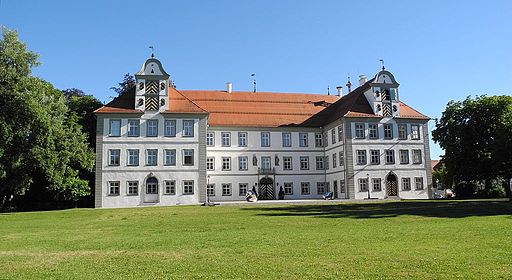
Neues Schloss Kißlegg
Neues Schloss Kißlegg rises majestically at the southern tip of an eight-hectare English-style park in the heart of Kißlegg, Upper Swabia. Commissioned by Johann Ernst II of Waldburg-Trauchburg and erected between 1721 and 1727, this three-storey Baroque palace showcases the artistic ambitions of early 18th-century Württemberg nobility. Its symmetrical façades, framed by risalits on either side, rest beneath a steeply pitched saddle roof and twin hipped roofs that anchor the building into the landscape.
Stepping inside, visitors encounter an expansive rococo staircase hall adorned with eight life-size Sibyl figures carved by Joseph Anton Feuchtmayer and illuminated by a private palace chapel at the rear. Sumptuous stucco ceilings by Johannes Schütz and Francesco Solari hover over frescoed salons designed by Johann Gabriel Roth. Every room was laid out to balance daylight, acoustics and circulation—an architectural choreography that guided guests from formal receptions to intimate family gatherings.
Today the palace serves as a cultural hub: the ground floor houses a Heimatmuseum chronicling local history, the first floor hosts concerts and municipal meetings, and the second floor regularly rotates contemporary art exhibitions. Seasonal events range from a first-Advent weekend Christmas market to open-air concerts in the landscaped gardens, ensuring the palace remains a living testament to baroque elegance and community life.
Architectural and Technical Parameters
General Layout
- Footprint: roughly 52 m (east–west) by 28 m (north–south)
- Storeys: three full levels above a raised basement
- Risalits: two projecting side wings aligned on the northern façade
- Roofs: main saddle roof with central ridge; hipped roofs atop each risalit
Structural Details
- Foundation: local limestone and sandstone footings extending 1.2 m below grade
- Load-bearing walls: 0.9 m thick masonry of brick infill and rendered exterior
- Floor structure: hand-hewn oak beams spaced at 0.6 m on-center, supporting wide-plank timber flooring
- Roof truss: half-hiped principal rafters with purlins and common rafters set at 45° pitch
Materials and Finishes
- Exterior render: lime-sand plaster tinted in pale ochre, edged with quoin-style plaster blocks
- Window frames: oak joinery with hand-blown glass panes in 19th-century restoration pattern
- Interior walls: lime plaster with oil-based coatings; later sections feature shellac-stained wood panelling
- Decorative elements: artisan-moulded stucco, local sandstone hearth surrounds, wrought-iron balustrades
Artistic Decorations
- Staircase figures: eight Sibyllen by baroque sculptor Joseph Anton Feuchtmayer
- Stucco ceilings: allegorical motifs by Johannes Schütz and Francesco Solari
- Frescoes: mythological scenes and trompe-l’oeil panels painted by Johann Gabriel Roth
- Palace chapel: vaulted barrel ceiling, simple rectangular plan, carved pulpit, and original oak pews
History and Restoration
Early Site Development
A 16th-century residence once stood on this spot until a 1704 fire leveled the timber framing. Remnants of the medieval Burg Alt-Trauchburg stones were reused in the new Baroque shell.
Baroque Rebuild (1721–1727)
Under the direction of Johann Georg Fischer from Füssen, the present three-story plastered structure rose with twin side projections, formal garden axes and an integrated chapel. The villa-style plan reflected contemporary French influences filtered through Southern German craftsmanship.
19th-Century Park Creation
Circa 1800, the surrounding grounds were reshaped into an English landscape park spanning eight hectares. Meandering paths, ornamental ponds and specimen trees created naturalistic vistas framing the white palace walls.
20th-Century Transformations
After 1941, the palace housed evacuee student hostels and later a wartime medical facility. Acquired by the municipality in 1960, it served as school premises until the late 1970s, then as a brass-band school and instrument museum through the early 1990s.
Modern Restoration
Since 1993, careful conservation has returned original plasterwork, restored the chapel roof and updated climate control for art exhibitions. Barrier-free access lifts and discreet lighting installations now enable year-round public use without compromising historic fabric.
How to Get Here
By Car
Enter Schlossstraße 8, 88353 Kißlegg into your GPS. From the A96 motorway, take exit Wangen/Kißlegg and follow B32 east for 5 km. Ample free parking is available adjacent to the palace grounds.
By Train
Board regional trains on the Ulm–Friedrichshafen line to Kißlegg station. It’s a 10-minute walk southwest along Lindenstraße and the Schlossallee path past the pond and through the park.
By Bus
Local buses from Wangen or Lindau disembark at the Rathaus stop in central Kißlegg. From there, cross Marktplatz and follow the park wall toward the palace entrance.
Visiting Today
Guided Tours
Public tours run Saturdays, Sundays and holidays at 15:00 from April through October. Private group tours can be booked year-round by calling the Gäste- und Bürgerbüro.
Opening Hours and Tickets
- April to October · Tue, Thu, Fri: 14:00–17:00 · Sun and public holidays: 13:00–17:00
- Admission · Adults € 4.00 · Youth (10–16 years) € 2.50 · Families € 9.00 · Group rate (10+ people) € 1.50 per person
Accessibility
An elevator provides barrier-free access to all public floors. Tactile guides and printed tactile maps are available on request. Restrooms and seating areas accommodate visitors with reduced mobility.
