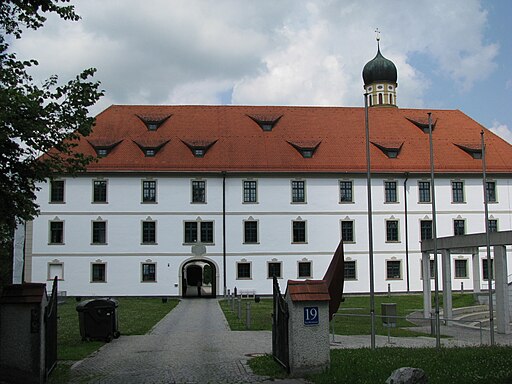
Schloss Marktoberdorf
Schloss Marktoberdorf stands as a four-winged Baroque gem at the eastern edge of Marktoberdorf, Bavarian Swabia. Erected between 1722 and 1729 under the direction of master builder Johann Georg Fischer, this former princely-bishop’s hunting lodge and summer residence reflects both ecclesiastical prestige and regional craftsmanship. Today it houses the Bavarian Music Academy and several municipal offices, while retaining its original courtyard layout, mansard roofline and ornamental façades.
Architectural and Technical Parameters
General Layout
- Four-winged plan enclosing a rectangular cour d’honneur
- Main façade length: approximately 60 m
- Wing depth: around 18 m each
- Central entrance portal accented by a segmental pediment
- Mansard roof with dormer windows across all wings
Structural Components
- Foundation: limestone rubble footings extending 1.0 m below grade
- Exterior walls: solid brick core with a 1.1 m thickness, clad in lime mortar render
- Floor heights:
- Piano nobile (first floor) – ca. 5.2 m clear height for grand reception halls
- Ground floor – ca. 4.0 m clear height for service and administrative rooms
- Second floor – ca. 3.6 m clear height for staff quarters and studios
- Roof structure: heavy oak purlins and principal rafters supporting a slate-covered mansard
Materials and Finishes
- Façade render: pale ochre lime-sand plaster with horizontal rustication lines
- Cornices and quoins: sculpted from local Allgäu limestone
- Window frames: oak joinery glazed with 18th-century reproduction glass
- Interior finishes: • Stucco ornamentation in Rococo style around doorcases and vault ribs • Sgraffito panels above principal windows depicting allegories of the four seasons • Marbleized plaster columns framing the courtyard arcade
Interior Spaces and Decorative Arts
- Grand staircase: stone treads with wrought-iron balustrade and stucco-encrusted vaulting
- Chapel wing: barrel-vaulted nave, carved pulpit and original Baroque organ case
- Saloons: vaulted chambers adorned with classical pilasters, festoon garlands and ceiling frescoes
- Underground concert hall: seating for up to 180, exposed concrete shell with adjustable acoustic panels
Historical Development
Medieval and Renaissance Origins
A 13th-century fortress once occupied this site, serving as a border stronghold between the Duchy of Bavaria and monastic territories. In the early 16th century, Prince-Bishop Heinrich von Lichtenau replaced the medieval tower house with a Late Gothic residence, later expanded around 1598 with timber framing and decorative arcades.
Baroque Rebuild in the 1720s
Prince-Bishop Alexander Sigismund commissioned Johann Georg Fischer to raze the older structure in 1722 and raise the current four-winged palace by 1729. The plan integrated a formal courtyard, chapel and symmetrical wings, unified under a mansard roof punctuated by pedimented dormers.
Secularization and 19th Century Adaptations
Following the 1803 secularization of ecclesiastical lands, the Bavarian state repurposed the palace for administrative functions. The former chapel became mock-Gothic assembly space, while the west wing housed the royal land court, and later the district surveying office.
20th Century Transformations
From 1876 to 1923 the palace accommodated a preparatory seminary. Between 1941 and 1960, wings served as student hostels and a wartime infirmary. A major fire in 1967 rendered the west and south wings vacant until a comprehensive renovation began in 1984.
Modern Restoration and Contemporary Use
A meticulous conservation campaign restored Baroque stucco, refurbished the chapel roof and upgraded mechanical systems for the palace’s new role as the Bavarian Music Academy. In 1996 the underground concert hall opened, cementing the castle’s reputation as a regional cultural center.
Cultural Significance and Events
Bavarian Music Academy and Concerts
Since 1984 the palace has been home to the Bavarian Music Academy Marktoberdorf. The ground-level rehearsal studios, historic chapel and underground hall host masterclasses, chamber music recitals and seasonal festivals in classical repertoire.
International Children’s Choir Festival
Each summer, Schloss Marktoberdorf welcomes over 200 youth choir members from around the world. Concerts take place in the Baroque grande salle and outdoors in the castle park, fostering cultural exchange and community engagement.
Museum and Exhibition Spaces
Selected rooms display a rotating exhibition on local history, ecclesiastical art and regional crafts. Portraits of former bishops, archival documents and restored furniture illustrate the palace’s layered past.
Schloss Park and Surroundings
Kurfürstenallee and Landscape Features
A two-kilometer lime tree avenue, planted in the 18th century, leads southeast from the palace to a hilltop viewpoint overlooking the Alps. The surrounding English-style park offers winding paths, ornamental ponds and specimen trees.
Underground Concert Hall
Buried beneath the east lawn, the Richard-Wengenmeier-Saale combines a 15 m ceiling height with variable acoustic reflectors. Its reinforced concrete shell ensures sound isolation while preserving the palace’s historic roofscape.
Town Center and Local Attractions
Adjacent to the castle stands the Baroque parish church of St. Martin. Marktoberdorf’s pedestrianized market square, lined with arcaded façades, hosts weekly markets and coffee houses popular with visitors.
How to Get Here
By Train
Regional trains on the Munich–Füssen line stop at Marktoberdorf station. The castle lies an 800 m walk eastward along Schlossstraße, taking about ten minutes.
By Bus
Local bus route 12 connects nearby villages Waal, Leuterschach and Ronsberg with the Schloss stop directly in front of the main gate. Timetables are available at the town’s visitor center.
By Car
From the A7 motorway exit Leuterschach/Marktoberdorf, follow the B12 toward Marktoberdorf city center. Free visitor parking is located north of the castle with a barrier-free path leading into the park.
By Bicycle and On Foot
A dedicated cycle path runs alongside the Wertach river, linking Marktoberdorf to Kaufbeuren. Pedestrians can follow a historic trail from the old town hall through half-timbered lanes, culminating at the castle forecourt.
Visitor Information
Guided Tours and Opening Hours
Guided tours operate April through October on weekends and public holidays at 11 AM and 3 PM. Year-round private group tours can be arranged via the Bavarian Music Academy office.
Accessibility and Facilities
The castle offers step-free access via an elevator installed in the west wing. Tactile guide maps, wheelchair-accessible restrooms and seating areas ensure an inclusive visit.
Tickets and Contact Details
Adult admission starts at 5 EUR, youth and senior discounts are available. Group rates and combined castle-chapel tickets can be purchased at the on-site ticket desk or online through the Marktoberdorf cultural portal.
Schloss Marktoberdorf invites you to step into layers of history, admire its technical finesse and immerse yourself in the timeless resonance of Baroque architecture and music.
