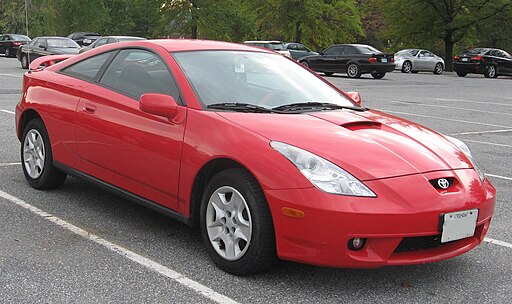
Toyota Celica faults
Engine and Drivetrain
- Excessive oil consumption and sludge buildup Owners of 1.8-litre 1ZZ-FE engines (1999–2005) often report burning a quart of oil every 500–1 000 km. Worn piston rings and poor crankcase ventilation let oil enter the combustion chamber, forming deposits that restrict oil galleries and starve the engine if left unchecked.
- Timing-belt and chain tensioner failure On high-revving 2ZZ-GE units (GT-S/ZZT230), the factory belt tensioner can lose preload, causing flutter or rattling at cold start. If the belt jumps teeth, valve-to-piston contact can result in bent valves and major engine damage. Toyota recommends replacing the belt and tensioner every 100 000 km.
- Coolant-system leaks and overheating Plastic water-pump housings and cylinder-head thermostat covers age poorly. Cracks in these components lead to slow coolant loss, overheating, warped heads and, in worst cases, blown head gaskets.
Transmission and Clutch
- Synchromesh wear in manual gearboxes High-mileage 5-speed transmissions, particularly in 7th-generation Celicas, develop crunching or grinding when selecting 2nd and 3rd gears. Worn brass synchro rings lose their ability to match gear speeds, necessitating a synchro-ring rebuild kit or full gearbox overhaul.
- Clutch slippage and pedal fade Drivers who push the Celica hard notice clutch wear by 120 000–150 000 km. A slipping clutch shows as reduced engine braking, a rising pedal, and loss of acceleration under load. Upgrading to a higher-specification clutch kit can restore performance.
- Automatic-transmission shudder Early-model 4-speed autos may shudder under light throttle or during kick-down. Worn torque-converter clutches and degraded pump seals cause this symptom. A fluid/filter change with the correct Toyota WS fluid often cures it temporarily, but a full rebuild is sometimes required.
Suspension and Steering
- Front strut-mount deterioration Rubber bearings in the MacPherson-strut tops harden and crack by 100 000 km, producing clunks over bumps and imprecise steering feedback. Replacing the strut mounts with OEM or uprated aftermarket units restores composure.
- Power-steering rack leaks Leaking seals on the rack or outer tie-rod boots let fluid escape, resulting in heavy steering effort at low speeds and whining noises. Left unrepaired, the pump can run dry and fail.
- Rear toe-arm bushing wear On T230 chassis, the rear suspension’s camber/toe arm bushings age into cracks, allowing excessive lateral movement. Symptoms include wandering on fast corners and feathered rear-tyre wear; OEM replacement bushes eliminate play.
Electrical and Electronics
- Mass-airflow and throttle-position sensor faults Dirt buildup on the MAF sensor or worn TPS units cause rough idle, hesitation on throttle tip-in, and unexpected stalling. Cleaning or swapping in a remanufactured sensor often cures drivability complaints.
- Instrument-cluster dimming and bulb failure Older Celicas (T180/T200) suffer from corroded PCB traces and expired gauge-lighting bulbs. Owners report blank fuel/fan gauges or warning lights that don’t illuminate. Reflowing solder joints and fitting LED dash bulbs resolves the issue.
- Coil-pack and spark-plug misfires Coil-on-plug units on the 2ZZ-GE and later VVT-i engines degrade by 120 000 km, triggering random misfire codes (P0301–P0304). Replacement with OEM or high-output coils and fresh iridium plugs restores smooth power.
Bodywork and Interior
- Corrosion on sills and wheel arches Sixth-generation Celicas (T200) lack robust under-seal in critical areas, leading to surface rust on wheel arches, door bottoms and scuttle panels. Early treatment with rust converter and undercoating prevents spread.
- Soft-top leaks and sunroof drain blockages Convertible Celicas develop cracked rubber seals on the folding top, admitting water into the cabin. Non-draining sunroof channels likewise overflow into footwells. Replacing seals and clearing drains cures damp-carpet issues.
- Dashboard cracking and glare UV exposure warps and cracks the T160/T180 dash skins, creating reflective patches and fuzzy plastic edges. Many owners fit bespoke dash covers or dye-coated trims to hide cracks and reduce glare.
Generation-Specific Issues
Fifth Generation (T160; 1985–1989)
- Pop-up headlamp actuator wear leading to non-deploying lights
- Fuel-sender corrosion in the tank causing erratic gauge readings
Sixth Generation (T200; 1993–1999)
- ABS-pump valve corrosion producing pulsating brake pedal
- 1ZZ-FE oil-sludge lawsuits and extended warranty recalls
Seventh Generation (T230; 1999–2006)
- 2ZZ-GE timing-chain guide failure and tensioner wear
- Coil-pack failures at high RPMs, especially in track-used cars
Toyota Celica as a used car
The Toyota Celica remains one of the most engaging sport coupes to enter the used-car market. Renowned for its balanced handling, reliable four-cylinder engines and distinctive styling across seven generations, the Celica offers a slice of driving excitement without exotic maintenance bills. Its appeal spans from early rear-wheel-drive classics to front-wheel-drive modern iterations, making it a versatile choice for collectors and daily drivers alike.
Generations and Body Styles
Early Eras: First to Third Generations (1970–1985)
These inaugural Celicas set the template for a lightweight, rear-wheel-drive coupe powered by 1.6- to 2.0-litre engines. Styling cues like pop-up headlights and long hoods defined a pure grand-tourer ethos. Most cars of this vintage carry simple leaf-spring rear suspension and carburettor or early electronic fuel injection, keeping servicing straightforward but parts slightly harder to source today.
Mid-Era: Fourth to Sixth Generations (1985–1999)
In 1985, Toyota switched to front-wheel drive, rotating through liftback, coupe and convertible variants. Engines ranged from 1.6-litre fuel-injected units to the daring 2.0-litre turbocharged 4WD GT-Four in the sixth generation. Aerodynamic bodywork, optional T-Bar roofs and early variable valve timing delivered better economy and sharper throttle response than before.
Modern Classic: Seventh Generation (1999–2006)
The final Celica, chassis code T230, blended aggressive wedge styling with two 1.8-litre engines: a 143 hp VVT-i base and a 192 hp VVTL-i T-Sport. Buyers could choose slick six-speed manuals or refined four-speed automatics. Thanks to a fully independent double-wishbone rear end, T230 models strike a rare balance between comfort and cornering poise in their segment.
Technical Specifications
Engine and Performance
• 1.6 L 16-valve I4 (86–116 hp) • 1.8 L VVTL-i I4 (143–192 hp) • 2.0 L Turbo I4 4WD (208–242 hp) on GT-Four • Peak torque spans 140–270 Nm depending on engine and induction • Redline varies from 6 000 rpm on base engines to 8 000 rpm on VVTL-i T-Sport
Drivetrain and Transmission
• Rear-wheel drive: Generations I–III • Front-wheel drive: Generations IV–VII • All-wheel drive on select fourth and sixth-gen turbo models • Transmission choices:
- 5-speed manual (early cars)
- 6-speed manual (VVTL-i T-Sport)
- 4-speed automatic (widely available)
- 5-speed automatic (late sixth-gen GT-Four)
Dimensions and Weight
| Gen | Years | Length (mm) | Width (mm) | Height (mm) | Curb Weight (kg) |
|---|---|---|---|---|---|
| I–III | 1970–1985 | 4 290–4 330 | 1 580–1 620 | 1 290–1 320 | 900–1 050 |
| IV–VI | 1985–1999 | 4 380–4 496 | 1 690–1 750 | 1 290–1 305 | 1 100–1 300 |
| VII | 1999–2006 | 4 335 | 1 735 | 1 320 | 1 210–1 240 |
Fuel Consumption
• Base 1.8 L VVT-i: 7.0–7.5 L/100 km (combined) • VVTL-i T-Sport: 7.5–8.5 L/100 km • Turbo 4WD GT-Four: 9.0–10.5 L/100 km • Real-world highway cruising often yields 10–15 % better economy than factory figures
Reliability and Ownership Costs
Toyota’s legendary build quality makes most Celicas durable beyond 200 000 km with routine oil, belt and wear-item changes. Early fuel-injection components and slave-cylinder failures on manual cars are common service items. Full timing-belt services every 100 000 km, along with cooling-system checks, help prevent head-gasket issues. Parts for most generations remain affordable and plentiful through specialty suppliers and salvage yards.
Buying Guide for a Used Celica
Trim Levels and Features
• Base Models: Basic cloth interiors, steel wheels, manual windows • Mid-Range: Alloy wheels, power accessories, air conditioning, sport suspension • Top-Spec (GT-Four / T-Sport): Limited-slip differential, performance brakes, leather or suede seats, high-revving VVTL-i engines
Inspection Checklist
- Confirm timing-belt history and water-pump replacement
- Inspect rear wishbones and strut top mounts for wear
- Check for oil leaks around valve covers and chain-area gaskets
- Test ABS operation and look for wheel-arch corrosion on older cars
- Verify all accessories (sunroof drains, power steering, HVAC) function correctly
Price Range and Depreciation
• Early (1970s–’80s) models: €5 000–€15 000, depending on condition and originality • Fourth–sixth gen commuter coupes: €3 000–€8 000 • Seventh gen T230: €4 000–€12 000, with high-spec T-Sport in the top bracket • GT-Fours and rare cabriolets command premium values and hold best against depreciation
Aftermarket Support and Enthusiast Community
A global network of Celica owners’ clubs, online forums and specialty tuners offers restoration panels, performance upgrades and chronographs for dyno-tuning the VVTL-i head. Popular modifications include coilover suspension kits, big-brake kits, intake-manifold porting and ECU remaps on turbo models. Track-day livery kits and concours-level restoration parts ensure every Celica can be tailored to its next owner’s vision.
Conclusion
As a used-car purchase, the Toyota Celica combines affordability, reliability and driving charisma in a package few sport coupes can match. Whether you seek the pop-up-headlight nostalgia of an early model, the AWD punch of a GT-Four or the high-rev exhilaration of a T-Sport, the Celica delivers a rewarding ownership experience.
