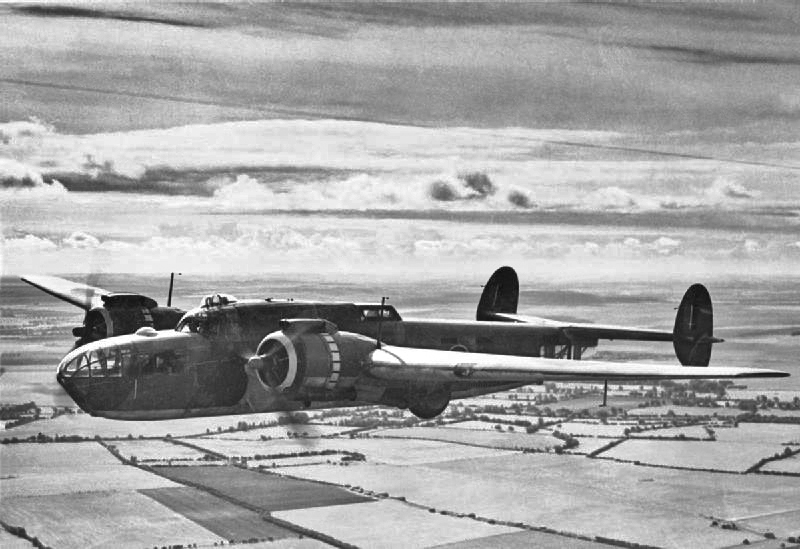
Armstrong Whitworth Albemarle
The Armstrong Whitworth Albemarle was a twin-engine transport and glider-tug aircraft that entered Royal Air Force service in early 1943. Originally conceived under Air Ministry Specification B.9/38 as a wooden-and-metal medium bomber without light alloys, it was extensively redesigned mid-development into a utility platform. Over 600 examples were built between 1941 and 1944, with production handled primarily by A.W. Hawksley Ltd. The Albemarle went on to support paratroop drops, glider towing, and general transport duties throughout the latter half of the Second World War.
Design and Development
Origins under Specification B.9/38
In 1938 the Air Ministry sought a twin-engine bomber that could be manufactured by non-specialist firms using wood and steel without reliance on scarce light alloys. Bristol initiated a reconnaissance-bomber design that failed to meet performance targets and was transferred to Armstrong Whitworth for redevelopment. Under this directive, Armstrong Whitworth reworked the airframe to satisfy both structural and aerodynamic requirements of the specification. The prototype first flew on 20 March 1940, validating the basic design concept before major role changes were imposed.
Transition from Bomber to Transport Roles
Early flight trials revealed that the Albemarle lacked the speed and defensive armament to compete with existing medium bombers such as the Wellington. With frontline planners favoring established types, production orders pivoted toward transport, glider-tug, and reconnaissance variants. Modifications included removal of bomb bays in favor of cargo space, installation of reinforced hooks and tow gear for gliders, and fitting a single manually operated dorsal turret for self-defense. These changes delayed frontline deliveries until January 1943 but ultimately aligned the aircraft with pressing operational needs.
Technical Specifications
Airframe and Dimensions
The Albemarle featured a mid-wing monoplane layout with mixed wood-and-metal construction. It measured 17.09 meters in length, spanned 26.02 meters, and stood 4.60 meters tall. Wing area totaled 72.5 square meters and the airframe’s robust landing gear comprised the first British-built tricycle undercarriage in production service. Empty weight hovered around 7,260 kilograms while maximum takeoff weight reached approximately 12,700 kilograms.
Powerplant and Performance
Power came from two Bristol Hercules XI fourteen-cylinder radial engines, each rated at 1,590 horsepower. This powerplant combination enabled a maximum speed of about 415 kilometers per hour and a cruising speed near 315 kilometers per hour. Service ceiling was 7,620 meters and operational range extended to roughly 1,760 kilometers with a full fuel load. Rate of climb and high-altitude performance were adequate for glider-towing and light transport missions but fell short of bomber benchmarks.
Payload and Equipment
Cargo and passenger loads were accommodated within a reconfigured fuselage bay capable of carrying up to 24 fully equipped troops or several jeeps and light supplies. Underwing hard points could support auxiliary fuel tanks or light ordnance for special operations. The dorsal gun position typically mounted two or four 7.7 mm machine guns. Radio and navigation gear were upgraded for night-and-all-weather duties in airborne assault roles.
Operational History
Royal Air Force Service
No. 295 Squadron at RAF Harwell became the first operational unit to receive Albemarles in January 1943. The type was rapidly adopted by airborne forces for paratroop drops, notably during the Sicily invasion in July 1943, and later during the Normandy campaign in June 1944. Albemarles towed Horsa and Hamilcar gliders into landing zones, enabling the delivery of troops and light armor behind enemy lines. The aircraft’s sturdy construction and versatile payload made it invaluable in Operation Market Garden at Arnhem, despite its modest defensive capabilities.
Soviet Order and Cancellation
In October 1942 the Soviet Air Force placed an order for 200 Albemarles to bolster its transport fleet. Only a handful were delivered before the Soviets suspended and eventually canceled the contract in May 1943 in favor of American C-47 Skytrains under Lend-Lease. This decision reflected the Albemarle’s comparatively limited payload and range for sustained Eastern Front operations. Surviving RAF examples continued service through early 1946, when the type was finally retired.
Variants
Mk I
The Mk I was the initial production variant configured primarily for towing gliders and general transport duties. It retained the dorsal turret and standard cargo bay arrangement, with minor structural reinforcements for towing operations. Approximately 350 Mk I airframes were completed before production shifted to the Mk II series.
Mk II and Later Production
The Mk II introduced aerodynamic refinements, strengthened tow fixtures, and revised crew accommodations for improved endurance on long-range missions. Some later machines featured additional fuel tanks in the wings and upgraded radio suites for special operations. Total production across all variants reached 602 aircraft by late 1944.
Legacy and Conclusion
Although the Albemarle never fulfilled its original bomber role, it became a workhorse of Allied airborne operations. Its pioneering tricycle undercarriage influenced subsequent British designs, and its service in pivotal amphibious and airborne missions underlined the strategic value of multipurpose transports. Today, the Albemarle stands as a testament to wartime adaptability and the importance of versatile support aircraft in combined operations. Enthusiasts and historians continue to study its development as an example of mid-war design evolution driven by urgent operational demands.
