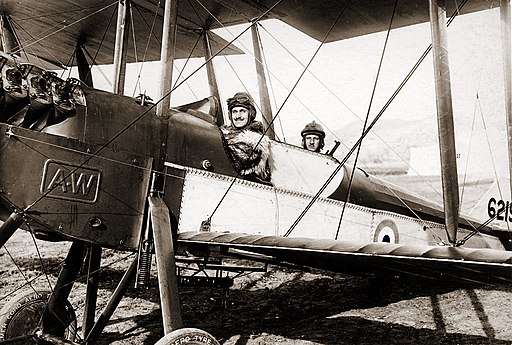
Armstrong Whitworth F.K.3
The Armstrong Whitworth F.K.3 was a British two-seat general-purpose biplane introduced during the First World War. Designed by Frederick Koolhoven and built by Armstrong Whitworth, it aimed to improve upon the stability and structural simplicity of the Royal Aircraft Factory B.E.2c. Entering production in 1915, the F.K.3 served in reconnaissance, light bombing, and training roles. Its straightforward construction and balanced handling earned it limited operational deployment, primarily on secondary fronts. The type laid the groundwork for later Armstrong Whitworth designs that emphasized ease of manufacture and maintenance.
Design and Development
Origins and Objectives
Early in 1915, Armstrong Whitworth sought to replace the complex B.E.2c with a more robust and easier-to-build aircraft. Frederick Koolhoven reversed the crew positions to place the pilot in front and the observer behind, enhancing the observer’s field of fire. The fuselage structure eliminated welded joints in favor of a simple steel-tube and wooden frame covered in fabric. Emphasis was placed on reliable operation in front-line and second-line theatres alike.
Prototype Evolution
Initial trials of the F.K.2 prototype revealed underpowered performance and marginal stability at higher speeds. Engineers extended the fuselage, revised the tail assembly, and added swept-back wings balanced by horn-trimmed control surfaces. The RAF 1a V-8 engine was standardized, delivering consistent power and ease of maintenance. By mid-1916, these refinements matured into the production F.K.3.
Structure and Aerodynamics
Fuselage and Wings
The F.K.3 featured a rectangular cross-section fuselage built from steel tubing and imbricated wooden longerons. Fabric covering kept weight low while enabling rapid repairs. Wings were single-bay biplane panels of unequal span, with the upper wing slightly swept to improve stall characteristics. Automatic leading-edge slats were omitted in favor of simple wing rib fairings that smoothed airflow.
Control Surfaces
Balanced ailerons on the upper wing reduced control forces at low speeds. The rudder and elevators incorporated horn-trim tabs to lessen pilot workload during prolonged patrols. Cable-and-pully linkage provided predictable responses, crucial for inexperienced observers operating the rear Lewis gun. Dive or steep-angle bombing used modest aerodynamic dive-brakes mounted under the lower wing.
Powerplant and Performance
RAF 1a Engine
Power was supplied by a single RAF 1a eight-cylinder V-8 liquid-cooled engine rated at 90 horsepower. The choice of the RAF 1a emphasized simplicity and parts commonality with other RAF types. A fixed-pitch wooden propeller married the engine’s torque to efficient thrust in the F.K.3’s speed regime. Cooling retained the radiator in the upper wing centre section.
Flight Characteristics
Top speed reached 140 km/h at sea level, dropping slightly at altitude. Climb performance was modest, taking 19 minutes to reach 1 524 m. The ceiling topped out near 3 660 m, sufficient for reconnaissance against lightly defended targets. Endurance averaged around three hours on internal fuel, enabling extended coastal patrols or liaison flights.
Armament and Equipment
Primary Armament
Defensive armament consisted of a single 7.7 mm Lewis machine gun on a Scarff ring in the observer’s cockpit. The forward cockpit was unarmed, allowing the pilot to focus on navigation and engine management. Ammunition boxes were stowed behind the observer’s seat, with flexible feed chutes simplifying reloading in flight.
Bombing Capability
When operating without an observer, the F.K.3 could carry up to 90 kg of light bombs under the lower wings. Bomb racks accommodated small fragmentation or incendiary bombs for tactical strikes. A simple Clinometer-type bombsight in the forward cockpit guided shallow-angle attacks, but precision bombing remained challenging.
Operational Use
Royal Flying Corps Deployment
No. 47 Squadron was the primary unit to receive the F.K.3 in late 1916, deploying to Macedonia for patrols over Salonika. The type proved reliable in hot, dusty conditions where more complex aircraft suffered frequent failures. Pilots valued its forgiving stall behaviour during low-speed reconnaissance and artillery-spotting missions.
Balkans Service
On the Salonika front, F.K.3s flew night patrols against Austro-Hungarian observation balloons and battery positions. Their endurance and stability made them well suited to low-altitude loitering. Although they never operated in large numbers, F.K.3s contributed to maintaining Allied air presence in a secondary theatre.
Variants
F.K.2 Prototype
The F.K.2 was the initial seven-aircraft prototype series powered by the RAF 1a engine. It retained straight wings and a short fuselage, revealing shortcomings in performance and handling. Flight tests guided the development of the definitive F.K.3.
Standard F.K.3 Production
Production F.K.3s featured an extended fuselage, revised tailplanes, and swept upper wings. Armstrong Whitworth built approximately 150, with Hewlett & Blondeau constructing another 350. Only a fraction saw combat, the remainder serving in training units.
Engine Adaptations
A small batch of F.K.3s was fitted with the RAF 1Ba engine, boosting output to 105 horsepower. A dozen airframes later experimented with the 120 hp Beardmore inline engine during engine shortages. These modifications improved climb rate but added weight forward, affecting handling.
Technical Specifications
| Parameter | Specification |
|---|---|
| Crew | 2 |
| Length | 8.84 m |
| Wingspan | 12.19 m |
| Height | 3.63 m |
| Wing area | 41.1 m² |
| Empty weight | 629 kg |
| Loaded weight | 983 kg |
| Powerplant | 1× RAF 1a V-8 liquid-cooled; 90 hp |
| Maximum speed | 140 km/h at sea level |
| Service ceiling | 3 660 m |
| Climb to 1 524 m | 19 min |
| Endurance | 3 h |
| Armament | 1× 7.7 mm Lewis gun; up to 90 kg bombs |
Legacy
The Armstrong Whitworth F.K.3 demonstrated how simplified construction and judicious design changes could yield a capable two-seat platform for varied roles. Its service on the Macedonian front underscored the value of reliability over cutting-edge performance in secondary theatres. Lessons from the F.K.3’s development informed later aircraft such as the F.K.8, which carried greater bomb loads and defensive armament. Today the F.K.3 stands as an early example of iterative wartime design focused on manufacturability and operational economy.
