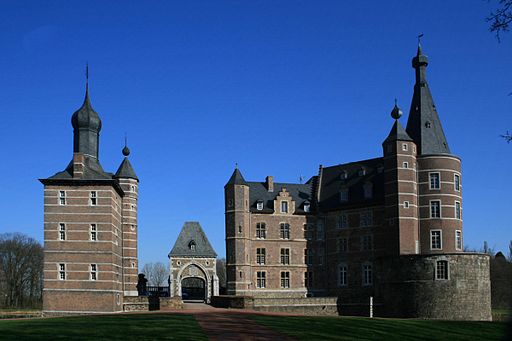
Schloss Merode
Perched on a gentle rise in the Rur valley near the town of Merode, Schloss Merode stands as a living chronicle of over seven centuries of Rhineland heritage. Surrounded by a protective moat and set within sweeping parkland, the castle complex unfolds through successive architectural styles, a testament to the evolving tastes and fortunes of the Merode family. Today, its well-preserved walls, interiors and gardens offer visitors an immersive encounter with medieval defense systems, Baroque splendour and modern conservation.
Historical Evolution
Medieval Origins and Early Fortress
The origins of Schloss Merode trace back to the early 12th century, when the local noble house established a fortified manor on a strategic bend of the Rur River. The initial structure consisted of a timber-framed hall and earth-lined ramparts, later replaced by a quadrangular stone keep and curtain walls. Its river-crossing location enabled the lords to levy tolls and control regional trade routes linking Aachen to Liège.
Renaissance Transformation under the Merode Line
In the late 15th century, the family commissioned a rebuild in the Renaissance style, replacing austere battlements with mullioned windows and embellished gables. Skilled masons from the Cologne school carved coats of arms above the entrance portal, while an inner courtyard took shape, flanked by arcaded walkways and topped with steeply pitched roofs. This era introduced the first painted ceilings and decorative plasterwork inside the great chambers.
Baroque Refinement in the 17th Century
The Thirty Years’ War left Merode with battered ramparts and depopulated lands. A mid-17th-century restoration under Count Johann Wilhelm of Merode embraced Baroque ideals: symmetrical facades, a grand staircase tower crowned by an onion dome and formal parterres in the garden. Italian stucco masters adorned reception rooms with allegorical reliefs, while a new chapel wing received painted altarpieces and gilded pews.
19th- and 20th-Century Preservation Efforts
Industrialisation in nearby coalfields threatened many Rhineland estates, but the Merode family’s careful stewardship ensured the castle remained intact. Late-19th-century romantic restorations re-criated Gothic details lost over time, while early 20th-century conservationists introduced steel-reinforced beams and weather-resistant roofing. Post-World War II repairs focused on structural stability and reopened the estate to public tours by the 1960s.
Architectural Highlights
The Moat and Gatehouse
A broad water-filled trench encircles Schloss Merode, originally fed by diverted Rur water channels. The surviving gatehouse features a drawbridge mechanism restored to working order, while dual portcullis grooves in the entry arch recall its once-formidable defenses. Flanking guardrooms contain interpretive displays of medieval weaponry and siege engines.
The Keep and Residential Wings
The central keep rises four storeys above the moat, its lower walls nearly two metres thick. Narrow embrasures permitted crossbow fire, while a spiral stairwell ascends to the former lord’s solar. Attached residential wings showcase successive architectural layers: a Renaissance loggia on one side and a Baroque bow window on the other.
Chapel and Family Vault
Linked by a covered gallery, the private chapel exemplifies 17th-century devotion. Polished marble floors, carved oak choir stalls and a miniature pipe organ create an intimate worship space. Beneath the altar, the family crypt houses intricately carved sarcophagi bearing Merode heraldry, accessible via a concealed trapdoor.
Restoration and Conservation Techniques
Recent conservation campaigns have employed laser scanning to map structural deformations, while custom-cast lead roof tiles replicate historic profiles. Lime mortar mixes matched to original samples prevent wall damage, and a gentler cleaning process using dry ice has revived centuries-old stone carvings without aggressive abrasives.
The Interiors and Collections
Great Hall and Tapestries
The castle’s original banquet hall retains a soaring timber roof supported by chamfered beams. Enormous Flemish tapestries woven around 1600 depict mythological scenes with vivid colours that resist fading. Long oaken tables and benches evoke communal feasts, while iron chandeliers dangle overhead.
Library and Archives
A narrow stone-vaulted chamber houses a collection of leather-bound volumes dating from the 16th to 19th centuries. Handwritten charters, family diaries and maps of the Rur valley line oak shelves. Researchers can request access to guided archive visits, learning how the Merode family documented land holdings and political alliances.
Portrait Gallery and Family Heirlooms
An adjoining corridor displays painted portraits of ancestors in ancestral costume. Elaborate frames hold oil paintings of knights, barons and counts wielding swords and sceptres. Cases beside the canvas walls contain ceremonial swords, silver reliquaries and a 17th-century sedan chair once carried through Cologne’s guild processions.
Exhibited Period Furniture
The castle’s sitting rooms present authentic 18th-century walnut cabinets, inlaid desks and high-backed chairs upholstered in silk damask. Curved-legged sofa sets and gilt mirrors reflect the salon culture that flourished under Countess Maria Clara von Merode. Carpets knotted in Brussels spread beneath ornate tea tables in delicate floral patterns.
Gardens and Parkland
Baroque Garden Layout
Radiating from the chapel gallery, formal parterres defined by clipped yew hedges create a star-shaped design. Gravel walkways intersect at marble fountains crowned by putto statues. Boxwood knots outline flower beds that once featured tulips, hyacinths and scented roses introduced from Dutch nurseries.
English Landscape Park
Beyond the formal gardens, a 19th-century English parkland unfolds with rolling lawns, meandering streams and specimen trees. An arboretum planted under the direction of Count Stephan von Merode includes giant sequoias, ginkgo specimens and rare oaks imported from America. Winding footpaths lead to vantage points overlooking the castle silhouette.
Rare Plantings and Arboretum
A greenhouse near the stables shelters subtropical plants: citrus trees, bougainvillea and camellias that bloom from winter through spring. Botanists catalogue each species, offering guided tours focused on manor-house horticulture and botanical exchanges between European estates.
Seasonal Highlights
Spring sees the garden awash in tulip carpets and lilac blossoms, while summer brings hydrangeas, asters and roses to peak bloom. Autumn transforms the park into a tapestry of crimson and gold, and winter illuminations during December invite twilight walks amid candlelit paths.
Cultural Events and Activities
Annual Renaissance Faire
Each June, the castle grounds host a Renaissance fair with costumed artisans, archery demonstrations and period-music ensembles. Stallholders offer hand-forged ironwork, leather goods and tapestry-style textiles, while actors recreate jousts and theatrical pageants on the moat’s grassy banks.
Chamber Music Concerts
Starting in July, a summer concert series fills the chapel with baroque ensembles and string quartets. Candlelit seats face a portable baroque organ, and audience members sip local Ahr Valley Riesling from crystal stemware during intermissions.
Educational Workshops and Guided Tours
The estate school partners with local universities to host conservation workshops, covering stone masonry, archival preservation and eco-friendly gardening. Daily guided tours trace the castle’s timeline, with specialist tours available for families and photography groups.
Culinary Festivals and Local Partnerships
In autumn, Schloss Merode collaborates with regional food producers for a harvest festival highlighting artisanal cheeses, heirloom apples and wild game dishes. Wine merchants set up tasting booths along the drawbridge approach, connecting castle hospitality with Rhineland viticulture.
Surrounding Region and Nearby Attractions
The Eifel and Zülpich Lake
A short drive west leads to the Eifel’s volcanic landscapes and the sandy shores of Zülpich Lake. Hiking and cycling trails wind through crater lakes, pine forests and volcanic cones, offering panoramic views back toward Schloss Merode’s towers.
Local Villages and Artisan Studios
Historic villages such as Nideggen and Burg Heimbach lie within easy reach. Pottery studios, glassblowers and weaving workshops open their doors to visitors, showcasing crafts that have shaped the Rur valley’s cultural identity for centuries.
Cycling Routes and Hiking Trails
Well-marked cycling routes follow former railway embankments and river paths. The RurUfer cycle path offers a 75-kilometre loop from Merode to Heimbach, with rest stops at floodplain meadows and Roman ruins. Hiking trails climb the rolling hills, passing hidden chapels and panoramic stone outlooks.
Practical Visitor Information
Getting There by Car and Public Transport
Schloss Merode is located off the B399, about 20 kilometres south of Düren. Ample parking lines the approach road. Regional trains stop at Düren station, where a connecting bus or taxi ride of 15 minutes reaches the castle entrance.
Opening Hours and Ticketing
The castle welcomes guests from April through October, Tuesday to Sunday, with extended summer openings until dusk. General admission includes a self-guided audio tour. Specialized guided tours and garden-only tickets are available online or at the ticket office.
On-Site Amenities and Accessibility
A café in the former carriage house offers refreshments and light regional dishes. Restrooms and a small gift shop occupy the renovated stables. While the ground-floor rooms and gardens are wheelchair-accessible, the keep’s upper levels require stair access; staff assist guests upon request.
Accommodation Options in Merode and Surroundings
Nearby pension houses and guesthouses in the villages of Golzheim and Heimbach provide country-style rooms. A historic manor converted into a boutique hotel lies five kilometres away, combining modern comforts with period furnishings.
Tips for Photographers and Architecture Enthusiasts
Soft morning light drapes the moat reflections in muted pastels, while sunset backlighting accentuates crenellations. A telephoto lens captures ornamental details on the chapel dome, and wide-angle shots highlight the juxtaposition of Gothic, Renaissance and Baroque elements.
Conclusion: Embracing the Heritage of Schloss Merode
Schloss Merode weaves together centuries of noble ambition, artistic endeavour and landscape design into a cohesive tapestry. From its medieval bulwarks to its sculpted gardens and vibrant cultural calendar, the estate invites every visitor to step into history. Whether exploring hidden corridors, savouring local vintages or meandering through shaded arboretums, the castle promises a deeply personal encounter with Rhineland tradition and timeless architectural beauty.
.jpg)