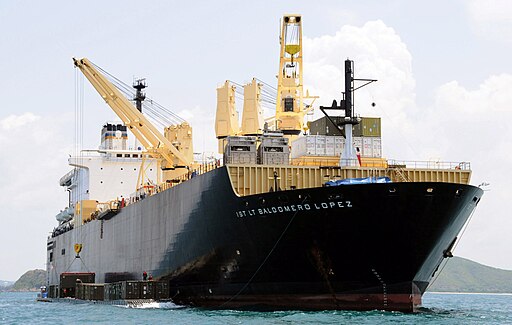
USNS 1st Lt. Baldomero Lopez (T-AK-3010)
USNS 1st Lt. Baldomero Lopez is a dry cargo ship of the 2nd Lt. John P. Bobo class, serving under Military Sealift Command as a prepositioning vessel. She functions as a floating warehouse, positioned near strategic regions to deliver vehicles, fuel, water, and supplies rapidly to forward-deployed forces. Her robust cargo capacity, durable steel hull, and automated systems enable sustained operations without shore infrastructure.
Namesake and Role
Namesake
The ship honors First Lieutenant Baldomero Lopez, a U.S. Marine awarded the Medal of Honor for heroic actions during the Korean War. His legacy of valor and sacrifice embodies the vessel’s mission to support combat readiness and humanitarian relief in austere environments.
Prepositioning Mission
Assigned to Maritime Prepositioning Ship Squadron 2, Baldomero Lopez operates out of Diego Garcia in the Indian Ocean. Her purpose is to maintain stocks of equipment and supplies near potential theaters, ensuring rapid offload and distribution during crisis response or major combat operations.
Construction and Acquisition
Shipyard and Keel Laying
Construction began in March 1984 at the Fore River Shipyard in Quincy, Massachusetts. Modular block assembly techniques allowed hull sections, machinery zones, and accommodation units to be built simultaneously, accelerating the build schedule.
Delivery and Service Entry
Launched in October 1985 and delivered to the Maritime Administration that November, she initially operated under charter by American Overseas Marine. In January 2006 Military Sealift Command formally acquired her, reclassifying the ship as T-AK 3010 and integrating her into the Navy’s prepositioning fleet.
Hull Design and Dimensions
Hull Form and Structure
Her monohull steel construction emphasizes strength and damage tolerance. A flared bow and transom stern improve seakeeping at speed, while the contiguous outer hull houses ballast tanks for precise trim and stability control during loading and discharge.
Dimensions and Displacement
At full load Baldomero Lopez displaces 44,330 metric tons. She measures 204.98 meters in length, 32.31 meters in beam, and 8.97 meters in draft. Light displacement is approximately 19,600 metric tons, allowing deep load carriage of vehicles and bulk supplies.
Propulsion and Maneuvering
Main Propulsion Plant
Propulsion derives from two Werkspoor 16TM410 medium-speed diesel engines producing a combined 27,000 horsepower. Power is transmitted through a single fixed shaft and a large fixed-pitch propeller, providing reliable transit up to 18 knots.
Auxiliary Systems
A 1,000-horsepower bow thruster supports slow-speed maneuvers in constrained harbors. Three diesel-driven generators supply hotel power and cargo system hydraulics, ensuring uninterrupted offload capability even with main engines offline.
Performance
Her service speed of 18 knots enables timely repositioning between operating areas. Endurance exceeds several thousand nautical miles at cruising speed, limited primarily by fuel stores and scheduled maintenance intervals.
Cargo Capacity and Handling Systems
Vehicle and Container Spaces
The Ro-Ro deck offers 162,500 square feet of carriage space for tanks, armored vehicles, and palletized loads. Container stowage reaches up to 522 TEU in cell guides and on deck, maximizing flexibility for different cargo mixes.
Petroleum and Water Stowage
Dedicated tanks accommodate 1,605,000 gallons of petroleum products and 81,700 gallons of potable water. These stowage volumes support embarked units during initial surge operations ashore.
Cargo Handling Equipment
Three deck cranes—one rated at 35 tons and two at 18 tons—enable independent loading and discharge without shore-based gear. A causeway stowage area and small boat davits facilitate rapid transfer of modular platforms and amphibious connectors.
Aviation and Embarked Facilities
A reinforced flight deck supports heavy helicopters such as the CH-53E Sea Stallion for vertical replenishment. The helipad is equipped with approach lighting, securing points, and fuel hydrant connections to sustain embarked aviation operations.
Sensor and Communications Suite
Navigation and Radar
Multi-band radars provide surface search and navigation guidance in both coastal and open-ocean environments. Integrated GPS antennas feed precise positioning data directly to bridge consoles.
Communications and Data Links
Satellite terminals support global voice and data exchange, while Link-11 and Link-16 interfaces enable tactical networking with allied forces. Internal Ethernet networks monitor cargo system statuses and machinery performance.
Integrated Monitoring Systems
Onboard automation tracks container weights, tank levels, and crane stresses in real time. Centralized alarming and diagnostics accelerate fault isolation, reducing downtime during critical offload periods.
Crew and Habitability
Ship’s Company
A core civilian mariner complement of approximately 55 personnel operates propulsion, navigation, and cargo functions. Their professional seafaring expertise maintains vessel readiness on extended deployments.
Specialist Embarkations
Mission-specific teams—up to ten technicians in roles such as maintenance, IT, and logistics—embark to support loading sequences and shore-side distribution. These specialists integrate seamlessly with the ship’s command and control structure.
Living Spaces
Berthing compartments feature two- to four-person cabins, and dedicated offices for senior leadership. Common areas include a self-service mess, recreation lounge with multimedia capability, and a gym, ensuring morale and welfare needs are met.
Operational Employment
In major exercises and real-world contingencies, Baldomero Lopez has offloaded combat gear, vehicles, and sustainment stockpiles to support joint and coalition forces. Her rapid discharge capability has proven critical during amphibious operations, disaster relief efforts, and large-scale logistics drills.
Technical Specifications
| Parameter | Specification |
|---|---|
| Class & Type | 2nd Lt. John P. Bobo-class dry cargo ship |
| Displacement (light/full) | 19,600 t / 44,330 t |
| Length | 204.98 m |
| Beam | 32.31 m |
| Draft | 8.97 m |
| Propulsion | 2 × Werkspoor 16TM410 diesels; 27,000 hp combined |
| Shaft & Propeller | 1 × fixed shaft; fixed-pitch propeller |
| Bow Thruster | 1,000 hp |
| Speed | 18 knots |
| Range & Endurance | several thousand nm; limited by fuel and stores |
| Vehicle Deck Area | 162,500 ft² |
| Container Capacity | up to 522 TEU |
| Fuel & Water Capacity | 1,605,000 gal fuel; 81,700 gal water |
| Cargo Cranes | 1 × 35 t; 2 × 18 t |
| Helicopter Facilities | Heavy-lift helipad; aviation fuel hydrants |
| Crew Complement | ~55 civilian mariners; up to 10 specialists |
| Homeport | Diego Garcia, British Indian Ocean Territory |
.jpg)