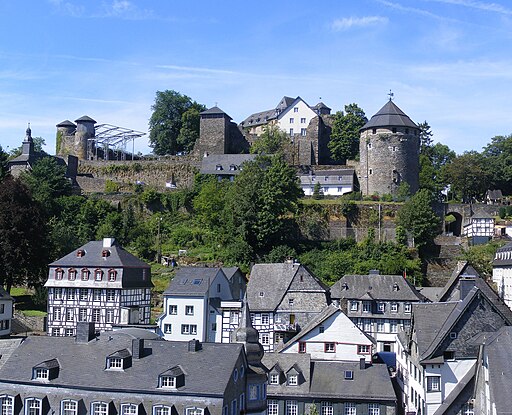
Monschau Castle: A Fortified Legacy in the Eifel Region
Monschau Castle (German: Burg Monschau) stands as a testament to medieval fortification engineering and regional power dynamics in the Eifel region of western Germany. Perched above the picturesque town of Monschau in North Rhine-Westphalia, the castle has evolved from a strategic military bastion into a cultural landmark. This article explores its architectural parameters, historical significance, and structural adaptations through the centuries.
Historical Overview
Origins and Strategic Importance
Constructed in the early 13th century, Monschau Castle was commissioned by the Dukes of Limburg to secure their territorial interests near the Belgian border. Its location atop a rocky hill provided natural defense and surveillance over the Rur River valley, a vital trade and military corridor.
Transition of Ownership
Throughout the Middle Ages, the castle changed hands multiple times, reflecting the shifting allegiances and feudal conflicts of the region. By the 15th century, it had become part of the Duchy of Jülich, and later integrated into Prussian holdings during the Napoleonic era.
Architectural Parameters
Site Topography and Layout
- Elevation: Approximately 380 meters above sea level
- Slope Gradient: 15–25% on the southern and eastern flanks
- Foundation Material: Devonian slate bedrock
- Total Enclosure Area: ~3,200 m²
The castle’s layout follows an irregular polygonal plan, adapted to the contours of the hill. Defensive walls encircle the inner courtyard, with bastions and towers placed at strategic angles to maximize visibility and fire coverage.
Defensive Structures
Curtain Walls
- Height: 8–12 meters
- Thickness: 1.5–2.2 meters
- Construction Material: Locally quarried schist and sandstone
- Bonding Technique: Lime mortar with rubble core infill
The curtain walls were designed to resist siege weaponry and provide elevated platforms for archers and later, small artillery.
Towers and Bastions
- Main Keep (Bergfried):
- Height: 22 meters
- Diameter: 9 meters
- Wall Thickness: 2.5 meters at base
- Function: Final refuge and observation post
- Flanking Towers:
- Quantity: 4
- Height Range: 12–18 meters
- Features: Arrow slits, machicolations, and crenellations
These towers allowed defenders to cover blind spots and repel attackers attempting to scale the walls.
Gatehouse and Access Control
- Primary Gate Orientation: Northwest
- Drawbridge Span: 6 meters over dry moat
- Portcullis Mechanism: Counterweight-driven vertical lift
- Guardroom Dimensions: 4 × 6 meters
The gatehouse was fortified with murder holes and a double-door system to trap and neutralize intruders.
Internal Structures and Living Quarters
Residential Wing
- Floor Count: 3
- Total Area: ~600 m²
- Heating System: Hypocaust-style flue channels (later replaced with fireplaces)
- Roofing: Timber trusses with slate tiles
The residential wing housed the lord’s family and key retainers. It featured vaulted cellars, a great hall, and private chambers with latrine chutes integrated into the outer walls.
Chapel and Cultural Spaces
- Chapel Dimensions: 8 × 12 meters
- Architectural Style: Early Gothic
- Vaulting: Ribbed with keystone bosses
- Windows: Lancet with stained glass inserts (restored in 20th century)
The chapel served both religious and ceremonial functions, reinforcing the castle’s role as a seat of feudal authority.
Restoration and Modern Usage
Structural Rehabilitation
Major restoration efforts were undertaken in the 20th century to stabilize the deteriorating masonry and adapt the site for public access. Key interventions included:
- Wall Reinforcement: Stainless steel anchors and grout injection
- Drainage Improvements: Perimeter French drains and roof guttering
- Accessibility Upgrades: Staircase retrofits and handrails for visitor safety
Current Functions
Today, Monschau Castle hosts cultural events, including concerts and theatrical performances. It also serves as a youth hostel and educational venue, with guided tours highlighting its architectural and historical significance.
Technical Challenges and Preservation Strategies
Moisture Management
Due to its elevation and exposure, the castle faces persistent moisture ingress. Preservation teams monitor:
- Wall Humidity Levels: Target <12% for structural integrity
- Capillary Rise: Mitigated via breathable lime plaster
- Roof Runoff: Managed through custom-fitted copper gutters
Material Conservation
Original stonework is preserved using compatible materials and techniques:
- Stone Replacement: Only where structural failure is evident
- Mortar Composition: Lime-sand mix with pozzolanic additives
- Surface Treatments: Silicate-based consolidants for weathered facades
Conclusion
Monschau Castle exemplifies medieval fortification adapted to rugged terrain and evolving military technologies. Its enduring structure and thoughtful restoration reflect both historical resilience and modern conservation expertise. As a cultural beacon in the Eifel region, Burg Monschau continues to inspire visitors and scholars alike with its architectural complexity and storied past.
