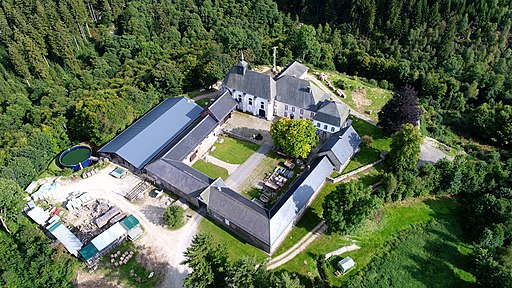
Kloster Reichenstein
Kloster Reichenstein is a monastic complex whose surviving buildings and landscape record layers of religious, economic, and architectural development across centuries. Nestled in a river valley and often associated with surrounding vineyards and forested slopes, the site combines fortified features, cloistral organization, and later secular adaptations. The following article describes the monastery in technical and architectural terms, traces its historical evolution, and sets out the conservation challenges and strategies necessary to preserve its fabric for the future.
Historical Development
Foundation and Early Growth
Kloster Reichenstein was established as a religious house to serve both spiritual functions and regional land management. The monastery’s initial growth followed the common medieval model: acquisition of agricultural holdings, development of ancillary buildings for crafts and storage, and construction of a church as the liturgical heart. The community exploited the local topography for defense and resources, siting workshops and mills along watercourses while positioning the principal buildings on firmer ground above flood levels.
High and Late Medieval Periods
During the high medieval period, economic expansion is reflected in enlargements to the church and the addition of cloister ranges. Building campaigns under successive abbots typically introduced masonry upgrades—stone vaulting in place of timber, buttressing to support higher roofs, and more substantial foundations where earlier timber piles had proved insufficient. In the late medieval period, the complex often shows evidence of fortified elements added in response to regional conflicts: gatehouses, defensive walls, and controlled access routes.
Dissolution and Postmonastic Use
Like many monastic sites, Kloster Reichenstein underwent secularization in the early modern era. Buildings were repurposed for agricultural estates, manor houses, or industrial use depending on local demand. This period introduced structural interventions such as inserted floors, enlarged openings for grain storage, and adaptive roofing. The site’s survival into the modern era has depended on the adaptability of its core masonry and the continuity of use, even when that use required substantial reconfiguration.
Monastic Architecture and Technical Parameters
Site and Topography
- Site Setting: River valley terrace with surrounding slopes used for orchards and vineyards.
- Elevation Range: Buildings typically sited between 220 and 300 meters above mean sea level depending on local valley configuration.
- Orientation: Church axis aligned roughly east-west with the main entrance and precinct access to the west.
- Geology: Local bedrock of mixed sandstone and slate; bedrock outcrops inform foundation choices and quarry sources.
Plan and Spatial Organization
- Enclosure Typology: Rectilinear precinct with inner cloister, chapter house, dormitory range, refectory, and church.
- Cloister Dimensions: Typical garth 18 × 22 meters for modest regional monasteries; surrounding ambulatory width 3.0–3.6 meters.
- Church Dimensions: Nave width 7–9 meters, total internal length 32–45 meters for a monastic church of medium scale.
- Vertical Zoning: Ground floor service and storage, first floor public and liturgical, upper floors private cells or attic storage.
Structural Systems
Foundations and Substructure
- Foundation Types: Shallow spread footings on bedrock sections; stepped footings and rubble-filled trenches where bedrock dips.
- Foundation Depth: 0.6–1.2 meters typical beyond preparing the bedrock surface; deeper underpinning where vault thrust concentrated.
- Drainage: Sub-sill drainage channels and historic soakaways to reduce capillary rise into masonry.
Wall Construction
- Materials: Local sandstone and quarried slate rubble with lime-based mortar.
- Thickness: External walls 0.9–1.8 meters depending on load and era; cloister walls often 0.6–1.0 meters.
- Bonding: Irregular rubble with larger ashlar blocks at corners and openings; later restorative work includes coursed masonry repairs.
Roofing and Timber Work
- Roof Framing: Heavy timber trusses for refectory and nave; collar-beam and queen-post trusses present in later medieval roofs.
- Roof Coverings: Initially wooden shingles or stone slate; later replaced with fired clay tiles or imported natural slate depending on era and wealth.
- Eaves and Rainwater: Historically minimal projecting eaves, modern interventions often include discreet gutters and lead flashings to protect masonry.
Vaulting and Lateral Support
- Vault Types: Ribbed stone vaults in choir and chapter house; simple barrel vaulting or timber roofs in ancillary ranges.
- Buttressing: External buttresses added to support heavier vault loads and resist lateral thrust in the nave and choir.
Doors, Windows, and Openings
- Window Typology: Lancet windows in early Gothic phases; later mullioned and traceried windows in decorated work.
- Opening Dimensions: Clerestory windows 0.6–1.2 meters wide by 1.2–2.5 meters high; aisle windows larger in later renovations.
- Joinery: Oak frames and shutters; iron strap hinges and remnant wrought-iron fittings typical in surviving fabric.
Artistic and Liturgical Spaces
Church Interior
- Choir Layout: Multi-bay choir with choir stalls on stone or timber platforms; elevated sanctuary with stone altar plinth.
- Liturgical Furnishings: Stone altars, piscina niches, sedilia cut into the choir wall, and carved capitals on columnar supports.
- Acoustics: Vaulted masonry contributes to long reverberation times, originally appropriate for chant but requiring mitigation for modern events.
Cloister and Chapter House
- Cloister Arcade: Series of arches supported on columns with carved capitals; capitals depict vegetal or figurative motifs depending on period.
- Chapter House: Often polygonal or rectangular, vaulted, and linked directly to the cloister; served as administrative and judicial space.
- Surface Finishes: Lime plaster with painted decoration in the high medieval period; later whitewash or plain finishes during secularized use.
Ancillary Spaces
- Refectory: Long hall with raised dais for the abbot or prior; heated seating or warming hearths and service accesses to kitchens.
- Cellarage and Storehouses: Subterranean or semi-subterranean vaults for grain, tithes, and wine with controlled humidity and ventilation.
- Workshop Zones: Blacksmith, carpenter, and tannery spaces typically sited downwind and separated from living quarters.
Later Uses Restoration and Conservation
Adaptive Reuse Patterns
Following dissolution, Kloster Reichenstein’s buildings were variously converted to agricultural barns, tenant dwellings, or a manor house. Such uses introduced partition walls, inserted floors, and enlarged openings which both preserved and compromised original fabric. Conservation must reconcile these palimpsests to tell the full history while stabilizing the structure.
Diagnostic Assessment
- Material Condition Survey: Mortar porosity, stone decay mapping, and timber condition assessment using resistograph and boroscope techniques.
- Structural Monitoring: Crack gauges and tilt sensors on arches and buttresses to detect progressive movement.
- Moisture Mapping: Thermal imaging and electrical resistance meters to identify rising damp and active water ingress paths.
Conservation Interventions
- Masonry Repairs: Use of lime-based mortars matched to original hardness and permeability to avoid trapping moisture.
- Timber Conservation: Consolidation of historic beams using resin injections where appropriate and splice repairs with seasoned oak.
- Roof Reinstatement: Where collapsed or replaced with inappropriate modern coverings, roofs are rebuilt using traditional carpentry and breathable coverings to protect vaults.
- Reversibility and Minimal Intervention: New inserts for mechanical services are routed to minimize cutting into historic fabric and are made reversible where possible.
Environmental Controls
- Ventilation Strategy: Passive cross-ventilation for vaults and cellars complemented by discreet mechanical heat recovery systems to control humidity.
- Thermal Performance: Internal insulation avoided on primary masonry walls; focus placed on roof insulation and draught-proofed joinery to improve comfort without damaging breathability.
- Biological Decay Management: Regular monitoring and treatment programs for wood-boring insects, fungal colonization, and bird nesting.
Visiting Interpretation and Cultural Role
Presentation of the Site
- Interpretive Routing: A guided sequence through the gatehouse, cloister, chapter house, church, and select domestic ranges gives visitors both spatial sense and historical layering.
- Exhibition Areas: Adaptive display of reclaimed liturgical objects, agricultural tools, and a materials panel explaining masonry and timber conservation techniques.
- Accessibility: Careful insertion of ramps and discreet lifts where possible to improve access while minimizing interventions to the historic plan.
Events and Educational Use
- Community Use: Concerts, lectures, and local festivals exploit the acoustic and atmospheric qualities of the church and refectory.
- Educational Programs: Craft workshops on stonemasonry, lime mortar mixing, and medieval carpentry provide practical connection to conservation techniques.
- Research Opportunities: On-site archaeological investigations and dendrochronology studies contribute to chronological understanding and inform conservation priorities.
Conclusion
Kloster Reichenstein is a multi-layered historic complex whose architectural and technical characteristics document centuries of monastic life, secular adaptation, and modern conservation practice. Effective stewardship combines rigorous material science, sensitive structural intervention, and interpretive programming that makes the site legible to the public. Maintaining breathable masonry systems, respecting original construction techniques, and adopting minimally invasive modern services will ensure that Kloster Reichenstein remains both structurally sound and culturally resonant for future generations.
