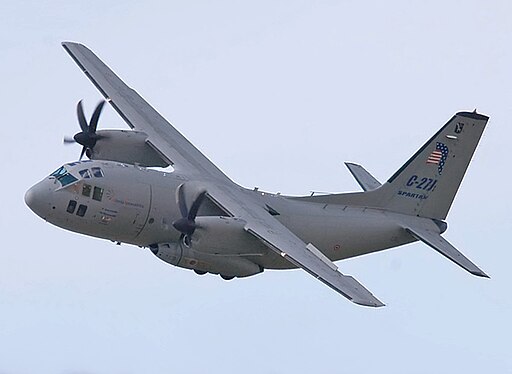
Alenia C-27J Spartan: Europe’s Agile Tactical Airlifter
The Alenia C-27J Spartan redefines the concept of tactical airlift by blending jet-age performance with the rugged simplicity of a classic turboprop. Designed to bridge the gap between strategic transports like the C-130 Hercules and light utility aircraft, the C-27J offers militaries and humanitarian operators around the globe a highly flexible, survivable platform for troops, supplies, medevac, and special operations. This article dives deep into its development, airframe design, propulsion system, avionics suite, mission roles, variants, global operators, and key technical parameters.
Development History
Origins and Collaborative Vision
In the late 1990s Alenia Aeronautica (now Leonardo) teamed with Lockheed Martin to evolve the proven G.222 into a modern tactical lifter. By mating the Wings of the C-130J Super Hercules to an uprated fuselage, the partnership aimed to deliver higher cruise speed, longer range, and reduced lifecycle costs. First flight of the prototype took place in September 1999, and the first production C-27J entered service with the Italian Air Force in 2006.
Production and Industrial Share
Components of the Spartan derive from a truly multinational supply chain. Major wing assemblies come from the United States, fuselage sections from Italy, empennage units from Romania, and final assembly lines operate in Italy, the United States, and Australia. This collaboration not only spread development costs but also built sustainment networks across three continents.
Airframe and Structural Design
Fuselage and Cargo Compartment
The Spartan’s box-shaped fuselage measures 20.3 meters long and 2.74 meters wide internally, providing a volume of 86 cubic meters. Reinforced floors support up to 9,000 kilograms of palletized cargo. A hydraulically actuated rear ramp and side paratroop doors enable rapid load/unload, airdrops, and emergency exits. Tie-down rails and roller conveyance simplify handling of standard 463L pallets.
Wing and Landing Gear
A high-wing layout with 28° sweepback optimizes cruise speed and ground clearance. Each wing carries external fuel tanks, boosting ferry range. The tricycle landing gear features dual wheels on each main leg, permitting operations from unprepared strips and semi‐prepared dirt or grass fields. Robust oleo-pneumatic shock absorbers cushion touchdown in austere environments.
Propulsion and Performance
Propeller-Driven Thrust
Twin Rolls-Royce AE 2100D3 turboprop engines each deliver 4,637 shaft horsepower to six-blade composite Dowty propellers. Variable-speed hubs automatically adjust blade pitch for optimum efficiency across all flight regimes. The result is a cruise speed of 540 km/h—nearly as fast as small jets—combined with excellent short-field performance.
Flight Envelope
- Maximum Cruise Speed: 540 km/h (292 kt) at FL200
- Stall Speed (landing config): 105 kt
- Service Ceiling: 9,144 meters (30,000 ft)
- Takeoff Distance (MTOW, sea level): 650 meters
- Landing Distance (MLW, sea level): 580 meters
- Maximum Range (ferry): 5,926 km with auxiliary tanks
Avionics and Mission Systems
Glass Cockpit and Flight Management
C-27J crews rely on dual Honeywell PRIMUS Epic integrated avionics suites featuring four large LCDs, synthetic-vision capability, and advanced flight-management computers. Head-up guidance for low-level flight and automatic terrain-following modes enhance safety in demanding environments.
Defensive Aids and Self-Protection
For tactical operators, the Spartan can be fitted with missile-warning sensors, laser warning receivers, radar warning receivers, and chaff/flare dispensers. An optional DIRCM (directional infrared countermeasure) turret further hardens the aircraft against modern MANPADS threats.
Mission Roles and Capabilities
Tactical Lift and Airdrop
The C-27J excels at delivering personnel and supplies to forward bases. Its rear ramp supports container-delivery system airdrops and paratroop drops. Precise GPS-guided airdrop modules allow high-accuracy pallet delivery within a few meters of designated drop zones.
Medevac and Humanitarian Aid
A rapid-reconfiguration kit transforms the Spartan into a flying hospital in under an hour. Two medical teams can treat up to 60 stretchers or litters, ventilators, and life-support systems. Climate-controlled zones maintain patient comfort in extreme temperatures.
Special Operations and SIGINT
Smaller than a C-130 and harder to detect, the C-27J lends itself to covert insertions, airborne surveillance, and signals-intelligence missions. Operators can integrate electro-optical/infrared sensors, side-looking radar, and communication relays to support joint task forces.
Variants and Upgrades
C-27J SPM
Special Purpose Mission version adds a mission-control operator station, large observation windows, and under-fuselage pods for surveillance radars or cameras. Used by border-security and coast-guard agencies for maritime patrol.
C-27J JEM
The Joint Effects Module configures the Spartan into a tactical fires and electronic-warfare platform. Equipped with datalink towers, advanced ECM suites, and counter-battery radars, it can defeat enemy air defenses and coordinate artillery strikes.
Future Growth Potential
Leonardo continues to certify enhancements such as digital autopilot upgrades, enhanced vision systems, and new cargo-handling modules. Block-upgrade programs focus on reducing crew workload, improving fuel efficiency, and integrating next-generation defense aids.
Global Operators and Service Record
Italian Air Force
First operator and launch customer, Rome fields Spartans in tactical transport wings, deploying them in Afghanistan, Iraq, and to support NATO rapid-reaction forces. Italian C-27Js have performed over 50,000 flight hours in combat zones.
U.S. Air Force and National Guard
Designated C-27J Spartan in USAF service, they flew domestic missions for homeland security and Reserve training. Despite early retirement, lessons from the Spartan program informed modern agile-combat-employment concepts.
African, Asian, and Pacific Customers
Spartans serve in Australia, Mexico, Peru, Romania, Morocco, and Finland, among others. Their ability to operate from short, unpaved airfields makes them invaluable for disaster relief, wildfire support, and remote-area logistics.
Maintenance, Support, and Lifecycle Costs
Health-and-Usage Monitoring
On-board sensors collect engine data, airframe loads, and mission profiles, uploading to ground-station prognostic systems. Predictive maintenance reduces unscheduled downtime by up to 30 percent and extends component life.
Global Support Network
Leonardo’s joint venture with Lockheed Martin established maintenance depots in Europe, North America, and Australia. Combined with regional spares pipelines, 98 percent availability rates are typical even in forward deployed conditions.
Cost-of-Ownership
Spartan operators report direct operating costs around USD 5,000 per flight hour—roughly one-third that of comparable tactical jets—while carrying similar payloads and achieving superior takeoff/landing performance.
Technical Specifications
| Parameter | Specification |
|---|---|
| Crew | 2 (pilot, co-pilot) + loadmaster |
| Length | 22.7 m |
| Wingspan | 28.7 m |
| Height | 10.1 m |
| Wing Area | 71.2 m² |
| Empty Weight | 17,057 kg |
| Maximum Takeoff Weight (MTOW) | 31,800 kg |
| Powerplant | 2 × Rolls-Royce AE 2100D3; 4,637 shp each |
| Maximum Speed | 540 km/h (292 kt) |
| Cruise Speed | 500 km/h (270 kt) |
| Stall Speed (landing config) | 194 km/h (105 kt) |
| Service Ceiling | 9,144 m (30,000 ft) |
| Range (with max fuel, no cargo) | 5,926 km |
| Payload Capacity | 9,000 kg |
| Takeoff Distance (MTOW, SL, ISA) | 650 m |
| Landing Distance (MLW, SL, ISA) | 580 m |
| Fuel Capacity | 11,400 L internally + 2,000 L optional |
Future Prospects
Leonardo continues to explore digital transformation initiatives—integrating augmented-reality maintenance aids, AI-driven mission planning, and hybrid-electric ground taxi systems. As modern conflicts demand rapid, flexible logistics, the C-27J Spartan’s blend of speed, ruggedness, and advanced mission systems will keep it in high demand for decades to come.
Conclusion
The Alenia C-27J Spartan stands at the intersection of reliability, performance, and adaptability. Its evolutionary design builds on half a century of turboprop expertise to meet the multifaceted needs of today’s air forces, relief agencies, and special-operations units. Whether flying in support of combat operations, delivering humanitarian relief, or quietly conducting surveillance, the Spartan continues to prove that agility and capability need not be sacrificed in a world that demands both.
.jpg)