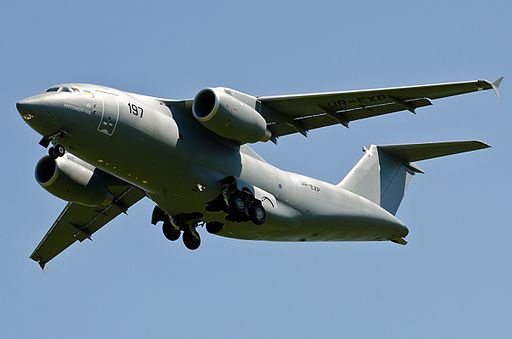
Antonov An-178
The Antonov An-178 is a twin-engine medium-range transport aircraft developed by Ukraine’s Antonov Design Bureau. Unveiled in 2015, it leverages commonality with the regional jet An-158 to deliver a flexible, cost-effective cargo and troop carrier. Engineered for rapid reconfiguration, austere airfield operations, and strategic lift roles, the An-178 addresses modern military and humanitarian airlift demands with advanced systems and high-payload capability.
Design and Development
Concept and Requirements
In the early 2010s, Antonov initiated the An-178 program to bridge the gap between tactical lift platforms like the An-26 and heavy transports such as the An-72. Requirements called for a payload of at least 18,000 kg, a cruising range exceeding 3,000 km, and the ability to operate from unpaved or unprepared strips under harsh weather conditions.
Airframe and Materials
The An-178 adopts a high-mounted wing and T-tail configuration derived from the An-158 regional jet. The fuselage incorporates high-strength aluminum alloys in primary structures, while composite materials reinforce winglets, fairings, and cargo-door surrounds. A one-piece wing center section simplifies assembly and maintenance, and the rugged landing gear absorbs rough-field stress through dual-tandem main wheels.
Aerodynamics and Flight Systems
A moderate wing sweep of 25° combined with double-slotted flaps and full-span leading-edge slats optimizes lift at low speeds. Winglets reduce induced drag, enhancing fuel efficiency at cruise altitudes. The digital fly-by-wire flight control system integrates envelope protection, automatic trimming, and load alleviation, improving handling during steep approaches and short-field operations.
Propulsion and Auxiliary Systems
Propulsive power derives from two Ivchenko-Progress D-436-148FM turbofan engines, each delivering 73.5 kN of thrust. Full-authority digital engine control (FADEC) regulates performance and reduces pilot workload. An onboard auxiliary power unit (APU) supplies electrical and pneumatic power for engine starts, environmental control, and deicing systems. Dual air conditioning packs maintain cabin comfort between –50 °C and +50 °C.
Variants and Mission Profiles
- An-178 Cargo A palletized freighter version accommodating up to eighteen standard 2.4 m × 3.2 m military cargo pallets, or bulk loads including vehicles and machinery.
- An-178 Troop Transport Configured for up to 83 fully equipped soldiers, with overhead stowage and quick-release seating. Integration of paratroop doors and jump-seat installations is optional.
- An-178 Medevac Equipped with up to 36 medical litters, life-support modules, and onboard monitoring stations. Dedicated oxygen and electrical outlets serve critical-care patients.
- An-178 VIP/Crew Trainer Custom cabins configured for executive transport or pilot training, featuring modular interiors and advanced mission-planning consoles.
Technical Specifications
Dimensions and Weights
| Parameter | Value |
|---|---|
| Wingspan | 28.90 m |
| Length | 31.93 m |
| Height | 10.40 m |
| Wing Area | 92.7 m² |
| Fuselage Cross-Section | 3.40 m × 3.40 m |
| Maximum Takeoff Weight | 74,000 kg |
| Maximum Payload | 18,000 kg |
| Operating Empty Weight | 34,500 kg |
| Fuel Capacity | 24,000 L |
Performance
| Parameter | Value |
|---|---|
| Maximum Cruise Speed | 800 km/h |
| Typical Cruise Altitude | FL330 (10,060 m) |
| Range (Max Payload) | 3,000 km |
| Ferry Range (No Payload) | 4,500 km |
| Service Ceiling | 12,500 m |
| Takeoff Distance (MTOW) | 1,600 m |
| Landing Distance | 1,300 m |
| Rate of Climb | 12 m/s |
| Maximum Operational Load Factor | +2.5 / –1.0 |
Powerplant
- 2 × Ivchenko-Progress D-436-148FM turbofan engines
- Thrust: 73.5 kN each
- FADEC with integrated thrust-reverser control
- Engine inlet anti-icing and variable-geometry exhaust for noise reduction
Avionics and Systems
- Glass cockpit with four 15-inch multifunction displays
- Dual flight management systems supporting RNP approaches
- Enhanced ground-proximity warning system and weather radar
- Traffic Collision Avoidance System (TCAS II)
- Health and Usage Monitoring System (HUMS) for real-time diagnostics
- Satcom and data-link communications for strategic operations
Operational History
Development Flight Testing
The An-178 prototype first flew in May 2015. Subsequent trials validated short-field performance, payload handling, and system reliability. Testing included gravel runway operations and high-altitude hot-and-high scenarios.
Entry into Service
The Ukrainian State Border Guard Service placed the first production aircraft on strength in 2020, deploying it for border patrol, medevac, and search-and-rescue missions. Orders from several international operators are in various stages of finalization.
Notable Deployments
- Humanitarian airlift missions delivering relief supplies to earthquake-affected regions.
- Logistic support for peacekeeping forces in remote desert operations.
- Strategic airdrop exercises demonstrating rapid offload of pallets and vehicles.
Maintenance and Support
Airframe Maintenance
Scheduled inspections follow a 1,000-hour cycle, focusing on wing-root fittings, landing gear torque links, and composite control surfaces. Modular panel design permits rapid replacement of damaged sections in the field.
Engine Overhaul
D-436 engines undergo non-intrusive borescope inspections at 2,000-hour intervals and full overhauls at 6,000 hours. Hot-section inspection intervals can be extended through blended technology coatings that resist corrosion and erosion.
Avionics Upgrades
An-178 operators benefit from software-update packages that introduce synthetic-vision overlays, enhanced navigation databases, and predictive maintenance algorithms, minimizing downtime and maximizing sortie reliability.
Conclusion
The Antonov An-178 delivers a modern, efficient solution for medium-lift transport missions, combining proven high-wing architecture with advanced propulsion and avionics. Its payload flexibility, rough-field capability, and digital systems position it as a competitive asset for military operators, humanitarian agencies, and commercial freighters seeking strategic airlift performance.
Additional Insights
Comparative Edge
Compared with legacy turboprops in the 15–20 ton class, the An-178 offers higher cruise speeds, longer range, and lower crew workload due to digital flight systems. Its payload cross-section also accommodates outsized cargo that smaller transports cannot.
Future Prospects
Antonov continues to evaluate an extended-range An-178ER with auxiliary fuel pods and upgraded engines targeting transcontinental missions. Prospective developments include a dedicated air-refuelable variant for long-endurance patrol roles.
Operational Tips
Flight crews transitioning from An-26 series aircraft note the An-178’s predictable handling on short finals, intuitive avionics layout, and robust environmental controls as key enhancements that reduce pilot fatigue during demanding missions.
