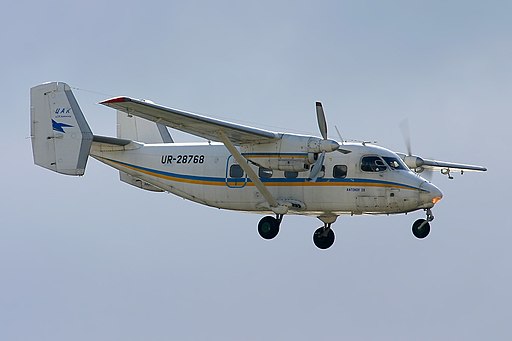
Antonov An-28
The Antonov An-28 is a twin-engine, high-wing light transport aircraft developed by the Ukrainian Antonov Design Bureau in the late 1970s. It emerged as an evolution of the An-14 “Pchelka,” featuring stretched fuselage, improved aerodynamics, and more powerful engines. Its design emphasizes short takeoff and landing (STOL) capabilities, making it suitable for operation from unprepared fields and remote airstrips.
The An-28 first flew in 1969 as the An-14M prototype, but the definitive An-28 configuration reached service in 1982. Over 150 units have been built, serving in civil, military, and special-mission roles in more than 20 countries. Its rugged construction and versatile performance continue to appeal to operators in challenging environments.
Design and Development
Airframe and Structure
The An-28’s airframe utilizes a mixed construction of welded steel tubing for the fuselage and riveted aluminum alloy for the wings and tail surfaces. The high-mounted wing offers excellent downward visibility and ground clearance for the turboprop engines. External struts brace the wing, allowing a lighter internal structure without compromising strength.
The fuselage cross-section is nearly rectangular, maximizing cabin volume. Large double doors on the port side and a cargo ramp at the rear facilitate rapid loading and unloading of passengers, cargo, or stretchers. Fixed tricycle landing gear with large, low-pressure tires absorb rough-field operations.
Cabin and Payload
The pressurized cabin can accommodate up to 17 passengers in a high-density seating layout or be reconfigured for cargo, parachute operations, or medevac missions. Floor tracks and tie-down points allow quick installation of seats, cargo pallets, or medical litters. The generous door dimensions—1.2 m by 1.5 m—simplify loading of bulky freight.
Thermal and acoustic insulation in the cabin ensures comfortable conditions in a wide range of climates. Auxiliary heating and ventilation systems maintain internal temperatures down to –40 °C during ground operations. An emergency exit on the starboard side meets international safety regulations.
Powerplant and Performance
Engine Options
The An-28 is typically powered by two turboprop engines. Common configurations include the Garrett (Honeywell) TPE331-10 with 715 shp each, or the Klimov TVD-850 with 735 shp. These engines drive four-blade constant-speed propellers optimized for low-speed thrust.
Dual-engine operation ensures redundancy in remote areas, while full autorotation capability enhances safety in case of engine failure. Fuel consumption averages 220 kg per hour per engine at cruise power settings, striking a balance between efficiency and performance.
Flight Performance
The aircraft’s STOL characteristics stem from its wing design and high-lift devices. Leading-edge slats and double-slotted flaps yield a stall speed as low as 95 km/h. Typical takeoff distance to 15 m clearance is 460 m at maximum weight, and landing roll is under 400 m.
Cruise speed ranges from 300 km/h to 350 km/h depending on payload and atmospheric conditions. Maximum range without auxiliary tanks is approximately 1,400 km; with optional ferry tanks, it can extend to 1,900 km. Service ceiling peaks at 7,500 m.
Avionics and Systems
Flight Deck Layout
The An-28 features a traditional “steam gauge” cockpit with analog instruments supplemented by optional digital upgrades. Primary flight instruments are centrally located, with engine gauges on either side. An optional glass cockpit retrofit replaces select analog dials with multi-function displays.
Standard navigation equipment includes VOR/ILS receivers, ADF, DME, and an optional GPS unit. Communication is handled by VHF radios with dual-antenna diversity. Handheld backup radios and emergency locator transmitters enhance operational safety.
Electrical and Hydraulic Systems
A 28 V DC electrical network, powered by two engine-driven generators (28 kVA each) and a 24 V battery, supplies avionics, lighting, and environmental systems. Circuit protection uses conventional thermal and magnetic breakers. Hydraulic power—sourced from a single engine-driven pump—operates the flaps, nose-wheel steering, and main gear brakes.
Critical systems are dual-redundant or feature manual backup capabilities. In-flight electrical failures allow for manual extension of landing gear using gravity, ensuring safe recovery.
Variants and Special Missions
- An-28: Base civil transport model.
- An-28M Bryza: Maritime patrol version with search radar and sonobuoy dispensers.
- An-28R: Dedicated cargo variant with reinforced floor and hoisting winch.
- An-28RV: Aeromedical configuration with medical equipment and oxygen system.
- An-28F: Fire-fighting version with belly-mounted retardant tanks.
Special-mission variants serve roles in geological survey, aerial photography, parachute training, and humanitarian relief. Custom interiors and mission racks adapt the airframe to specific operator requirements.
Operational History
The An-28 has seen extensive use in Eastern Europe, Africa, and South America. Its ability to access rough airstrips proved invaluable during bush missions in Canada and charter operations in Alaska. Military aerobatic teams in Poland and Russia have also showcased the type’s agility.
Civil operators praise the An-28 for low acquisition and operating costs, while air forces value its ruggedness and ease of maintenance. Several upgrades—such as noise reduction kits, modern avionics suites, and corrosion-resistant treatments—have extended the service life well beyond 40 years.
Technical Specifications
| Parameter | Specification |
|---|---|
| Crew | 2 (pilot and co-pilot) |
| Capacity | 17 passengers or 2,500 kg cargo |
| Length | 14.44 m |
| Wingspan | 17.40 m |
| Height | 4.24 m |
| Wing area | 32.5 m² |
| Empty weight | 2,675 kg |
| Maximum takeoff weight (MTOW) | 5,700 kg |
| Powerplant | 2 × TPE331-10 turboprops, 715 shp each |
| Maximum speed | 355 km/h |
| Cruise speed | 310 km/h |
| Stall speed (flaps down) | 95 km/h |
| Range | 1,400 km (standard tanks) |
| Service ceiling | 7,500 m |
| Takeoff distance | 460 m to 15 m obstacle |
| Landing distance | 390 m to 15 m obstacle |
Beyond its proven track record, the An-28 inspires modern retrofits such as hybrid-electric propulsion trials and advanced composite wing kits. Operators curious about noise abatement can explore propeller blade tip fences and active vibration dampers. For enthusiasts, flight-simulation communities offer realistic Antonov cockpits, while scale-model builders share tips for scratch-built STOL kits.
