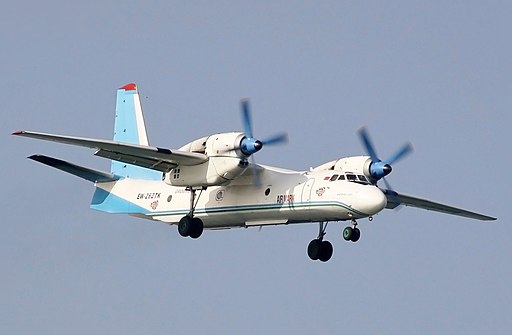
Antonov An-32
The Antonov An-32 is a twin-turboprop tactical transport aircraft developed to operate in extreme “hot and high” conditions. Originating as a derivative of the An-26, the An-32 incorporates more powerful turboprops and structural reinforcements to deliver improved payload and performance from short, unpaved strips. Since its first flight in 1976, the An-32 has served militaries and civilian operators across Asia, Africa, South America, and the Arctic circle.
Beyond its core transport role, the An-32’s rugged design and adaptable cargo bay have made it a platform for paratroop insertion, medical evacuation, aerial survey, and electronic warfare missions. More than 400 units have been produced, and upgrades over four decades have kept the type relevant in both established air forces and emerging civil operators.
Design and Development
Origins and Mission Requirements
The An-32 program emerged when civilian and military operators in tropical and mountainous regions demanded higher single-engine climb rates and reduced takeoff runs. By replacing the An-26’s AI-24 engines with 5,100-shp Ivchenko AI-20DM turboprops, engineers achieved a 60 percent increase in power. Reinforced pylons, enlarged air intakes, and improved cooling systems ensure reliable operation in ambient temperatures above 45 °C and airfields at altitudes exceeding 3,500 m.
Airframe and Structure
The An-32 retains the high-wing, braced monoplane layout of its predecessor but features several key enhancements:
- Fuselage reinforced around wing roots and engine mounts to absorb higher torque
- Enlarged nose wheel well for improved steering on rough surfaces
- Corrosion-resistant aluminum alloys and sealed control surfaces for maritime operations
- Enlarged cargo door on the starboard side, measuring 2.0 m by 1.8 m
- Reinforced cabin floor with a 1,500 kg/m² load capacity
Fixed-strut landing gear with wide-track bungee suspension and low-pressure tires allow the An-32 to absorb uneven terrain without runway damage.
Powerplant and Performance
Engine Configuration
Power is supplied by two Ivchenko AI-20DM turboprops, each delivering 5,100 shp at takeoff. Key engine features include:
- Twin-channel FADEC for optimized fuel scheduling and engine monitoring
- Integral oil coolers with pre-heat capability for sub-zero starts
- Four-blade reversible-pitch propellers for improved landing rollout control
- Auxiliary power unit option for ground operation of environmental and mission systems
Flight Performance
The An-32’s combination of high power and STOL-oriented aerodynamics yields the following performance characteristics:
- Maximum speed: 560 km/h at sea level
- Cruise speed: 530 km/h at FL200
- Stall speed (flaps down): 155 km/h
- Takeoff distance to 15 m obstacle: 1,100 m
- Landing distance from 15 m obstacle: 860 m
- Service ceiling: 8,000 m
- Range with maximum fuel: 2,500 km
- Maximum payload: 7,500 kg
High-lift devices—automatic leading-edge slats and double-slotted flaps—ensure stable flight at low speeds during cargo runs and drop-zone approaches.
Avionics and Systems
Cockpit and Flight Instruments
Originally equipped with analog “steam gauges,” many An-32s have received glass-cockpit retrofits featuring:
- Dual multi-function displays (MFDs) for navigation and engine monitoring
- Integrated GPS/INS with moving-map presentation
- VHF/UHF radios with SELCAL and SATCOM options
- Digital autopilot supporting altitude and heading hold
Redundancy is built into critical systems, with manual backups for pitch trim, flap operation, and gear extension.
Cargo Handling and Environmental Controls
The pressurized cargo compartment accommodates up to 42 troops or 6 standard 463L pallets. Features include:
- Quick-release tie-down rails and roller-floor tracks for rapid reconfiguration
- Environmental control system capable of cabin heating down to –40 °C and cooling up to +45 °C
- Onboard winch rated at 2,000 kg for underslung loads
- Optional paratroop door on the port side with jump-platform and static line hooks
Variants and Special Configurations
- An-32B: Basic transport version with standard avionics
- An-32RE: Upgraded engines and advanced FADEC controls
- An-32P: Paratroop trainer with static line rig and pack-door modifications
- An-32M: Medical evacuation model with stretcher racks and life-support suite
- An-32EW: Electronic warfare platform featuring radar-warning receivers and jammers
Custom mission kits can include aerial spraying booms, geophysical sensors, or VIP interiors.
Operational History
Entering service in 1980, the An-32 proved indispensable in the Indian Air Force’s high-altitude operations, including support to border posts above 4,000 m. African operators utilized the type for humanitarian relief during flood and drought crises. Arctic-certified An-32s serve in polar research programs, flying from ice camps to coastal stations.
Modernization programs have extended airframe life to 30,000 flight hours, with composite propeller blades, corrosion-inhibiting surface treatments, and glass-cockpit integrations ensuring relevance into the 2040s.
Technical Specifications
| Parameter | Specification |
|---|---|
| Crew | 2 (pilot and co-pilot) |
| Capacity | 42 troops or 6 × 463L pallets |
| Length | 23.79 m |
| Wingspan | 29.20 m |
| Height | 7.85 m |
| Wing area | 71.5 m² |
| Empty weight | 16,800 kg |
| Maximum takeoff weight | 27,000 kg |
| Powerplant | 2 × Ivchenko AI-20DM turboprops, 5,100 shp each |
| Maximum speed | 560 km/h |
| Cruise speed | 530 km/h |
| Stall speed (flaps down) | 155 km/h |
| Range | 2,500 km (maximum fuel) |
| Service ceiling | 8,000 m |
| Takeoff distance (15 m obstacle) | 1,100 m |
| Landing distance (15 m obstacle) | 860 m |
Future Upgrades and Legacy
Ongoing programs are exploring hybrid-electric auxiliary propulsion for ground taxiing and emergency power. Advanced cargo-bay health-monitoring sensors aim to predict structural wear before inspections. As air forces and civilian operators seek cost-effective transports with proven hot-and-high capability, the An-32’s adaptability ensures it will remain in production under license or rebuild well into the mid-21st century.
