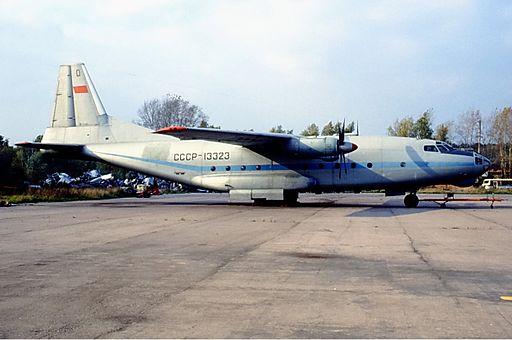
Antonov An-8
The Antonov An-8 occupies a unique place in aviation history as the Soviet Union’s first twin-turboprop military transport. Emerging in the mid-1950s to meet the need for a medium-range airlifter, it combined rugged simplicity with unprecedented payload capacity for its class. Powered by two high-output turboprops, the An-8 could handle unprepared fields, carry armored vehicles, and deploy paratroopers deep behind enemy lines. Its pioneering design laid the groundwork for later Antonov transports such as the An-12 and An-22, cementing the design bureau’s reputation for reliable workhorses.
Design and Development
Conceptual Origins
In response to shifting Cold War logistics requirements, the Soviet Air Force in 1953 issued a call for a twin-engined transport to replace aging piston models. The requirement specified a payload of at least eight tonnes, short takeoff performance, and the ability to operate from rough strips. Antonov’s design bureau leveraged lessons from the An-2 biplane but moved to a high‐wing monoplane layout to maximize cargo volume and simplify loading.
Prototype and Testing
The first An-8 prototype flew in February 1956. Early trials focused on the new Ivchenko AI-20A turboprops and reinforced airframe structure. Engineers discovered vibration harmonics in the wing roots during high-speed passes, prompting local stiffening of the spars and addition of fillets at strut junctions. Subsequent tests validated the aircraft’s 550 km/h top speed and confirmed its ability to lift eight tonnes over distances exceeding 1,500 km.
Production Challenges
Bringing the An-8 into series production presented supply-chain hurdles. The AI-20 engines required precision machining that Soviet factories had not yet mastered, leading to delayed deliveries of powerplants. Structural assemblies, originally designed for hand-crafted jigs, later transitioned to semi-automated lines to boost output. By 1960, production peaked at twenty airframes per year before shifting focus to the larger An-12.
Airframe and Structure
Fuselage and Cargo Bay
The An-8’s cylindrical fuselage measures nearly 25 meters in length and integrates a rear-loading ramp rated for eight tonnes. The cargo deck sits low to the ground, reducing the need for ground handling equipment. Tie-down rails and roller tracks in the bay streamline loading of wheeled vehicles, pallets, or standard ISO containers. Insulated walls and a .75 m² emergency door on the starboard side enhance crew comfort and safety.
Wing Design
A high-mounted wing with a straight, moderately tapered planform provides stable lift at low speeds. Double-slotted flaps and leading-edge slats deploy pneumatically, enabling takeoff runs under 600 meters fully loaded. The wing structure uses riveted aluminum alloys with foamed-core sandwich panels in non-critical zones to save weight. Struts brace each wing to the lower fuselage, offering simple inspection access in the field.
Landing Gear
Featuring a tricycle arrangement, the An-8’s main gear retracts into robust pods on either side of the fuselage. Each unit uses dual wheels with low-pressure tires to distribute loads on soft ground. Oleo-pneumatic shock absorbers soften hard landings, while the steerable nosewheel simplifies taxiing on rough airstrips. Maintenance crews can change a main wheel in under 30 minutes thanks to quick-release bearings and plug-in hydraulic lines.
Powerplant and Propulsion
Engine Choice
The heart of the An-8 is a pair of Ivchenko AI-20A turboprop engines, each rated at 4,000 shaft horsepower. These two-spool turboprops provided a step change in reliability and specific fuel consumption compared to piston predecessors. Modular in design, the AI-20A allows frontline mechanics to swap a power section in under two hours.
Propeller System
Mated to each engine is a four-bladed constant-speed propeller with reversible pitch. Constructed from composite-reinforced aluminum, the blades resist erosion and maintain aerodynamic shape across thousands of flight hours. Reversible pitch lets pilots shorten landing roll dramatically by dumping propeller thrust forward after touchdown.
Fuel and Efficiency
Wing tanks hold 7,200 liters of Jet A-1 fuel, granting a ferry range of 2,500 kilometers. In mission cruise at 450 km/h, the An-8 burns approximately 700 liters per hour, delivering a favorable lift-to-fuel ratio for medium-haul operations. An auxiliary tank option increases endurance to eight hours for aerial survey or reconnaissance missions.
Cockpit and Avionics
The An-8 cockpit seats two pilots, a navigator, a flight engineer, and a radio-operator. Instrumentation blends analog dials with early Soviet digital readouts for engine parameters. Navigators relied on astro-compass and radio-direction finders, while dual VHF radios and an HF set ensured long-range communications. Weather radar and a forward-looking infrared system were optional upgrades for Arctic patrols.
Cargo and Payload Capabilities
The An-8’s eight-tonne payload capacity proved revolutionary for mid-century airlift. Typical configurations include:
- Eighteen fully equipped paratroopers seated on side-facing bench seats
- Sixty troops on minimally cushioned pads for short-haul ferry flights
- Armored reconnaissance vehicles such as the BTR-40 or UAZ-469
- Up to twelve standard 2.44 m × 1.22 m cargo pallets
Tie-down points at 1 meter intervals secure uneven or outsized loads. A built-in winch can handle 2,000 kg loads for self-loading operations.
Performance Characteristics
The An-8’s turboprop power and aerodynamics yield competitive numbers:
- Maximum speed: 550 km/h
- Cruise speed: 450 km/h
- Stall speed (dirty): 120 km/h
- Service ceiling: 7,500 m
- Takeoff distance over 15 m obstacle: 600 m
- Landing distance over 15 m obstacle: 550 m
- Rate of climb (sea level): 9 m/s
These figures allowed the An-8 to operate from unpaved strips at altitudes up to 2,000 meters, even when laden near maximum takeoff weight.
Operational History
Early Service
By 1958, An-8 squadrons equipped rapid-reinforcement brigades along the western border. Crews quickly learned to exploit short strips in East Germany and Poland, where road convoys risked ambush. Paratroop units favored the An-8 for its spacious cabin and reliable engines in sub-zero temperatures.
Cold War Deployments
During the 1960s, An-8s participated in Warsaw Pact exercises, flying night-drop missions and cross-country resupply sorties. Their ability to carry light tanks and artillery upended NATO planning, forcing the construction of more hardened forward bases.
Civilian and Research Use
After military retirements in the late 1970s, a handful of An-8s found homes in Arctic research fleets. Scientists valued their capacity to haul bulk lab equipment and land on icy coastal strips. Customized cabin modules converted some airframes into aerial geophysical survey platforms, mapping mineral deposits across Siberia.
Variants and Upgrades
Several specialized versions extended the An-8’s lifespan:
- An-8B: VIP transport with pressurized cabin and seating for ten officials
- An-8C: Civilian freighter with simplified cockpit and enhanced cargo handling
- An-8R: Reconnaissance platform equipped with side-looking airborne radar
- An-8T: Tanker version for in-flight refueling of piston-powered transports
Modernization programs in the 1990s retrofitted select airframes with digital avionics and noise-reduction insulation to meet evolving airworthiness standards.
Technical Specifications
| Parameter | Value |
|---|---|
| Crew | 5 (two pilots, navigator, flight engineer, radio operator) |
| Capacity | 48 troops or 8,000 kg cargo |
| Length | 24.92 m |
| Wingspan | 29.10 m |
| Height | 8.38 m |
| Wing area | 79.5 m² |
| Empty weight | 16,500 kg |
| Maximum takeoff weight | 25,000 kg |
| Powerplant | 2 × Ivchenko AI-20A turboprops, 4,000 shp each |
| Maximum speed | 550 km/h |
| Cruise speed | 450 km/h |
| Range (ferry) | 2,500 km |
| Service ceiling | 7,500 m |
| Takeoff run (MTOW) | 600 m |
| Landing run (MTOW) | 550 m |
| Fuel capacity | 7,200 L |
