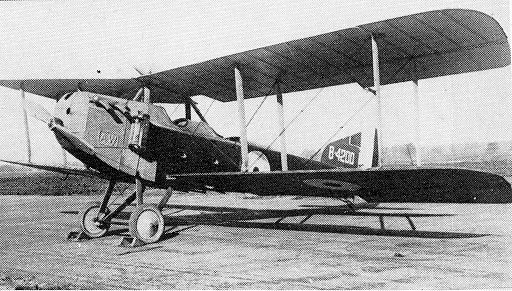
Armstrong Whitworth F.K.8
The Armstrong Whitworth F.K.8 was a British two-seat general-purpose biplane that first flew in May 1916. Designed by Frederick Koolhoven and built by Armstrong Whitworth, it served in reconnaissance, artillery spotting, light bombing, and training roles. Production continued through 1918, resulting in over 1 600 aircraft. Its straightforward construction and adaptable mission fit made it a workhorse of the Royal Flying Corps and later the RAF.
Design and Development
Origins and Objectives
Early in 1916, the Royal Flying Corps required an aircraft more robust than the B.E.2 series yet easier to manufacture than competing designs. Frederick Koolhoven set out to create a stronger airframe with improved pilot visibility and stable flight characteristics. Crew positions were reversed from earlier models, placing the pilot in the forward cockpit and the observer behind to optimize field of fire and communication.
Prototype Evolution
The first prototype, initially designated F.K.7, revealed underpowered performance and marginal stability. Engineers responded by lengthening the fuselage, revising tail surfaces, and fitting swept upper wings. A switch to the 160 hp Beardmore six-cylinder inline engine provided adequate power. Testing throughout late 1916 confirmed the refined layout and led to official adoption as the F.K.8.
Production Roll-out
Armstrong Whitworth established production lines at Gosforth and contracted Angus Sanderson & Co for supplemental output. By late 1917, manufacturing reached a peak of eighty aircraft per month. Variants featured different engines—including the 150 hp RAF 4a and 200 hp RAF 4d—as well as incremental airframe tweaks to improve reliability on front-line airfields.
Airframe and Construction
Structure and Materials
The F.K.8 employed a welded steel-tube fuselage with wooden longerons and fabric covering. This hybrid structure balanced strength with ease of repair. Wing spars and ribs used spruce and ash, while metal fittings reinforced high-stress joints.
Wing Design
Unequal-span single-bay biplane wings adopted slight sweep on the upper plane to mitigate stall tendencies. Balanced ailerons on the top wing reduced control forces. Interplane struts and bracing wires maintained rigidity without excessive drag.
Undercarriage
Original oleo undercarriage legs absorbed landing shocks but proved fragile on rough fields. Later production machines received simplified vee-type gear from Bristol F.2 Fighters for enhanced durability. A sprung tailskid completed the landing assembly.
Powerplant and Propulsion
Primary Engine
The standard powerplant was a Beardmore six-cylinder inline water-cooled engine delivering 160 hp. It featured a single-bay radiator mounted above the upper wing center section. Propulsion drove a two-blade fixed-pitch wooden propeller optimized for climb and cruise.
Alternative Engines
To overcome supply constraints, some F.K.8s were fitted with 150 hp RAF 4a, 200 hp RAF 4d, or 150 hp Lorraine-Dietrich engines. Higher-powered variants improved climb rates but added weight that slightly reduced maneuverability.
Performance and Handling
The F.K.8 achieved a maximum speed of 150 km/h at 2 438 m and sustained cruise at 130 km/h. It reached 1 981 m in approximately 15 minutes 25 seconds and 3 048 m in 27 minutes 50 seconds. Service ceiling topped out at 3 962 m. Endurance approached three hours, allowing prolonged reconnaissance or artillery-spotting sorties. Pilots praised its forgiving stall behavior and stable gun platform for observers.
Armament and Equipment
Offensive and Defensive Guns
Forward armament comprised a synchronized .303 in Vickers machine gun for the pilot. The observer manned one or two .303 in Lewis guns on a Scarff ring mount, providing 360-degree coverage. Ammunition lockers and reload chutes were positioned for quick access.
Bomb Load
Under-wing racks accommodated light bombs totaling up to 118 kg. Typical loads included fragmentation or incendiary munitions for tactical strikes. A simple brackets-type bombsight aided shallow-angle attacks.
Communication and Navigation
Basic dual-control fittings allowed observers to fly in emergencies. Wireless telegraphy sets were installed in later production models for frontline coordination. The cockpit featured simple instruments: altimeter, airspeed indicator, compass, and magnetic compass repeater.
Operational History
Western and Secondary Fronts
First deliveries to No. 35 Squadron RFC began in January 1917. The F.K.8 saw extensive service in France, Belgium, and the Macedonian front. Its stable gun platform made it effective against observation balloons and ground targets. Loss rates remained moderate thanks to its structural resilience.
Post-War and Civil Use
After the Armistice, surplus F.K.8s were auctioned and found civilian roles as joy-ride aircraft, newspaper carriers, and survey platforms. Several exported units served with Qantas in Australia, performing mail flights and photographic survey work.
Variants
Early Production
Initial machines featured the 160 hp Beardmore engine, straight wings, and original oleo gear. Approximately the first 300 airframes followed this layout.
Improved F.K.8
Later production added swept upper wings, simplified vee undercarriage, refined tail surfaces, and streamlined nose sections. Engine variations expanded operational flexibility.
Experimental Engines
A limited number trialed the 105 hp RAF 1Ba and the 120 hp Beardmore engines during powerplant shortages, improving climb but altering handling characteristics.
Technical Specifications
| Parameter | Specification |
|---|---|
| Crew | 2 (pilot and observer) |
| Length | 9.45 m |
| Wingspan | 13.29 m |
| Height | 3.35 m |
| Wing area | 50.16 m² |
| Empty weight | 869 kg |
| Loaded weight | 1 275 kg |
| Powerplant | 1×Beardmore 160 hp inline engine; alternative 150 hp RAF 4a; 200 hp RAF 4d; 150 hp Lorraine |
| Maximum speed | 150 km/h at 2 438 m |
| Cruise speed | 130 km/h |
| Range | Approximately 350 km (3 h endurance) |
| Service ceiling | 3 962 m |
| Rate of climb | 1 981 m in 15 min 25 s; 3 048 m in 27 min 50 s |
| Armament | 1×.303 in Vickers; 1–2×.303 in Lewis on Scarff ring; up to 118 kg bombs |
Legacy
The Armstrong Whitworth F.K.8 demonstrated how pragmatic engineering and streamlined production could meet diverse wartime roles. Its success on secondary fronts and post-war civilian applications underscored a balance of reliability, ease of maintenance, and adequate performance. Design lessons from the F.K.8 informed later two-seat reconnaissance and light-bomber types, cementing its place in early military aviation history.
.jpg)