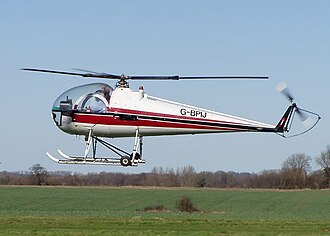
Brantly B-2: The Unusual Little Helicopter That Helped Define the Personal Rotorcraft
The Brantly B-2 is one of the more distinctive light helicopters to emerge from the great expansion of rotorcraft development in the United States during the 1950s. Compact, unconventional in appearance and designed primarily with the private owner in mind, the B-2 represented an attempt to make helicopter ownership more accessible at a time when the idea of the “personal helicopter” was attracting considerable attention. Developed by Newby O. Brantly after the earlier B-1, the B-2 abandoned the complexity of its predecessor’s coaxial rotor arrangement in favor of a more conventional single main rotor and anti-torque tail rotor. The first B-2 prototype flew on 21 February 1953, and after a lengthy development period the type entered production in the late 1950s. The aircraft eventually evolved through B-2, B-2A and B-2B versions, with the later B-2B receiving a fuel-injected 180-horsepower Lycoming engine and other improvements. Although it was small enough to be considered a practical personal helicopter, the B-2 also attracted military interest and was evaluated by the United States Army under the designation YHO-3. Its career ultimately demonstrated both the possibilities and limitations of small piston-powered helicopters, while its unusual rotor system and long production history gave it a lasting place in aviation history.
The Origins of the Brantly B-2
The story of the B-2 begins with Newby O. Brantly’s first helicopter, the B-1. Developed during the 1940s, the B-1 employed a coaxial rotor arrangement in which two rotors turned in opposite directions, eliminating the need for a conventional tail rotor to counteract engine torque. Although the arrangement had theoretical advantages, Brantly concluded that the resulting aircraft was too complicated and heavy for the private market he hoped to reach. The B-2 was therefore conceived as a simpler alternative, using a single main rotor and a conventional anti-torque tail rotor. This change may appear straightforward, but it represented an important shift in the design philosophy. Instead of pursuing an unusual rotor arrangement that could maximize compactness and eliminate torque reaction, Brantly concentrated on producing a comparatively conventional helicopter that could be manufactured and operated more economically.
The first B-2 prototype made its maiden flight on 21 February 1953. Development did not end there, however. A second prototype followed on 14 August 1956, reflecting the considerable amount of testing and refinement required before a small helicopter could be placed into series production. The eventual production aircraft received FAA certification on 27 April 1959, and the B-2 began to establish itself as a genuine two-seat light helicopter rather than merely an experimental personal aircraft.
The Dream of the Personal Helicopter
The B-2 appeared during a period when aviation manufacturers were exploring whether helicopters could become practical transportation machines for ordinary private owners. The ability to take off and land vertically seemed to offer enormous possibilities. A helicopter did not need a runway, could operate from comparatively small areas and could potentially take its owner directly from one location to another without the infrastructure required by a conventional airplane.
The challenge was economics. Helicopters were mechanically complex, and their engines, transmissions and rotor systems made them substantially more expensive to build and maintain than many fixed-wing aircraft. Brantly’s answer was to create a relatively small machine with two seats and a piston engine, concentrating on useful personal transportation rather than trying to make a miniature commercial helicopter.
The B-2 was therefore an early attempt to make helicopter ownership approachable. Its compact dimensions and relatively simple configuration reflected the idea that a private helicopter should not need to be a large, elaborate machine.
A Distinctive Helicopter Design
The B-2 has a conventional single-main-rotor layout, but its proportions make it immediately recognizable. The cabin is positioned toward the front of the fuselage, with the engine installed vertically behind the occupants. The main rotor sits above the cabin, while a small tail boom extends rearward to the anti-torque rotor. The resulting silhouette is compact and somewhat unusual compared with modern light helicopters, whose engines and fuselage arrangements tend to follow more standardized patterns.
The aircraft’s two-seat cabin is central to its purpose. With the occupants seated side by side, the B-2 could be used for personal transportation, observation, instruction and recreational flying. The relatively small cabin also kept the helicopter’s overall dimensions and weight under control.
The fuselage of the B-2B was of all-metal construction, while the aircraft’s rotor system evolved during production. The later B-2B incorporated three-bladed articulated main rotor technology and could be fitted with different landing-gear arrangements, including skids, wheels or floats. These options gave operators some flexibility depending on the intended mission and operating environment.
The Unusual Main Rotor
One of the B-2’s most interesting technical characteristics is its main rotor system. The aircraft used a three-bladed rotor, and the rotor blades incorporated an unusual construction arrangement that became associated with the Brantly design. The rotor system was engineered around the demands of a small piston-powered helicopter, where vibration, rotor dynamics and ground resonance could have significant effects on the aircraft.
The B-2’s rotor was not simply a scaled-down version of a large helicopter’s system. Small helicopters have their own challenges, particularly because low rotor inertia and lightweight structures can make vibration and dynamic behaviour important design considerations. The Brantly approach consequently became one of the defining engineering features of the aircraft.
The unusual appearance of the rotor and its relatively low position also contributes to the B-2’s distinctive visual identity. It is an aircraft that looks immediately different from the Bell, Robinson and Hughes designs that later became more familiar to the public.
The B-2A and B-2B
The original B-2 was followed by the B-2A, which introduced a redesigned cabin and additional refinements. One of the most noticeable changes was the cockpit canopy, which improved visibility and gave the aircraft a somewhat more modern appearance. Production figures from historical aviation references indicate that approximately 194 B-2s and 18 B-2As were produced before the improved B-2B became the principal version.
The B-2B represented a much more significant development. It introduced metal rotor blades and a fuel-injected Lycoming engine producing approximately 180 horsepower. The additional power allowed the helicopter to operate at a higher gross weight, while the improved rotor system helped modernize the aircraft. The B-2B received its type certification on 1 July 1963. Approximately 165 B-2Bs were built between 1963 and 1967 according to historical production records.
Why More Power Mattered
For a helicopter, additional engine power can have a particularly important effect because the engine must provide enough energy not only for forward flight but also for hovering and climbing. A relatively small increase in useful power can therefore improve the aircraft’s ability to carry additional fuel, equipment or passengers while maintaining acceptable performance.
The B-2B’s 180-horsepower Lycoming engine represented a major increase over the engines associated with earlier B-2 versions. It also allowed the aircraft’s maximum weight to rise, making the later helicopter more useful as a general-purpose machine.
The improved B-2B consequently became the most important version of the family and the model most commonly encountered in surviving examples and historical references.
Military Evaluation: The YHO-3
Although the B-2 was designed primarily for civilian use, its small size and ability to operate from confined areas made it interesting to the military. The United States Army obtained five B-2 helicopters for evaluation in the light observation role. These aircraft received the designation YHO-3 and were tested at Fort Rucker and the Naval Air Test Center at Patuxent River, Maryland.
The Army’s interest reflected the rapidly expanding role of helicopters in military aviation during the 1950s. Helicopters could perform observation and liaison missions without conventional runways, making them potentially valuable for battlefield reconnaissance and command operations.
The B-2’s compact size was both an advantage and a disadvantage in this context. It was easy to operate from relatively restricted areas, but the Army ultimately considered the aircraft too small for practical military use. The five evaluation aircraft were eventually returned to the manufacturer.
A Lesson in Mission Requirements
The YHO-3 evaluation illustrates an important point about aircraft development: a successful civilian design does not automatically make a successful military aircraft. Military operators often require greater payload, endurance, equipment capacity and environmental capability than private users.
For a private owner, a two-seat helicopter might be perfectly adequate. For a military observation mission, however, the aircraft might need additional radios, observation equipment, armor, fuel or other equipment. The B-2’s small dimensions left relatively little room for such additions.
Nevertheless, the Army evaluation was significant because it showed that the B-2’s basic configuration was sufficiently credible to be considered for a military role.
Production and Corporate Changes
The B-2 enjoyed a surprisingly long production history for such a small helicopter. Historical records indicate that the improved B-2B remained in production into the 1960s, with the company becoming associated with Gates Learjet from 1966. Production figures vary somewhat between sources depending on whether prototypes and later derivatives are included, but approximately 334 B-2-family aircraft are commonly cited.
The type’s longevity was helped by the fact that its basic concept remained useful. A compact two-seat helicopter could serve a variety of private and commercial purposes, while the ability to use different landing-gear configurations expanded its operating possibilities.
Ownership and manufacturing rights changed hands over the years. Brantly Helicopter Industries eventually acquired the type certificates for the B-2B and Model 305 in 1994, after earlier changes in ownership and production rights. This succession of companies and rights holders is typical of long-lived specialist aircraft designs, where continued support can be more important than large-scale new production.
The Brantly 305
The B-2 also became the foundation for a larger derivative, the Brantly Model 305. Developed in the 1960s, the 305 retained the basic character of the B-2 but enlarged the fuselage and increased the seating capacity to five. The prototype first flew in January 1964 and was powered by a 305-horsepower Lycoming engine.
The 305 demonstrated that the B-2 concept could be expanded. The original helicopter had been deliberately compact, but there was clearly a market for a larger machine offering more passenger capacity. The derivative therefore extended Brantly’s design philosophy into a more capable utility helicopter.
The relationship between the B-2 and 305 is important because it shows that the B-2 was not an isolated design. Its configuration was sufficiently successful to serve as the basis for a larger aircraft, reinforcing the importance of the original helicopter in Brantly’s product history.
The B-2 in Popular Culture
The Brantly B-2 also achieved a small place in popular culture. One example appeared in the 1967 James Bond film You Only Live Twice, giving the unusual helicopter a fleeting connection with one of cinema’s most famous fictional secret agents.
Although the appearance did not transform the B-2 into a household name, it is an amusing reminder of how distinctive the helicopter’s appearance was. Its compact dimensions and unusual rotor arrangement made it visually memorable, and its presence in a major film provided an additional historical curiosity for aviation enthusiasts.
Why the Brantly B-2 Still Matters
The B-2 is historically important because it captures a particular stage in helicopter development. During the 1950s, the basic helicopter configuration was becoming increasingly standardized, but manufacturers were still experimenting with ways to make rotorcraft smaller, cheaper and more accessible.
The B-2’s answer was to keep the aircraft compact and relatively straightforward. It was not intended to compete with large turbine-powered helicopters, nor was it designed for heavy commercial operations. Instead, it targeted the space between experimental rotorcraft and larger utility helicopters.
Its survival in the aviation world is also a testament to the durability of the basic concept. More than half a century after the first B-2 prototype flew, examples of the family remain identifiable in aviation records and collections. The aircraft’s relatively modest size and piston engine also make it an interesting contrast to the sophisticated turbine helicopters that dominate many modern commercial and military applications.
An Important Chapter in Light Helicopter History
The Brantly B-2 deserves recognition alongside better-known light helicopters because it represents a genuine attempt to democratize vertical flight. The dream of a helicopter in every private pilot’s garage never became reality on the scale imagined during the 1950s, largely because helicopters remained expensive and mechanically demanding.
Yet the B-2 came closer to that ideal than many of its contemporaries. It was small, relatively simple and designed specifically for the private market. Its two-seat layout made it practical for personal flying, while its later variants demonstrated that the design could be developed into a more capable aircraft.
The helicopter also illustrates the importance of evolutionary engineering. Brantly did not create the final B-2 in a single step. The aircraft developed through prototypes, testing, cabin improvements, engine upgrades and rotor-system changes. Each stage addressed practical shortcomings and increased the helicopter’s usefulness.
Conclusion
The Brantly B-2 is an unusual but important chapter in American helicopter history. Conceived by Newby O. Brantly after the more complicated B-1, it represented a deliberate attempt to create a simpler helicopter for private owners. Its first flight in 1953 began a development program that ultimately produced the B-2, B-2A and B-2B, with the later B-2B receiving a more powerful 180-horsepower fuel-injected Lycoming engine and improved rotor blades.
The aircraft’s small size was both its defining characteristic and its principal limitation. For private owners, the compact two-seat layout was attractive, but the same characteristics made the helicopter less suitable for demanding military missions. The Army’s YHO-3 evaluation confirmed that the B-2 had potential as an observation helicopter but ultimately judged it too small for practical service.
Despite that limitation, the B-2 proved remarkably durable as a design. Its long production run, development into the larger Model 305 and continued recognition among helicopter enthusiasts demonstrate that Brantly’s basic concept had genuine merit.
Perhaps the most interesting aspect of the B-2 is what it represents. The helicopter was created at a time when vertical flight was still new enough to inspire visions of personal transportation, yet mature enough for engineers to begin seriously considering how to make small rotorcraft practical. The B-2 was one answer to that challenge. It may never have become the “helicopter for everyone” that some imagined, but it helped establish the idea that a helicopter could be compact, relatively straightforward and designed specifically around the needs of the private pilot.
Today, the Brantly B-2 remains instantly recognizable and historically valuable. Its unconventional proportions, distinctive rotor system and long development history make it far more than an obscure light helicopter. It is a snapshot of an era when designers were still discovering what the practical personal helicopter could be—and an enduring reminder of just how diverse the early generations of rotorcraft really were.
Brantly B-2 Technical Specifications
The specifications below primarily describe the B-2/B-2B family, with the engine and performance figures most closely associated with the later B-2B. Individual aircraft and earlier versions differed in engine, weight, landing gear and equipment.
| Specification | Brantly B-2 / B-2B |
|---|---|
| Aircraft type | Two-seat light utility helicopter |
| Manufacturer | Brantly Helicopter Corporation |
| Designer | Newby O. Brantly |
| First flight | 21 February 1953 |
| Production introduction | 1958–1959 |
| Crew / occupants | 2 |
| Configuration | Single main rotor with anti-torque tail rotor |
| Main rotor | 3-bladed |
| Fuselage | All-metal on B-2B |
| Engine, B-2B | Lycoming IVO-360-A1A |
| Engine type | Air-cooled, horizontally opposed piston engine |
| Power | 180 hp (134 kW) |
| Length | Approximately 8.41 m (27 ft 7 in) |
| Height | Approximately 2.11 m (6 ft 11 in) |
| Main rotor diameter | Approximately 7.24 m (23 ft 9 in) |
| Rotor disc area | Approximately 41.2 m² (444 sq ft) |
| Empty weight | Approximately 463 kg (1,021 lb) |
| Maximum gross weight | Approximately 757 kg (1,669 lb) |
| Cruise speed | Approximately 145 km/h (90 mph / 78 kt), depending on version |
| Range | Approximately 400 km (249 miles) |
| Service ceiling | Approximately 3,290 m (10,800 ft) |
| Rate of climb | Approximately 579 m/min (1,900 ft/min), source/configuration dependent |
| Landing gear | Skids, wheels or floats depending on configuration |
| Military designation | YHO-3 |
| Military evaluation | United States Army light-observation trials |
| B-2A introduction | Redesigned cabin and equipment improvements |
| B-2B introduction | Fuel-injected 180 hp engine and improved metal rotor blades |
| Approximate B-2-family production | 334 aircraft commonly cited |
| Related development | Brantly Model 305 |
Performance and dimensions can vary between B-2, B-2A and B-2B aircraft, so figures should be treated as representative rather than universal.
