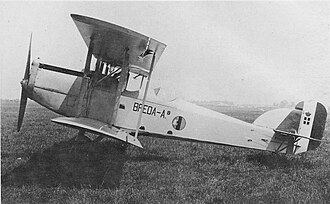
Breda A.9: The Italian Biplane Trainer That Prepared a New Generation of Pilots
The Breda A.9 was a compact Italian biplane that played an important role in the development of military aviation during the late 1920s and early 1930s. Designed primarily as a trainer for the Regia Aeronautica, the A.9 was created at a time when Italy was rapidly expanding and reorganizing its military flying schools and needed aircraft that could bridge the gap between elementary instruction and the demanding skills required of operational pilots. Built by Società Italiana Ernesto Breda, the aircraft combined a conventional single-engine biplane layout with a surprisingly versatile design philosophy. It could be operated as a two-seat trainer with dual controls or adapted to single-seat flying, while different lower-wing arrangements allowed the aircraft to be used for different stages of instruction. Powered by the 260-horsepower Isotta Fraschini Asso 200, the A.9 was not a high-speed combat aircraft, but it offered the performance and handling qualities needed for advanced instruction and aerobatic training. Approximately 60 examples were produced, including 43 for military service, and the type remained in use until 1934. Its direct successor, the Breda Ba.25, retained much of the A.9’s basic configuration while introducing a stronger fuselage and improved landing gear, eventually becoming one of Italy’s most important trainer aircraft.
The Origins of the Breda A.9
The A.9 emerged from a period when Italian aviation was undergoing major institutional and technological change. During the 1920s, the Italian military was seeking reliable aircraft that could support the systematic training of pilots for an increasingly modern air force. Training aircraft had to accomplish more than simply getting a student into the air. They needed to provide enough performance for advanced exercises while remaining manageable for pilots who were still developing their skills.
Breda’s aviation division entrusted the design of the A.9 to engineer Ugo Abate. His approach was deliberately conventional, producing a biplane with a single engine, tandem cockpits and a fixed tailskid undercarriage. The aircraft was built using a mixed construction method, with a wooden airframe and fabric covering, while sheet metal was used around the cockpit areas. This construction philosophy was entirely consistent with the aircraft technology of the period and allowed Breda to produce a relatively lightweight structure without requiring the extensive all-metal manufacturing techniques that would become increasingly common during the 1930s.
The resulting aircraft was intended primarily for advanced instruction and aerobatic work. This was an important distinction. The A.9 was not simply an elementary trainer designed to teach a student how to take off and land. It was intended to prepare pilots for more demanding flying, including the skills required for fighter training.
A Trainer Designed for Different Stages of Flight Training
One of the most interesting characteristics of the A.9 was its adaptability. The aircraft could be configured as a two-seat machine for instruction, with the student and instructor sitting in tandem, but it could also be operated as a single-seat aircraft. Even more unusually, the lower wing could be provided in different spans. A lower wing matching the span of the upper wing was intended for second-period training, while a reduced-span lower wing was associated with more advanced, third-period instruction and aerobatic work.
This arrangement reflected the way military pilot training was being organized at the time. Rather than expecting one aircraft to perform every task identically, the A.9 could be adapted to give students progressively more demanding flying experience. The aircraft could therefore serve as a bridge between basic instruction and the more specialized flying expected of military pilots.
Such versatility was especially useful for an air force building its training infrastructure. Aircraft were expensive resources, and a design that could perform several instructional roles offered obvious practical advantages.
The A.9’s Conventional Biplane Configuration
Visually, the Breda A.9 belonged firmly to the biplane era. Its two wings were arranged in a conventional single-bay configuration, with the wings unstaggered. The aircraft had a relatively substantial wing area, helping it maintain useful low-speed characteristics despite the weight of its relatively powerful engine and robust construction.
The open cockpits were arranged in tandem, giving the instructor and student separate positions while maintaining the traditional arrangement used by many military trainers of the period. The fixed tailskid undercarriage was simple and durable, an important consideration for training operations where aircraft could experience considerably more frequent takeoffs and landings than frontline machines.
The structure was predominantly wooden and fabric-covered, although the cockpit areas received sheet-metal covering. This mixed construction approach was typical of the late 1920s. Wood remained an excellent material for aircraft structures because it could provide adequate strength at relatively low weight, while fabric offered a simple and lightweight aerodynamic covering.
Why the Biplane Still Made Sense
By the late 1920s, monoplane designs were beginning to demonstrate the aerodynamic advantages that would eventually make the biplane obsolete for most military roles. Yet the biplane remained extremely attractive for training. Its two-wing configuration provided substantial lift and structural strength within a relatively compact span, making it possible to build an aircraft with useful low-speed handling characteristics.
For a trainer, those characteristics could be more important than absolute speed. Students needed an aircraft that responded predictably and gave them enough time to recognize and correct mistakes. A biplane could provide the forgiving behavior that instructors wanted while still offering enough performance for advanced exercises.
The A.9 therefore represents an interesting transitional stage. It incorporated a reasonably powerful engine and was intended for advanced flying, yet it retained the fundamental configuration of an earlier generation of aircraft.
The Isotta Fraschini Asso 200
The Breda A.9 was powered by the Isotta Fraschini Asso 200, an Italian liquid-cooled inline engine. The Italian Air Force’s historical record gives the engine’s output as 260 horsepower. This was a substantial amount of power for a relatively small training aircraft and helped the A.9 achieve a maximum speed of approximately 180 km/h.
The use of a domestically produced engine was significant for Italy’s aviation industry. During the interwar period, Italian manufacturers were developing a wide range of indigenous aircraft engines, and the Asso family became associated with numerous Italian aircraft designs.
For the A.9, the engine provided enough power to make the aircraft suitable for advanced training and aerobatic work. The objective was not to achieve fighter-like speed but to provide a capable platform in which students could develop the skills necessary for more demanding aircraft.
The engine installation also contributed to the A.9’s relatively substantial empty and loaded weights. According to the Aeronautica Militare, the aircraft had an empty weight of 896 kg and a total weight of 1,211 kg.
Performance Suitable for Advanced Training
The official Italian Air Force figures list a maximum speed of 180 km/h and a maximum endurance of approximately three hours. These figures place the A.9 firmly in the advanced-training category rather than among high-performance fighters of its era.
The relatively modest maximum speed was not necessarily a disadvantage in its intended role. A training aircraft needs to provide adequate performance while retaining characteristics that allow instructors to operate safely with inexperienced pilots. The ability to remain airborne for up to three hours also offered sufficient time for extended training sorties without requiring excessively frequent fuel stops.
The A.9’s performance should therefore be judged according to its mission. It was not designed to win aerial combat. It was designed to produce pilots who might eventually fly aircraft that did.
Service With the Regia Aeronautica
The Breda A.9 was selected for military training use by the Regia Aeronautica, the Italian Royal Air Force. According to the Aeronautica Militare, 43 of the approximately 60 aircraft produced were destined for military service, where they were used to replace older SVA aircraft in the flight school of the Regia Aeronautica Academy.
This assignment gives the A.9 a particularly interesting place in Italian aviation history. The aircraft was not merely another trainer purchased in small numbers; it was directly connected with the institution responsible for preparing future military pilots.
The replacement of the SVA trainers also illustrates the pace of technological change. The Ansaldo SVA family had originated during the First World War and had continued to serve in various roles after the conflict. By the late 1920s, however, the Italian Air Force needed more modern aircraft for its training system. The A.9 provided a purpose-built alternative better suited to the requirements of a new generation of pilots.
Training and Aerobatic Flying
The A.9’s role in aerobatic instruction was particularly important. Military pilots needed to understand aircraft behavior under conditions that went beyond ordinary straight-and-level flying. Turns, climbs, dives, stalls and other maneuvers formed part of the foundation of advanced pilot training.
The aircraft’s configuration allowed it to serve these purposes while retaining a degree of practicality. The single-seat configuration could be used when the student had progressed sufficiently to fly without an instructor aboard, while the two-seat arrangement provided supervision during earlier stages.
This dual-purpose philosophy was one of the design’s strengths. Instead of requiring separate aircraft for every stage, a school could use the A.9 as a flexible training platform.
The Breda A.9bis
The standard A.9 was followed by the A.9bis, a slightly smaller-span version intended for Italy’s civilian aeroclubs. The reduced size reflected the different requirements of civilian flying organizations, where aircraft could be used for recreational flying, pilot development and aerobatic activities rather than exclusively for military training.
The A.9bis is significant because it demonstrates that the basic design had appeal beyond the military. A successful trainer can often be adapted to civilian flying because the same characteristics that make it suitable for instruction—predictable handling, structural strength and useful performance—are also valuable to private pilots.
The existence of the A.9bis also shows that Breda was not treating the A.9 as a single-purpose military product. The underlying airframe could be adjusted to meet different operational requirements.
The Breda A.10 Connection
The A.9 family also led to the Breda A.10, a related single-seat fighter-trainer prototype. Only one A.10 was built. It featured a reduced wingspan and was powered by an Isotta Fraschini V.6 engine rated at approximately 250 horsepower.
The A.10 is interesting because it reveals the potential Breda saw in the basic A.9 configuration. The company could take the fundamental biplane arrangement and adapt it toward a more fighter-oriented role. While the A.10 did not develop into a major production aircraft, it illustrates the versatility of the underlying design philosophy.
This kind of development was common during the interwar period. Manufacturers often used successful trainers as the basis for other aircraft because the existing design offered a tested structural and aerodynamic foundation. The process could reduce development risk compared with starting a completely new aircraft from the beginning.
From A.9 to Ba.25
The most important descendant of the A.9 was the Breda Ba.25, which drew directly on the experience gained with the earlier aircraft. The Aeronautica Militare describes the Ba.25 as retaining the same basic layout while introducing a stronger fuselage made from welded steel tubes and a landing gear with independent wheels. The Asso 200 engine remained, still producing 260 horsepower.
The Ba.25 would become considerably more successful in production terms. Military production began in June 1932 and continued until 1942, with 661 examples built. Initially intended for advanced training, the Ba.25 was also assigned to other flight schools from 1937.
This makes the A.9 particularly important historically. Although only around 60 were produced, its design experience directly contributed to an aircraft that became one of Italy’s most widely produced military trainers of the interwar and early wartime period.
Lessons From the A.9
The transition from A.9 to Ba.25 demonstrates how aircraft design evolves through practical experience. The A.9’s basic layout had proven useful, but the successor strengthened the fuselage and replaced the tailskid arrangement with a more conventional wheeled landing gear.
The Ba.25 also had a somewhat lighter structure and improved performance. Its maximum speed was approximately 204 km/h, compared with around 180 km/h for the A.9 according to Aeronautica Militare specifications.
The successor therefore retained the successful elements of the earlier design while addressing some of its limitations. In that sense, the A.9 was not an evolutionary dead end. It was a foundation.
The A.9’s Place in Italian Aviation History
The Breda A.9 is not as famous as aircraft such as the Macchi fighters, Savoia-Marchetti bombers or Fiat’s later combat aircraft, but its historical importance lies in the training system. Military aviation depends on trained personnel, and aircraft dedicated to pilot instruction rarely receive the attention given to combat types despite their essential role.
The A.9 belongs to the generation of Italian aircraft that helped transform military flying from the pioneering activity of the First World War into a more structured and professional system. Its use by the Regia Aeronautica Academy placed it directly within that transformation.
The aircraft also represents a moment when the biplane remained a perfectly rational choice for training. Within only a few years, monoplane designs would become increasingly dominant, and the technology of aviation would move rapidly toward stressed-skin construction, retractable landing gear and increasingly powerful engines. The A.9 therefore captures a transitional period when traditional aircraft architecture was being refined even as a fundamentally different generation of airplanes was approaching.
Conclusion
The Breda A.9 was a modest aircraft in size and production numbers, but its contribution to Italian aviation was considerably greater than those figures might suggest. Designed by Ugo Abate for Breda, it provided the Regia Aeronautica with a flexible advanced trainer capable of two-seat instruction, single-seat operation and aerobatic training. Its conventional wooden-and-fabric biplane structure, tandem open cockpits, fixed tailskid landing gear and 260-horsepower Isotta Fraschini Asso 200 engine reflected the practical requirements of late-1920s military aviation.
Approximately 60 A.9-family aircraft were produced, including 43 military examples, and the aircraft remained in service until 1934. The A.9bis broadened the concept into civilian aeroclub use, while the A.10 explored a more fighter-oriented derivative. Most importantly, experience with the A.9 contributed directly to the development of the Breda Ba.25, which retained the basic configuration while introducing a stronger fuselage and improved landing gear and eventually achieved production of 661 aircraft.
The Breda A.9 is therefore best understood not as a forgotten biplane but as an important stepping stone in Italian military aviation. It helped modernize pilot training, introduced a flexible approach to advanced instruction and provided Breda with experience that would feed directly into one of the country’s more successful trainer designs. Its career also illustrates how quickly aviation was changing during the interwar years: an aircraft that represented modern training technology in 1928 was already being replaced by a more advanced derivative only a few years later.
For aviation enthusiasts, the A.9 is especially interesting because it embodies the character of its era. It was traditional without being obsolete, versatile without being overly complicated and powerful enough to prepare pilots for the next generation of aircraft. Although few examples were built, its influence can be seen in the much larger success of the Ba.25 and in the continuing development of Italy’s military flying schools during the 1930s.
Breda A.9 Technical Specifications
The following table uses the Breda A.9 figures published by the Aeronautica Militare, which differ in some respects from figures reproduced in older reference works. Where historical sources disagree, the official Italian Air Force data are used here as the primary reference.
| Specification | Breda A.9 |
|---|---|
| Aircraft type | Advanced training and aerobatic biplane |
| Manufacturer | Società Italiana Ernesto Breda |
| Designer | Ugo Abate |
| Country of origin | Italy |
| First flight | 1928 |
| Primary operator | Regia Aeronautica |
| Crew | 2 in standard training configuration |
| Configuration | Single-engine, single-bay biplane |
| Seating | Tandem, open cockpits |
| Construction | Wooden structure with fabric covering; sheet metal around cockpit areas |
| Engine | 1 × Isotta Fraschini Asso 200 |
| Engine type | Liquid-cooled inline piston engine |
| Power | 260 hp (194 kW) |
| Length | 8.10 m (26 ft 7 in) |
| Height | 3.10 m (10 ft 2 in) |
| Wingspan | 9.32 m (30 ft 7 in) |
| Wing area | 27 m² (291 sq ft) |
| Empty weight | 896 kg (1,975 lb) |
| Maximum/total weight | 1,211 kg (2,670 lb) |
| Maximum speed | 180 km/h (112 mph) |
| Maximum endurance | Approximately 3 hours |
| Landing gear | Fixed tailskid undercarriage |
| Primary mission | Advanced pilot training |
| Secondary mission | Aerobatic training |
| Civilian derivative | A.9bis |
| Related prototype | A.10 fighter-trainer |
| Approximate production | 60 aircraft |
| Military production | 43 aircraft |
| Service period | Approximately 1928–1934 |
Note: Some older English-language references give different figures for dimensions, weights, engine output and performance. The specifications above follow the official Aeronautica Militare historical entry for the A.9, while the historical discussion incorporates information from other aviation references where useful.
