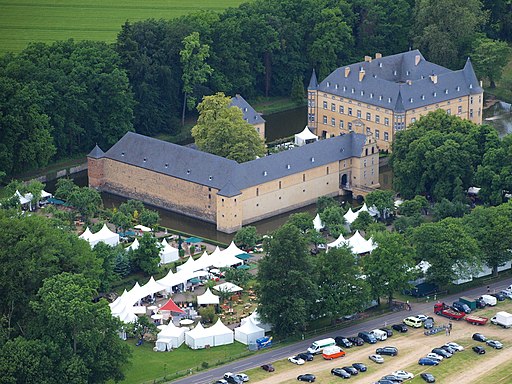
Burg Adendorf
Burg Adendorf is a Renaissance-era water castle situated on the fringe of the Rhine floodplain near Remagen in Rhineland-Palatinate. Encircled by a four-armed moat fed by groundwater springs, it combines defensive waterworks with elegant residential wings arranged around a central courtyard. Over centuries it has evolved from a fortified noble estate into a heritage hotel and event venue, while retaining its historic fabric and architectural integrity.
Historical Development
Foundation and Early Ownership
Construction of Burg Adendorf began in the mid-16th century under the patronage of Johann von Loë, a local nobleman with ties to the Electoral court in Bonn. The choice of site—low-lying farmland with abundant groundwater—enabled creation of a full water barrier. Initial building phases comprised two main wings and a gatehouse, erected in regional trachyte and local sandstone for durability and status.
17th and 18th Century Transformations
During the Thirty Years’ War the moat and outer works proved effective in deterring small-scale raids, though the castle’s interiors suffered neglect. In the late 17th century the second owner repurposed part of the northern wing into agricultural storage. Baroque modifications introduced larger windows and decorative gables, transforming weapon niches into parlor alcoves. A covered wooden bridge replaced the original drawbridge in the early 18th century.
19th Century Decline and 20th Century Revival
By the 19th century Burg Adendorf had fallen into disrepair, with collapsed roofs and waterlogged cellars. Systematic restoration after World War II stabilized foundations and replaced failing timber elements. A comprehensive renovation in the 1970s converted living quarters into conference rooms and restored the chapel as a reception hall, ensuring the castle’s ongoing viability while respecting its historic character.
Site and Landscape Context
Topography and Water Management
- Elevation: 60 meters above sea level
- Moat dimensions: four arms each 7–8 meters wide and 1.5–2 meters deep
- Water source: perennial springs on the southern grounds feeding the moat via concealed stone culverts
The castle occupies a rectangular islet approximately 90 × 60 meters. Surrounding farmland lies within a historical flood zone, necessitating embankments to protect agricultural outbuildings.
Access and Approach
Primary access crosses the western moat arm via a fixed timber bridge spanning 6.5 meters. The approach path angles slightly to channel visitors toward the gatehouse façade, reinforcing ceremonial entry while maintaining defensibility.
Architectural Layout
Overall Plan
- Courtyard dimensions: 25 × 15 meters
- Two principal wings:
- Eastern residential wing: three stories, hipped roof
- Southern service wing: two stories, vaulted cellars below
- Gatehouse block: single-story with vaulted passage and former portcullis groove
The plan forms a U-shape opening to the northwest, where gardens occupy the former outer bailey.
Defensive and Ceremonial Elements
- Moat and embankment: primary water defense supplemented by earthworks on the outer bank
- Gatehouse features: murder-hole sockets in vaulted ceiling, slot for dividing timber barrier
- Corner bastions: small square turrets at each corner of the courtyard wall offering flanking views into the moat
Although intended for prestige as much as defense, these elements reflect a transitional phase between medieval fortification and early modern residence.
Structural Systems and Materials
Foundations and Substructure
- Footings: cut directly into alluvial gravel overlying clay, with lime concrete leveling pads
- Sub-moat walls: cobblestone rubble bonded with hydraulic lime to resist constant water exposure
- Cellar vaults: barrel vaults of brick with lime mortar, walls 1.2 meters thick to maintain cool storage temperatures
Superstructure Masonry
- Stone types: regional trachyte ashlar for corner quoining; local yellow sandstone for wall faces
- Wall thickness: ground floor external walls 1.0–1.2 meters; upper floors taper to 0.6–0.8 meters
- Bonding: alternating header-stretcher courses in ashlar sections; random rubble core in infill segments
Timber Framing and Roof
- Roof pitch: 45 degrees on residential wing, 36 degrees on service wing
- Truss types: collar-beam trusses with wind braces in great hall; queen-post trusses in bedrooms
- Coverings: originally oak shingles, replaced with clay tiles in the 18th century; modern restoration uses reclaimed slate to match historic profiles
Interior Layout and Decorative Features
Ground Floor and Service Areas
- Kitchen and bakehouse: located in the southern wing, with two hearths and a vaulted smoke room
- Cellars: five interconnected vaults totalling 200 square meters, divided into wine, grain, and equipment storage
- Guardroom: adjacent to the gatehouse, 4 × 3.5 meters, with arrow slits facing the causeway
Principal Floor and Reception Spaces
- Great Hall dimensions: 12 × 8 meters, ceiling height 5.5 meters, original wall anchors indicating tapestry installations
- Chapel niche: semicircular apse with ribbed timber vault above, serving as private oratory
- Painted wood panels: 17th-century decorative motifs applied over original lime plaster, conserved in situ
Upper Floors and Private Chambers
- Lord’s chamber: 6 × 6 meters with fireplace and garderobe chute in outer wall
- Guest chamber: 5 × 4.5 meters, secondary heating via floor ventilator from great hall hearth
- Attic storage: open timber framing, boards running on 1.0-meter centers, providing seasonal hay and linen storage
Conservation Challenges and Strategies
Moisture and Structural Stability
Persistent moat water saturation requires ongoing monitoring of sub-wall humidity. Capillary rise is mitigated by ventilated French drains installed during the 1970s restoration. Stainless steel anchors reinforce areas where mortar joints have opened due to differential settlement.
Material Compatibility
Early cement-rich repointing in the 19th century created hard, impermeable zones that accelerated decay of adjacent softer ashlar. Modern conservation replaces inappropriate mortars with hydraulic lime mixes matched to the original binder’s porosity and compressive strength.
Timber Preservation
Damp conditions in vaulted cellars and service spaces invite fungal growth in exposed joists. Regular inspections use resistograph drilling to assess hidden decay. Consolidation with epoxy resin injections is limited to secondary spaces to avoid altering historic timber integrity in principal rooms.
Modern Use and Public Engagement
Hotel and Event Venue
Since the 1980s Burg Adendorf has operated as a boutique hotel with nine guest suites housed in the residential wing. Conference rooms occupy former service spaces, and the great hall hosts weddings and concerts under expertly controlled humidity and lighting.
Educational Programmes
Guided tours focus on construction methods, masonry conservation, and the transition from fortress to stately home. Hands-on workshops teach visitors to mix traditional lime mortar and dress small ashlar prototypes, fostering understanding of conservation craft.
Conclusion
Burg Adendorf exemplifies the melding of defensive waterworks with Renaissance domestic elegance. Its technical features—from masonry foundations cut into floodplain gravels to precisely pitched roofs clad in slate—tell a story of evolving function and continuous care. Through sensitive conservation and adaptive reuse, this water castle remains both a living hospitality venue and a testament to regional heritage and architectural ingenuity.
