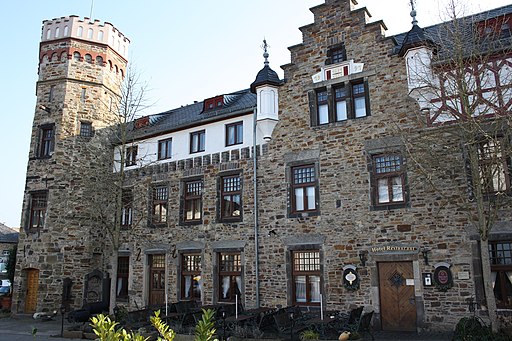
Burg Adenbach
Burg Adenbach stands atop a wooded ridge overlooking the Adenbach valley in Rhineland-Palatinate. Though now a picturesque ruin, the site preserves layers of defensive innovation, domestic architecture, and modern conservation. This article examines its historical evolution, technical parameters, architectural fabric, and ongoing preservation challenges.
Historical Development
Early Foundation in the High Middle Ages
The origins of Burg Adenbach date to the late 12th century, when a local knightly family established a wood-and-earth citadel on the hill crest to control forest resources and trade routes. Initial timber palisades and a motte were replaced by stonework within decades as wealth from tolls and forestry rights grew.
13th–14th Century Expansion
During the 13th century, the castle underwent major enlargement. A rectangular inner ward was enclosed with thick sandstone curtain walls. The great hall and residential range were added on the western slope, while a compact chapel occupied the eastern corner. Outer baileys for stables and workshops emerged below the upper enclosure.
15th–16th Century Modifications
In the late medieval period, Burg Adenbach’s defenses were reinforced in response to regional conflicts. Flanking towers with arrow slits replaced simple wall walks. Gunports were cut into the keep for hand cannons. Large mullioned windows and a vaulted ceiling appeared in the lord’s chamber, reflecting a shift toward comfort and status display.
Decline, Ruination, and Romantic Rediscovery
By the 17th century, Burg Adenbach lost strategic relevance and entered decline. Plunder during the Thirty Years’ War damaged walls and roofs. The site was abandoned after a fire in the late 18th century. In the 19th century, Romantic painters and travelers rediscovered the ruins, prompting early stabilization of wall fragments.
Site and Topography
Location and Strategic Position
- Elevation: 420 meters above sea level
- Prominence: 100 meters above the Adenbach valley floor
- Visibility: Nearly 300-degree views along forested ridges and valley approaches
The castle occupies a narrow basalt crest, with steep slopes on three sides. Access was restricted to a single winding path from the north, easily defensible with a gatehouse and rock-cut ditch.
Geology and Foundations
Local geology consists of basalt flows interbedded with slate. Builders cut directly into basalt ledges for footings, anchoring wall foundations on solid rock. Slate fragments served as rubble fill and levelling layers beneath masonry.
Architectural and Structural Analysis
Overall Plan and Zoning
The plan of Burg Adenbach follows a terraced design adapting to the ridge contours:
- Upper Ward (Inner Bailey): Keep, chapel, residential wing
- Middle Ward: Great hall, service ranges, courtyard
- Lower Ward (Outer Bailey): Stables, workshops, water cistern
Circulation between levels relied on stone stairways and narrow ramps carved into the bedrock.
Defensive Structures
Curtain Walls and Parapets
- Thickness: 1.4–2.0 meters at base
- Height: 7–10 meters in surviving sections
- Parapet Walkway: 1.1 meters wide, surfaced with dressed basalt slabs
Flanking Towers
- Quantity: Two projecting towers on eastern and southern walls
- Dimensions: Circular plan, 6 meters diameter, wall thickness 1.8 meters
- Height: 12–14 meters
These towers provided overlapping fields of fire along the curtain walls.
Keep and Tower
- Plan: Square, 8 × 8 meters internally
- Base Wall Thickness: 2.2 meters
- Original Height: Estimated 20 meters; extant ruin stands at 15 meters
- Access: Narrow spiral stair embedded in wall thickness, serving ground-level storage and upper-level chamber
The keep’s upper platform once held signalling equipment and small artillery.
Gatehouse and Entrance Defenses
The main gate on the northern side combined a double-leaf timber door and portcullis slot. A rock-cut ditch 3 meters deep fronted the entrance, crossed by a retractable wooden bridge. Murder holes and arrow slits in the gate passage created a lethal kill zone.
Domestic Quarters and Chapel
Great Hall and Residential Range
- Dimensions: 14 × 7 meters internally
- Ceiling Height: 6 meters with exposed timber trusses
- Hearth: Central stone hearth with flue leading into the outer wall
Private Chamber
A vaulted chamber above the chapel served as the lord’s private suite, featuring a stone bench and narrow window overlooking the valley.
Chapel
- Size: 6 × 4 meters internal
- Vaulting: Simple barrel vault
- Window: Single lancet on east wall
The chapel’s foundation walls incorporate ashlar blocks with carved remnants of religious motifs.
Materials and Masonry Techniques
Stone and Mortar
Builders used locally quarried basalt for ashlar blocks and random rubble. Sandstone lintels and slate slabs appear around openings. Mortar comprises lime binder with crushed slate aggregate, offering flexibility and breathability.
Timber Framework and Roofing
Original roof structures employed collar-beam trusses in the great hall and king-post trusses in service ranges. Roof coverings alternated between wood shingles and, later, clay tiles. Surviving timber fragments show mortise-and-tenon joinery and decorative chamfers.
Conservation and Restoration
Deterioration Mechanisms
Freeze-thaw cycles cause flaking in basalt faces. Former cement-based repointing has led to differential hardness, accelerating adjacent stone decay. Invasive vegetation roots exert pressure on masonry joints.
20th and 21st Century Interventions
- Repointing with natural hydraulic lime to match historic compressive strengths
- Installation of stainless steel ties in fractured sections to stabilize wall fragments
- Reconstruction of collapsed parapet segments using distinguishable replacement ashlar
- Protective canopies over the keep platform to shed rainwater
Maintenance Strategy
Annual condition assessments employ photogrammetry to monitor crack propagation. Vegetation is controlled through targeted herbicide application and manual removal. Roof remains receive periodic timber treatment against wood-boring insects, and drainage channels are cleared to prevent water pooling at foundations.
Public Access and Interpretation
Visitor Facilities
A stabilized path leads from the village to the upper gate, with handrails on steeper ramps. Interpretive panels explain the castle’s defensive systems and construction techniques. A cantilevered viewing platform provides panoramic vistas without stressing historic masonry.
Educational and Cultural Programmes
Local heritage groups host stone masonry workshops demonstrating traditional basalt dressing and lime mortar mixing. Guided medieval reenactments utilize the courtyard and great hall foundation, immersing visitors in everyday castle life.
Conclusion
Burg Adenbach exemplifies the adaptation of medieval fortification strategies to challenging terrain and volcanic geology. Its basalt ashlar walls, layered domestic and liturgical spaces, and evolving defensive innovations illustrate centuries of architectural and social history. Ongoing conservation balances compatible material repair, structural monitoring, and public engagement to ensure this hilltop ruin endures as a tangible link to the region’s medieval past.
