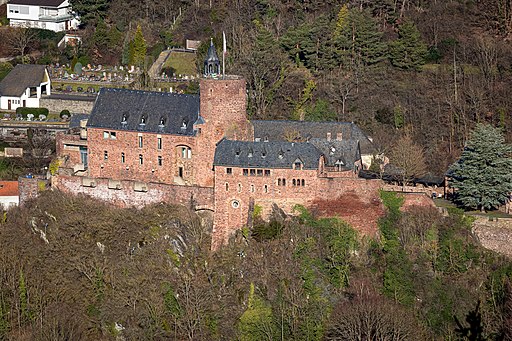
Burg Hengebach
Perched on a greywacke sandstone promontory above the Rur Valley, Burg Hengebach commands both strategic and scenic prominence in the North Eifel region of Germany. This hill castle, with origins tracing back to the 11th century, combines robust medieval engineering with adaptive reuse for cultural and hospitality purposes. Its well-preserved ring wall, bergfried (keep), and ancillary buildings provide insights into centuries of architectural evolution and defensive innovation.
Location and Site Context
Burg Hengebach overlooks the Rur River at an altitude of 216 m above sea level, rising from a natural ridgeline that offers panoramic views of the surrounding forested uplands. The site occupies coordinates 50° 38′ 0″ N and 6° 28′ 46″ E, situating it within the town limits of Heimbach in the district of Düren, North Rhine–Westphalia.
Technical Parameters
Geographical Coordinates and Elevation
- Latitude: 50° 38′ 0″ N
- Longitude: 6° 28′ 46″ E
- Elevation: 216 m above NN (Normalnull)
Architectural Styles and Materials
- Castle Type: Höhenburg (hill castle)
- Core Construction: Rubble-stone masonry (Bruchstein) for curtain walls and bergfried
- Bedrock: Built directly atop greywacke sandstone outcropping, integrating natural rock into foundations and lower wall courses
Layout and Dimensions
- Plan Shape: Oval ring fortress with an estimated footprint of 70 m by 50 m
- Curtain Wall Thickness: Approximately 1.2 – 1.5 m
- Bergfried Height: Roughly 25 – 30 m, featuring narrow embrasure slits and batter at the base for stability
- Inner Ward Structures:
- West Yard with combined palas (residential hall) and bergfried dating to the 12th–13th centuries
- Eastern Expansion comprising an outer bailey, garden enclosure, and zwinger (outer defensive courtyard) from the 14th century
- Southern Residential Buildings: Dual-purpose living quarters reinforced for fortification, constructed on cliff-edge foundations
- 18th-Century Additions: Northern courtyard buildings along Hengebachstraße, later tied into the main complex via stairways and elevator in 2009
Defensive Features
- Oval Ring Wall: Designed for overlapping fields of fire, minimizing blind spots
- Zwinger: Multi-level killing ground between inner and outer walls, measuring 5 – 8 m in width
- Embrasures and Hoardings: Evidence of wooden hoardings atop battlements for drop and missile defense
- Natural Moat: The steep rock faces on three sides augmented by man-made ditches where terrain permitted
Historical Development
Initial records attribute the first ownership to local noble families in the early 11th century. The structure evolved through successive phases:
- 11th–12th Century: Foundation phase with bergfried and palas
- 14th Century: Major enlargement adding outer ward, garden area, zwinger, and southern residential towers
- 18th Century: Civilian buildings erected near Hengebachstraße, reflecting diminished military utility
- 2009 Refurbishment: Integration of elevators and staircases connecting all levels, enabling access to art academy, restaurant, and municipal spaces
Current Use and Cultural Role
Today, Burg Hengebach hosts the International Art Academy Heimbach, offering studio courses and exhibitions within restored medieval wings. A castle tavern occupies part of the courtyard, serving regional cuisine, while municipal offices and a ceremonial tower chamber (Trauzimmer) provide civic functions. Overnight lodging is available in converted annexes, blending historic ambiance with modern amenities.
Getting Here
Car Access
- From Aachen or Cologne, take Autobahn A4 toward Olpe/Kreuz Aachen, exit at Kreuz Aachen and follow B56 southbound to Heimbach.
- Within Heimbach, follow signage for “Burg” and park in the designated lot at the foot of the castle hill. A short paved path and stairway lead up to the main gate.
Public Transport
- Rail: IC or ICE services to Cologne Hauptbahnhof; transfer to Regionalbahn toward Düren. From Düren, board Rurtalbahn (RB 21) direct to Heimbach station.
- From Heimbach station, it’s a 10-minute walk along the riverbank footpath and a gentle climb up the hill path to the castle’s entrance pavilion.
Surroundings and Activities
Hiking Trails
Burg Hengebach anchors several panoramic routes, including a segment of the 20 km-long Eifelsteig trail. Nature paths wind through mixed beech and oak forests, offering interpretive stops on geology and river ecology.
Water and Outdoor Sports
The Rur provides opportunities for guided kayak excursions. Paddlers launch downstream of the castle, enjoying views of the bastions from river level before returning via towpath trails.
Mountain Biking
Forest tracks radiate from Heimbach into the Nationalpark Eifel, with marked MTB loops ranging from 15 km to 45 km. Technical singletrack sections descend toward the Rursee reservoir, demanding moderate to advanced skill.
Cultural Events
In summer, courtyard concerts and art seminars animate the castle grounds. Seasonal festivals, medieval markets, and guided archaeological tours highlight both tangible ruins and intangible heritage.
Whether you arrive for the technical marvel of its medieval fortifications, the creative spark of the art academy, or the natural splendor of the Eifel outdoors, Burg Hengebach offers a multifaceted experience that bridges centuries of history and modern leisure pursuits.
