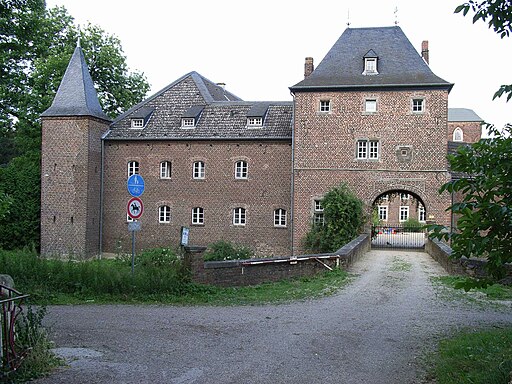
Schloss Kellenberg
Schloss Kellenberg stands as a striking water castle on a low hill north of the village of Barmen, in the Jülich region of North Rhine–Westphalia, Germany. Originating in the 15th century and expanded in the 16th, this moated fortress combines medieval defensive design with later residential refinements. Though privately owned and not regularly open to the public, its restored exterior and reflective moat draw interest from history buffs, architects, and photographers alike.
Location and Site Context
Schloss Kellenberg occupies a strategic site on a gentle rise at the northern edge of Barmen. Surrounded on three sides by a broad, water-filled moat fed by nearby Rur tributaries, the castle integrates natural and artificial defenses. The main axis of the complex aligns roughly north–south, placing the principal façade toward the village and agricultural lands, while the rear overlooks mixed woodland and meadow.
Technical Parameters
Geographical Coordinates and Elevation
- Latitude: 51° 0′ 12″ N
- Longitude: 6° 22′ 45″ E
- Elevation: approximately 75 m above sea level
Architectural Features and Materials
- Building Type: Wasserschloss (water castle)
- Primary Materials: red brick masonry with sandstone ashlar accents
- Foundation: set on compacted river gravel overlying Tertiary marl subsoil
- Roof Structure: steeply pitched timber trusses supporting interlocking clay tiles
Structural Dimensions and Layout
- Overall Footprint: about 80 m (north–south) by 60 m (east–west)
- Moat Width: 8–12 m with an average water depth of 1.8 m
- Curtain Wall Thickness: ranges from 0.9 m at upper levels to 1.5 m at the base
- Main Residential Block: 30 m long, two full storeys plus attic
- Corner Towers: four semi-circular towers, each 6 m in diameter and rising to 15 m
- Entrance Drawbridge Span: 6 m clear opening over the southern moat
Defensive and Water Features
- Water Management: inlet from a spring-fed channel, overflow controlled by stone-lined sluice
- Moat Reinforcement: timber piles driven along the inner bank to prevent erosion
- Gatehouse: double-leaf timber doors backed by a portcullis chute
- Bastion-Like Projections: flanking the gate to create overlapping fields of fire
- Arrow Slits: narrow vertical openings in towers sized to accommodate both bows and early firearms
Modern Renovation and Preservation
- Major Restoration: carried out in 1993–1995 after a severe fire, focusing on structural stabilization
- 2009 Ownership Transfer: sold to the state building authority, which consolidated ownership and completed exterior repointing and drainage improvements
- Current Condition: exterior masonry largely restored; roof fully re-covered; interior remains off-limits except for special guided tours
Historical Development
Construction began around 1450 under a local noble family, replacing an earlier wooden fort. In the early 16th century, a new brick residential wing was added, complete with an ornate gallery courtyard. Over the centuries, the castle saw occupants ranging from imperial marshals to merchant families. Military damage during the Thirty Years’ War prompted the addition of reinforced gateworks. By the 19th century, the site transitioned from defensive stronghold to stately residence, with formal gardens laid out on the moated island. A devastating blaze in 1992 destroyed much of the interior, spurring the late-20th-century conservation effort.
Current Use and Access
Though Schloss Kellenberg is privately maintained, the outer courtyard, moat, and exterior façades are freely visible from public paths that encircle the structure. Special events or heritage open-days occasionally allow interior visits by reservation. Interpretation panels along the perimeter trail highlight the castle’s evolution and technical features.
How to Get Here
By Car
- From Aachen or Düsseldorf, take Autobahn A44 toward Mönchengladbach.
- Exit at Jülich-Lövenich and follow signs for Barmen via L263.
- In Barmen, turn north onto Dorfstraße; park in the designated lot adjacent to the village chapel.
- A short 5-minute footpath leads through a meadow to the southern drawbridge.
By Public Transport
- Rail to Jülich station via Regional-Express services from Cologne or Aachen.
- From Jülich, catch bus line 226 toward Linnich-Barmen.
- Disembark at the “Barmen Ortsmitte” stop.
- Walk north along Dorfstraße for 700 m, then follow the moorland trail west to the castle entrance.
By Bicycle
- The Rur Cycle Route (RurUfer-Radweg) passes through Barmen. A dedicated spur trail leads east from the main route into the castle grounds. Secure bike parking is available near the visitor information kiosk.
Surroundings and Activities
- Castle Loop Trail: a 4 km circuit with interpretive signs on medieval engineering and local flora.
- Rur Watersports: canoe and kayak rentals available in neighboring Linnich, with scenic paddles past the castle’s moat.
- Birdwatching Hide: constructed on the western bank, offering views of kingfishers and herons.
- Annual Medieval Fair: held each May on the inner bailey, featuring craftsmen demonstrations and period reconstructions.
Schloss Kellenberg’s blend of robust 15th-century fortification, Renaissance charm, and modern conservation makes it a fascinating study in technical adaptation and heritage preservation. Whether you arrive to admire its brickwork, trace its water-management systems, or simply enjoy the reflective moat under a canopy of oaks, this moated jewel offers insights into centuries of architectural innovation.
