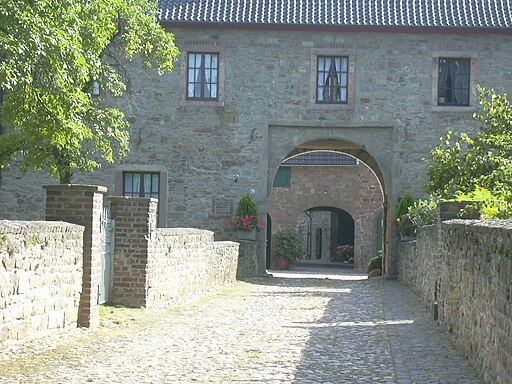
Burg Kreuzau
Burg Kreuzau is a medieval lowland water castle crowning a natural island in the Rur River near the town of Kreuzau in North Rhine–Westphalia, Germany. First erected in the early 14th century at the crossing of an ancient Roman road, it presents a rare combination of fortified masonry and hydraulic engineering that defended trade routes and served as a residence for regional nobles.
Location and Setting
The castle sits at 50° 44′ 58″ N, 6° 29′ 7″ E, rising some 146 m above sea level on an island formed by a broad moat fed directly from the Rur’s channels. Forested slopes and rolling farmland frame the site, while the historic village of Kreuzau clusters along the opposite bank, connected by old fording points now traversed by modern bridges.
Technical Parameters
Geographical Coordinates and Elevation
- Latitude: 50° 44′ 58″ N
- Longitude: 6° 29′ 7″ E
- Elevation: 146 m ü. NN (above Normalnull)
Architectural Composition and Materials
- Castle Type: Niederungsburg (lowland water castle)
- Core Construction: rubble-stone (Bruchstein) walls up to 1.5 m thick, set upon river-gravels and marl subsoil
- Corner Towers: round turrets anchoring the curtain wall, built from locally quarried greywacke
- Palas Remains: fragments of the original residential hall visible as stone wall footings and vestigial archways
Dimensions and Layout
- Moated Island Footprint: roughly 70 × 50 m enclosed by water
- Ring Wall: single continuous enceinte with battlement walk
- Zwinger: narrow killing ground between the inner wall and an outer forecourt, enhancing crossfire coverage
- Gate Complex: fortified entrance with drawbridge slots and a now-dismantled portcullis mechanism
Water Management and Defensive Features
- Perimeter Moat: fed directly from the Rur with masonry-lined inlet and overflow culvert
- Erosion Control: timber piling along the inner bank retains earthworks and prevents undercutting by currents
- Drawbridge Slots: grooves in the gatehouse threshold attest to a multi-leaf wooden bridge system
- Embrasures and Arrow Slits: narrow vertical openings in towers sized for longbows and early firearms
Historical Development
Foundation and Medieval Growth
The first stone castle rose around 1330 to guard a strategic ford and toll station on the ancient Roman road crossing the Rur. Dietrich von Schinnemann, a local knightly lord, expanded the initial fortifications, replacing an earlier wooden stronghold with a full ring wall and corner towers.
Early Modern Transformations
Through the 15th and 16th centuries, successive owners reshaped the castle’s residential wings. Sgraffito-decorated façades and ornate mullioned windows reflected Renaissance tastes, while Baroque interiors later enriched great halls with stucco ornament and fresco cycles.
Decline and Conservation
By the late 17th century, inheritance disputes and deliberate slighting led to partial demolition of the main castle block. The site then fell into utilitarian use as a granary and stable. Twentieth-century interest sparked comprehensive archaeological surveys and masonry consolidation, preserving today’s evocative ruins for public enjoyment.
Visiting Burg Kreuzau
While the interior is closed to regular tourism, Burg Kreuzau can be fully circled via a dedicated riverside footpath. Interpretive panels describe the engineering of its moat and wall systems. Occasional open-air concerts and heritage days invite limited interior access by guided booking.
How to Get Here
By Car
• From Cologne or Aachen, take Autobahn A4 to Kreuzau/Düren exit. • Follow B 264 south toward Kreuzau, then local signs for Burg Kreuzau. • Public parking is available at the riverside lot; a short footbridge leads to the castle island.
By Public Transport
• Travel via Regional-Express to Düren Hauptbahnhof. • Change to bus line 228 toward Kreuzau Ortsmitte. • Alight at “Kreuzau Burg” stop and walk ten minutes along the Rur floodbank path.
By Bicycle
• The RurUfer-Radweg cycle route passes directly by the castle moat. • Secure bike racks stand at the entrance to the island’s pedestrian bridge.
Surroundings and Activities
- Rur River Canoeing: paddle past the castle walls on guided excursions downstream.
- Forest Trails: hiking routes ascend nearby slopes to vantage points overlooking the ruins.
- Medieval Festival: annual spring market recreates historic crafts, tournaments, and music.
Burg Kreuzau remains a testament to medieval fortification and water-management ingenuity, offering visitors a window into the technical prowess and cultural evolution of the Rur valley.
