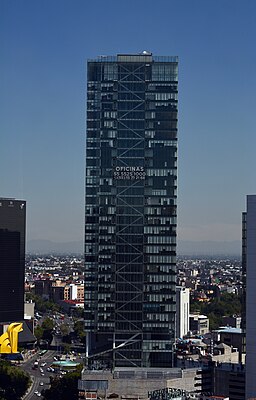
Cuarzo Towers
Located on the Paseo de la Reforma in Mexico City’s Cuauhtémoc district, Cuarzo Towers (Spanish: Torres Cuarzo) form a striking mixed-use complex. The address is Avenida Paseo de la Reforma 26, a historic boulevard that serves as Mexico City’s main commercial artery. The site is in the heart of the financial district and was a former lakebed, so the towers are built on deep foundations. As in many Mexico City skyscrapers, design drawings indicate perimeter slurry walls and cast-in-place piles extending 40–50 meters down to competent strata.
The complex comprises two towers united by a common podium base. The office tower rises about 180 m (591 ft) to its architectural top, with 40 above-ground floors (plus four basement levels). The adjacent hotel tower reaches about 110 m (361 ft) over 27 floors. Together they form one of Mexico’s tallest developments (the office tower is the 15th tallest in Mexico City). Underground, each tower has four subgrade levels (four basement parking levels).
Architectural Design
Cuarzo Towers were designed by Richard Meier & Partners in collaboration with local firm Diametro Arquitectos. The scheme is modernist and sculptural: a white, rectilinear office tower and a companion hotel tower are joined by a shared podium. According to the architects, the 40-story office tower accommodates high-end offices, retail shops, restaurants, a fitness center and parking. The 27-story hotel tower follows the same geometric principles and complements the complex’s program. Richard Meier (a Pritzker Prize laureate) conceived an “internal logic” by carving a large central atrium void through the office tower. This volumetric cut-out allows natural light and ventilation deep into the floor plates and creates panoramic views toward Mexico City’s historic center and Reforma Boulevard. The exterior facades feature floor-to-ceiling curtain walls and clean lines that emphasize transparency and views. The towers’ overall form – slender vertical shafts with inset balconies and recessed sections – was intended to be an “iconic” response to the city’s architectural fabric.
Floor heights are generous to suit premium office use. The base podium (shared by both towers) includes a grand lobby with high ceilings, retail outlets and amenity spaces. Architect’s publications note that the podium houses multi-level retail, restaurants and a gym. The exterior uses high-performance glazing and shading: manufacturer data indicates the facade glazing is tempered, laminated and insulated glass, likely with low-E coatings for thermal control. Interior finishes (lobby stone, high-quality millwork, etc.) are fitted out to Class A standards, though such details are proprietary.
Structural Engineering
Structural System
Both towers are built as all-steel structures. The main columns, beams and floor framing are structural steel (most likely ASTM hot-rolled sections with composite metal deck slabs). The all-steel designation means even floors and core elements are steel-framed rather than cast-in-place concrete. A deep steel-and-concrete core (housing elevators and stairs) provides vertical stability, and a perimeter braced frame resists horizontal loads. According to CTBUH data, the structural engineer of record was WSP Group (Paris). The foundation consists of reinforced concrete piles and basement walls: in line with Mexico City practice, engineers employed diaphragm (slurry) walls around the basement perimeter and caisson or barrette piles extending ~40–50 m to bear on firm strata. This arrangement counteracts the very soft lacustrine clay soils of the ancient lakebed beneath the city.
Seismic Protection
Given Mexico City’s extreme seismicity, Torre Cuarzo’s design incorporates advanced earthquake-resistant systems. Hundreds of fluid viscous friction dampers (over 450 units) are installed between floors in the steel frame. These seismic dampers slip under load and dissipate kinetic energy, acting as shock absorbers to protect the structure. In effect, the dampers prevent damage under moderate shaking and greatly reduce stresses in major tremors. The design followed a performance-based earthquake engineering approach: calculations set explicit performance objectives (life safety, minimal structural damage) for various hazard levels, beyond minimum code requirements. Notably, Torre Cuarzo survived the magnitude-7.1 Puebla-Morelos earthquake of 2017 with essentially no damage, even though one of its construction sites experienced very high ground motions. This “exceptional” performance is attributed to the dampers and the rigorous PBD analysis. In short, the steel braced frame plus viscous dampers give the towers high seismic resilience and post-quake occupant comfort.
Construction Materials
The towers use premium construction materials. As noted, the primary structural system is steel. Steel grades are not publicized, but tower projects of this era typically use high-strength alloy steels (e.g. ASTM A572 or A992). The floor slabs are composite: steel deck with poured concrete topping. Reinforced concrete was used for the deep foundations and basement slabs. The building envelope is a glazed curtain wall: according to the glass fabricator Millet, the project uses tempered, laminated and insulated glass panels. These are likely double- or triple-glazed low-emissivity (Low-E) units to meet energy targets. The mullion frames are probably aluminum or steel – CTBUH photos suggest slender metal profiles. Interior fit-out materials include stone and metal finishes in lobbies and meeting areas, LED lighting, and premium elevator interiors. (One published note indicates the towers incorporate Duhart Design interior elements, though technical specs are proprietary.) Overall, the material palette emphasizes durability: corrosion-resistant metals, fire-rated materials in shafts, and high-grade glazing.
Smart Technologies and Building Systems
Torre Cuarzo is equipped with modern intelligent systems. Notably, all 30 passenger elevators use Schindler’s PORT destination-dispatch technology. The Schindler PORT system uses a touch-screen panel (or smartphone app) where passengers register their destination floor before boarding; the controller then assigns cars in an optimized grouping, reducing wait times and energy use. The 30 elevators are divided into two banks (15 Schindler 7000 cars and 15 Schindler 5500 cars) with high speeds and collective control. In addition, a central building management system (BMS) monitors and controls HVAC, lighting, and security across the complex. For example, the HVAC uses variable-frequency drive pumps and fans, and the ventilation system is automated for demand-based air changes (as indicated by the 83% air-renewal rate reported). Lighting is likely high-efficiency LED with occupancy sensors in offices and common areas to save power. The tower also has its own backup generators and uninterruptible power supply (UPS) for emergency systems. Telecommunication infrastructure includes fiber-optic networks, and the building’s wireless connectivity is engineered for dense urban operation. Overall, the automation and digital systems help meet the project’s high efficiency and occupant comfort goals (as required by its LEED v4.1 targets).
Sustainability and LEED Certification
Sustainability was a major objective. In early 2022, Torre Cuarzo earned LEED Gold certification under the USGBC’s LEED v4.1 for Existing Buildings: Operations & Maintenance (O+M) rating system. (This puts it among Mexico’s top green office towers.) The certification reflects year-round performance. During the evaluation period (Oct 2020–Sept 2021), Torre Cuarzo demonstrated exceptional efficiency: its measured potable water usage was lower than 92% of similar offices, and its energy use was below 85% of peer buildings in the same climate. The HVAC chillers use non-CFC refrigerants with virtually zero ozone-depletion and very low global-warming potential. Indoor environmental quality is excellent: a dedicated ventilation system supplies fresh outside air to about 83% of the occupied floor area, ensuring low CO₂ and particle concentrations. Additional green measures include 100%-smoke-free indoor spaces and a “green cleaning” policy (low-VOC materials and disinfectants). Also, about 32% of building users commute by public transit (buses/Metro) due to the Reforma location, reducing vehicular emissions. All these factors – efficient fixtures, building automation, high-performance envelope, and occupant-friendly policies – contributed to the LEED Gold rating. In post-occupancy surveys, 97% of tenants reported being satisfied with air quality, lighting and thermal comfort, underscoring that the sustainability strategies also improve user wellbeing.
Amenities and Facilities
Cuarzo Towers offer a full suite of amenities for tenants and guests. Key features include:
-
Premium Office Space & Retail: The office tower contains 40 floors of Class A office area, with spacious open-plan layouts and panoramic city views. The podium levels include retail boutiques, cafes, and restaurants. Architect commentary notes “retail space, restaurants, [and] a fitness center” at the base. An upscale lobby provides concierge service and lounge seating.
-
Hotel: The adjacent 27-story tower houses a luxury hotel with 192 guest rooms and suites. (CTBUH lists 192 rooms). The hotel likely includes amenities like a full-service restaurant, meeting rooms or ballroom, and possibly a business center (typical for high-end hotels, though not publicized). Hotel guests and tenants share certain services via the common podium.
-
Fitness Center and Conference Facilities: As noted, a large fitness club (gym/spa) is provided for office tenants. Additional amenity spaces include conference and meeting rooms available for tenant use, plus lounge/terrace areas. Some floors may have sky lobbies or sky-gardens – the cut-out atrium design creates open interior space that could double as communal areas.
-
Parking: Combined basement parking offers roughly 1,250 covered car spaces for tenants and guests. CTBUH data lists 1,251 parking spots (per tower), so total parking is on the order of 2,500, shared between both towers. (The quoted number on an official listing is “más de 450” dissipadores, confirming the high count of dampers.) A published office listing notes “1 Cajón por 35 m²,” implying ample dedicated parking. Electric vehicle charging stations and secured bicycle storage are also provided, supporting sustainable commuting (common in LEED projects).
These amenities, combined with the sleek architectural spaces, make Cuarzo Towers a highly desirable mixed-use development in Mexico City.
Safety and Security Systems
Safety is built into every system. The towers feature comprehensive fire protection: all floors have automatic sprinkler coverage and smoke detectors. Egress is through multiple pressurized, fire-rated stairwells and protected elevator lobbies, as required by Mexico City codes for high-rises. Pressurized shafts ensure stairs stay smoke-free during an alarm. Life-safety systems include manual pull-stations, emergency lighting, and backup generators to power critical systems. Security is 24/7: the building is monitored by guards and closed-circuit cameras. Marketing materials explicitly list “24 Hour Security,” CCTV surveillance and alarms as standard features. Entry is controlled by access cards or biometrics at main doors and elevators.
The seismic safety is exceptional: the structural dampers (mentioned above) serve as an active safety system. In fact, following the 2017 Puebla earthquake (Mw 7.1), Torre Cuarzo recorded almost no damage or functional downtime. This real-world test confirms that the performance-based seismic design and over-450 dampers worked as intended, protecting occupants. In summary, Torre Cuarzo integrates modern fire-life-safety systems with state-of-the-art security and seismic protection to keep tenants safe under any conditions.
