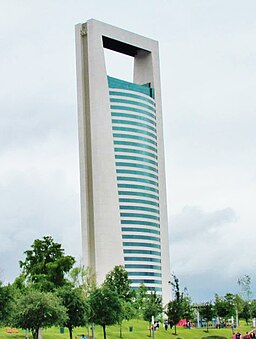
Torre Ciudadana
Torre Ciudadana rises as a commanding presence in Monterrey’s skyline, embodying advanced engineering and sustainable design. Completed in 2010, this 180-metre governmental office tower integrates robust seismic resilience, high-performance building systems, and a transparent public interface. Serving as the headquarters for the State of Nuevo León, it consolidates over 22 agencies under one roof and accommodates more than 4 000 occupants daily.
Location and Context
Urban Setting
Located at Calle Washington 2000 in Colonia Obrera, Torre Ciudadana anchors Monterrey’s strategic civic axis. It fronts Fundidora Park, sits adjacent to the Santa Lucía riverwalk, and connects directly to major surface boulevards and the nearby metrobus network.
Role in Civic Infrastructure
By co-locating multiple state agencies, the tower eliminates scattered lease expenses and streamlines public services. Its ground-floor civic hall provides free walk-in access for citizen inquiries, while the upper floors house executive offices, meeting suites, and administrative departments.
General Data
| Parameter | Specification |
|---|---|
| Architectural Height | 180 m |
| Total Floors | 36 above ground, 4 below ground |
| Gross Floor Area | 61 000 m² |
| Construction Period | October 2007 – March 2010 |
| Project Cost | USD 51.8 million |
| Architect | Augusto Reynaldo Arquitectura |
| Developer | Government of the State of Nuevo León |
| Structural Engineer | Coordination of Strategic Urban Projects |
| Foundation Type | 184 bored piles + 2 m-thick concrete raft |
| Façade System | Double-glazed curtain wall |
| Number of Elevators | 15 high-speed passenger lifts |
| Parking Capacity | ~3 000 vehicles |
Foundation and Geotechnical Design
Subsoil Conditions
Subsurface investigations revealed predominantly alluvial silts and clays overlying more competent volcanic deposits. Near-surface strata exhibit low bearing capacity and high compressibility, necessitating deep foundations.
Deep Pile and Raft System
A cluster of 184 reinforced-concrete bored piles—each 1.5 m in diameter and driven to depths of 35 m—transfers gravity and seismic loads to stable strata. A 2-metre-thick raft slab interconnects pile caps, ensuring uniform load distribution and minimizing differential settlement. Perimeter slurry walls retained groundwater and supported excavation for the four-level basement.
Structural System and Seismic Strategy
Core and Perimeter Frame
The building’s lateral and vertical loads are carried by a cast-in-place concrete core surrounded by a perimeter frame of reinforced concrete and structural steel. The core houses elevator shafts, stairs, and mechanical risers, achieving torsional stiffness and a robust vertical spine.
Seismic Resilience Measures
Monterrey lies in a moderate to high seismic zone. Torre Ciudadana’s design incorporates:
- Ductile detailing in shear walls and coupling beams
- Viscous dampers installed at mechanical-floor diaphragms to dissipate energy
- Controlled core-to-frame connectivity enabling inelastic deformation under extreme loads
These features limit interstory drift to under 1.5 percent of story height during a severe earthquake, preserving structural integrity and occupant safety.
Building Envelope
Curtain-Wall Assembly
A unitized curtain wall of low-emissivity, double-glazed glass and thermally broken aluminum frames wraps the tower. Floor-to-ceiling panels maximize daylight, while concealed horizontal sun-shades and vertical fins reduce solar heat gain.
Thermal and Acoustic Performance
- U-Value (overall): ~1.6 W/m²·K
- Solar Heat Gain Coefficient: 0.28
- Sound Transmission Class (STC): 45
High-performance glazing curbs HVAC loads and shields workspaces from external noise along busy urban thoroughfares.
Mechanical, Electrical, and Plumbing Systems
HVAC and Environmental Controls
A central chilled-water plant—comprising four centrifugal chillers with combined capacity of 12 000 kW—feeds variable-air-volume (VAV) air-handling units. Key features include:
- Heat-recovery wheels recapturing up to 70 percent of exhaust enthalpy
- Demand-controlled ventilation tied to CO₂ sensors in conference zones
- Direct digital controls (DDC) network orchestrating temperature, humidity, and fresh-air intake
Power Supply and Backup
Dual utility feeders from separate substations guarantee grid redundancy. Automatic transfer switches and a 1 500 kVA diesel generator ensure uninterrupted power for life-safety circuits, critical IT infrastructure, and emergency lighting.
Water Management
Rainwater harvesting channels runoff into a 300 m³ cistern for irrigation and cooling-tower makeup. Low-flow plumbing fixtures slash potable water demand by 50 percent, while condensate recovery systems feed graywater loops.
Vertical Transportation and Accessibility
Elevator Configuration
Fifteen gearless traction elevators operate at speeds up to 3 m/s, divided into low-rise and high-rise banks. Destination dispatch technology reduces wait times, while integrated seismic sensors command automatic parking and door opening at the nearest safe level when accelerations exceed 0.02 g.
ADA and Universal Access
Level thresholds, tactile wayfinding, and visible alarm systems ensure barrier-free access throughout public zones. Pressurized stairwells and refuge floors facilitate rapid egress for occupants with reduced mobility.
Fire Protection and Life Safety
Sprinkler and Detection Systems
A fully zoned wet-pipe sprinkler network covers all floors. Addressable smoke detectors and manual pull stations interface with voice-evacuation panels, enabling staged announcements and guided egress.
Pressurization and Emergency Power
Stairwells maintain positive pressure via dedicated fans, preventing smoke infiltration. An 800 kVA secondary generator sustains stair, corridor, and elevator lobby lighting for at least 72 hours during prolonged outages.
Sustainability and Smart Building Features
Building Management System (BMS)
A centralized BMS oversees HVAC, lighting, fire, and security controls. Real-time dashboards display sub-metered energy consumption, enabling targeted performance tuning and fault detection analytics.
Automated Lighting and Controls
Intelligent lighting networks adjust luminance based on occupancy and ambient daylight levels. Automated shading devices modulate solar glare while preserving outward views.
Functional Program and Amenities
Office Layout
Typical floors offer 1 700 m² of column-free workspace around the central core. Modular partitioning allows rapid reconfiguration for diverse tenant needs, with dedicated IT rack rooms and service corridors.
Civic and Retail Spaces
The podium includes a publicly accessible citizen services hall, information kiosks, and a ground-floor retail arcade featuring cafés and newsstands. Four basement levels house 3 000 parking stalls with automated guidance systems.
Conference and Event Facilities
Two multi-purpose auditoria with capacities of 300 and 600 seats occupy mid-tower levels. Each hall integrates flexible partitions, high-definition projection, and simultaneous‐translation booths.
Construction Timeline and Key Milestones
- Site Mobilization & Slurry Wall Installation: Q4 2007 – Q1 2008
- Piling & Raft Slab Completion: Q2 2008 – Q4 2008
- Core & Superstructure Erection: Q1 2009 – Q3 2009
- Façade Installation: Q4 2009 – Q1 2010
- MEP Commissioning & Fit-Out: Q1 2010 – Q2 2010
- Final Inspections & Handover: Q2 2010
Conclusion
Torre Ciudadana exemplifies a holistic approach to high-rise government architecture in a seismically active region. Its deep‐pile foundation, ductile concrete core, energy-efficient envelope, and intelligent building systems coalesce into a resilient, efficient, and accessible civic landmark. More than an office tower, it stands as a symbol of transparent governance and technological progress in Monterrey.
