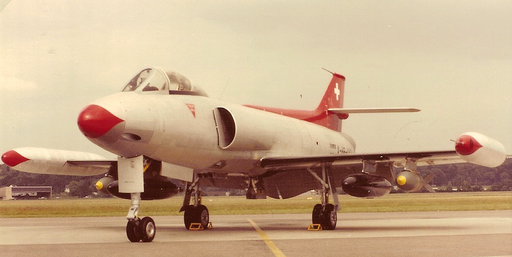
FFA P-16
FFA P-16: Switzerland’s Forgotten Jet Fighter
The FFA P-16 was a Swiss jet fighter developed in the 1950s by Flug- und Fahrzeugwerke Altenrhein (FFA). It was a bold attempt to produce a domestically-built, high-performance jet aircraft to replace Switzerland’s aging piston-powered fighters and early jet trainers. Although it never entered production, the P-16 was ahead of its time in several respects and remains a remarkable chapter in Swiss aviation history.
This article provides an in-depth technical and historical profile of the FFA P-16, including design philosophy, structural features, performance metrics, systems, and operational background.
Historical Background
Post-World War II, the Swiss Air Force faced the challenge of modernizing its fighter fleet while maintaining Switzerland’s long-standing policy of neutrality and defense self-reliance. In 1948, Switzerland initiated a program to develop an indigenous jet fighter. FFA, a company with a history of aircraft design and production, took on the challenge, resulting in the P-16 project.
Design work began in the early 1950s, aiming to produce a multi-role, ground-attack capable fighter suited to Switzerland’s unique geography — mountainous terrain, short runways, and the necessity for rapid deployment.
Design Philosophy and Airframe
The FFA P-16 was conceived as a single-seat, single-engine tactical fighter, optimized for both interception and close air support roles. The design focused on ruggedness, short-field capability, and advanced aerodynamics for the era.
Fuselage and Structure
The P-16 featured a streamlined fuselage constructed from aluminum alloy and high-strength steel, designed to withstand high g-forces and low-altitude operations. The forward fuselage housed the cockpit, avionics, and radar provisions, while the rear accommodated the engine and tail assembly.
The aircraft measured 13.55 meters (44 ft 5 in) in length, with a wingspan of 10.42 meters (34 ft 2 in). The low-mounted wings had a notable feature: full-span leading-edge slats and trailing-edge flaps, enabling excellent low-speed handling and STOL (Short Takeoff and Landing) performance — a must in Swiss operational doctrine.
Cockpit Design
The pressurized cockpit was equipped with ejection seats and featured a bubble canopy providing excellent visibility. Flight controls were conventional, with hydraulic boost assistance and trim systems. Later prototypes incorporated advanced gun sights and provisions for radar-based ranging systems.
Wing Design and Aerodynamics
One of the P-16’s most notable characteristics was its innovative wing design, tailored to optimize both high-speed flight and low-speed maneuverability. The wing used a moderate sweep angle of 32.5° at the quarter chord, and it included a boundary layer control system — quite advanced for the 1950s — which enhanced lift during landing and takeoff by blowing engine bleed air over the flaps.
Wing-mounted airbrakes improved deceleration and maneuvering control, particularly during dive-bombing or landing approaches. Spoilers and ailerons provided roll control, with a distinctive “pop-out” design for the speed brakes.
Powerplant and Propulsion
The P-16 was powered by a single British-built Armstrong Siddeley Sapphire turbojet, license-produced in Switzerland. The Sapphire was a proven, powerful engine used in several NATO aircraft, including the Hawker Hunter.
Engine Specifications:
- Model: Armstrong Siddeley Sapphire ASSa.6
- Thrust: 7,500 lbf (33.4 kN) dry thrust
- Compressor: 10-stage axial
- Turbine: Two-stage axial
- Maximum RPM: ~8,000 rpm
- Fuel type: Jet A1 or military-grade kerosene
The engine was mounted mid-fuselage with lateral air intakes located just behind the cockpit. A bifurcated duct design fed air to the engine, and the exhaust exited via a straight tailpipe under the rear fuselage. Later versions proposed fitting an afterburner, although this was never implemented before cancellation.
Performance Specifications
Despite its short development life, the FFA P-16 demonstrated performance metrics that rivaled or exceeded many of its contemporaries.
Estimated Performance (based on P-16 Mk III):
- Maximum speed: Mach 0.91 (~1,090 km/h / 678 mph) at altitude
- Cruise speed: ~900 km/h (559 mph)
- Combat range: ~1,000 km (621 mi)
- Ferry range: Up to 1,500 km (932 mi) with drop tanks
- Service ceiling: ~15,000 meters (49,200 ft)
- Rate of climb: ~60 m/s (11,800 ft/min)
- Takeoff run (fully loaded): ~450 meters (1,476 ft)
- Landing run: ~500 meters (1,640 ft)
These statistics made the P-16 ideal for dispersed air operations from alpine valleys and highway strips — a feature integrated into Swiss military doctrine during the Cold War.
Armament and Mission Loadout
The P-16 was designed as a multi-role aircraft, capable of engaging air and ground targets with equal effectiveness. Its armament suite reflected this flexibility.
Fixed armament:
- 4 × 30 mm Hispano-Suiza 825 cannons (two in each wing root), with 125 rounds per gun
External stores:
- 6 × underwing hardpoints, capable of carrying a combination of:
- 500 lb bombs
- Rocket pods
- Napalm canisters
- Air-to-ground missiles (provisioned but not tested)
- Drop tanks for extended range
The total external payload capacity was approximately 2,000 kg (4,400 lb). The aircraft was also considered for radar-guided interception roles, but no full radar suite was ever installed during development.
Avionics and Systems
Given its era, the P-16 featured relatively simple avionics, but with provisions for more advanced systems had the project matured further.
Avionics suite included:
- UHF/VHF radio communications
- IFF (Identification Friend or Foe)
- Gunsight with ranging reticle
- Navigation compass and gyro platform
- Provision for radar altimeter and gun-laying radar
Hydraulic systems powered the flight controls, landing gear, and airbrakes, with redundancy built into primary systems to improve survivability.
Testing, Accidents, and Cancellation
Between 1955 and 1958, several prototypes of the P-16 were built and tested. Flight tests showed promising performance, especially in STOL operations and low-level agility. However, the program suffered from multiple setbacks:
- 1955 – First crash: The initial prototype crashed due to a hydraulic failure.
- 1956 – Second crash: A second prototype broke up on landing due to structural failure in the wing.
- Delays and cost overruns followed, causing political controversy in the Swiss parliament.
- 1958 – Cancellation: Despite favorable flight performance, the Swiss government canceled the P-16 program in favor of purchasing the Hawker Hunter from the UK.
In total, six airframes were built (some incomplete), and no P-16 ever entered operational service.
Legacy and Influence
Though the FFA P-16 was ultimately canceled, its development left a mark on aviation history. The aircraft demonstrated advanced features such as boundary layer control, STOL performance, and integrated weapons systems well before these became standard. Moreover, the design directly influenced the creation of the Learjet, as engineer Bill Lear purchased parts of the P-16’s design, including wings and control surfaces, when creating his iconic business jet.
Today, only one surviving P-16 prototype exists and is preserved at the Flieger-Flab-Museum in Dübendorf, Switzerland — a silent tribute to one of the most ambitious aviation projects ever undertaken by a neutral nation.
Conclusion
The FFA P-16 was a remarkable achievement for Swiss aerospace engineering — a high-performance jet fighter that rivaled contemporary NATO aircraft in many aspects. Its innovative design, short-field capability, and powerful armament made it uniquely suited to Switzerland’s defensive needs. Though it never flew in operational service, the P-16 remains a symbol of engineering ambition and stands as a forgotten gem of Cold War aviation.
