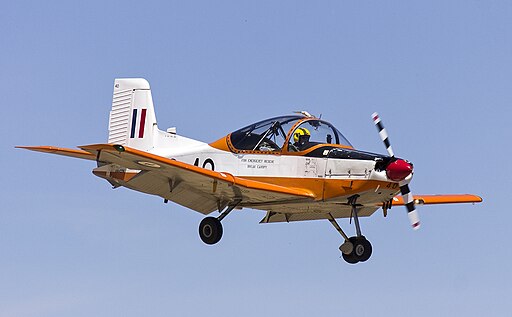
PAC CT/4 Airtrainer
PAC CT/4 Airtrainer: Technical Profile and Operational Insight
The PAC CT/4 Airtrainer is a single-engine, two-seat military basic trainer aircraft developed and manufactured by Pacific Aerospace Corporation (PAC) of New Zealand. Originally based on the earlier AESL Airtourer, the CT/4 represents a significant evolution in training aircraft design, providing robust performance, excellent handling characteristics, and a cost-effective platform for ab initio and intermediate flight training.
This article explores the technical specifications, design features, development history, and operational use of the PAC CT/4 Airtrainer in detail.
Development History
The origins of the CT/4 Airtrainer date back to the 1960s when New Zealand’s aviation manufacturer AESL (Aero Engine Services Ltd) sought to create a dedicated military trainer based on the Victa Airtourer, an Australian light aircraft design. The Airtourer had proven itself as a reliable civil trainer, but AESL’s ambitions extended into the military domain, where higher stress tolerances and aerobatic capability were required.
In 1972, the CT/4A Airtrainer first flew, incorporating a strengthened airframe, more powerful engine, and revised canopy design for military training suitability. Over time, the aircraft evolved through several variants including the CT/4B and CT/4E, each bringing incremental improvements in avionics, engine performance, and mission flexibility.
Airframe and Design Characteristics
The CT/4 features a conventional low-wing monoplane design with tricycle landing gear and side-by-side seating, optimized for ease of instruction. The aircraft is designed to withstand high-load aerobatic maneuvers, with G-limits of +6/-3g, making it suitable for both basic and advanced flight training programs.
Fuselage
Constructed from aluminum alloy, the fuselage employs a semi-monocoque structure that combines strength with relatively low weight. The cockpit is equipped with dual flight controls and offers 360-degree visibility due to the expansive bubble canopy — an essential feature for situational awareness during formation flying and aerobatic training.
Wings
The cantilever wings utilize a laminar flow airfoil optimized for stable flight characteristics while providing agility at low and medium speeds. The wingspan is 8.28 meters (27 ft 2 in), and the design includes integrated fuel tanks with a total usable capacity of approximately 130 liters (34 US gallons).
Landing Gear
The CT/4 uses a fixed tricycle landing gear configuration with a steerable nose wheel. While this fixed gear setup imposes some drag penalty, it simplifies maintenance and enhances durability during frequent training landings.
Powerplant and Performance
The CT/4 Airtrainer is powered by a single six-cylinder, horizontally opposed piston engine, most commonly the Lycoming IO-540 in later variants such as the CT/4E.
Engine Specifications (CT/4E variant):
- Engine model: Lycoming IO-540-L1C5
- Power output: 300 horsepower (224 kW)
- Fuel type: Aviation gasoline (Avgas 100LL)
- Propeller: Hartzell constant-speed two- or three-blade propeller
This powerplant delivers excellent performance in the training role, including sufficient power for aerobatics and high climb rates, while maintaining a simple and reliable mechanical configuration.
Performance Metrics:
- Maximum speed: 285 km/h (177 mph; 154 knots)
- Cruise speed: 250 km/h (155 mph; 135 knots)
- Stall speed (flaps down): 93 km/h (58 mph; 50 knots)
- Range: 1,060 km (659 miles; 573 nautical miles)
- Service ceiling: 6,100 meters (20,000 feet)
- Rate of climb: 6.1 m/s (1,200 ft/min)
The CT/4’s favorable power-to-weight ratio and responsive controls make it an ideal platform for aerobatic flight and complex maneuver training.
Avionics and Systems
The cockpit instrumentation evolved significantly over the CT/4’s development. Early models employed traditional analog gauges suitable for visual flight rules (VFR), while later variants such as the CT/4E incorporated modern glass cockpit elements.
Standard Avionics Suite (CT/4E):
- Primary Flight Display (PFD) with attitude, airspeed, and altitude indications
- GPS navigation system with moving map capability
- VHF/UHF radio communication systems
- Transponder with Mode C or Mode S functionality
- Audio panel with dual control selectors
- Optional IFR capability with backup instrumentation
These systems support comprehensive pilot training from primary stick-and-rudder skills to basic instrument navigation, making the CT/4 an ideal intermediate step before transition to turbine trainers.
Variants
Several major variants of the CT/4 Airtrainer have been produced, each tailored to the specific requirements of different air forces and training programs.
CT/4A
The original production model introduced in the 1970s. Used primarily by the Royal Australian Air Force (RAAF). Powered by a 210 hp Continental IO-360 engine.
CT/4B
An improved version with structural reinforcements and refined controls. Widely exported, including to Thailand and Singapore.
CT/4C
A proposed turboprop variant that never entered production.
CT/4E Airtrainer
The most advanced model, featuring a 300 hp Lycoming engine, updated avionics, and revised aerodynamics. Developed in collaboration with Aerospace Industry Development Corporation (AIDC) of Taiwan.
Operational Use
The CT/4 has served in multiple air forces around the world, primarily in the training role. Its easy maintenance, high reliability, and solid aerobatic performance have made it an attractive solution for initial military flight screening.
Operators:
- Royal Australian Air Force (RAAF): Utilized the CT/4A and CT/4B extensively in its Basic Flying Training School (BFTS).
- Royal New Zealand Air Force (RNZAF): Employed CT/4E for training missions before transitioning to the Beechcraft T-6 Texan II.
- Republic of Singapore Air Force (RSAF): Used CT/4B for ab initio training in Western Australia.
- Royal Thai Air Force (RTAF): Operated several CT/4 variants in its pilot training academy.
- Private and civilian operators: Some aircraft have entered civilian service after retirement, used for aerobatic competitions and advanced flight instruction.
Conclusion
The PAC CT/4 Airtrainer stands as a testament to practical, cost-effective training aircraft design. With its strong aerobatic capability, modern avionics options, and time-tested construction, the CT/4 continues to be appreciated by both pilots and instructors alike. While more advanced turboprop trainers have superseded it in some military services, the Airtrainer’s legacy endures as a highly capable and versatile training platform that served as the first flying experience for thousands of military aviators across the globe.
_landing_during_the_Warbirds_Downunder_2013_(cropped).jpg)