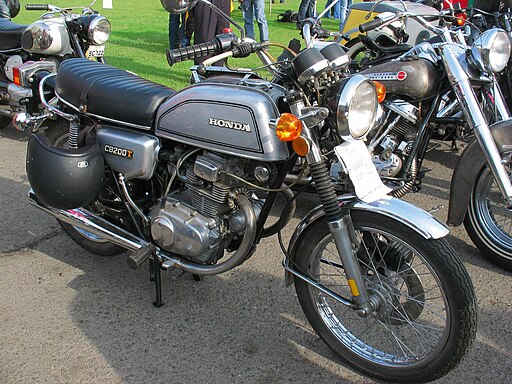
Honda CB200: The Classic Twin That Stole Hearts
The Honda CB200 sits at the sweet spot between beginner-friendly charm and enough sophistication to delight seasoned riders. Launched in the mid-1970s as the successor to the venerable CB175, this 198 cc air-cooled twin offered smooth power delivery, light handling, and bulletproof reliability—all wrapped in Honda’s signature build quality. Decades later it remains a prized entry-level classic, perfect for urban commuting, light touring, and weekend café-cruising.
Historical Roots and Design Intent
From CB175 to CB200
Honda’s CB175 won fans in the late ’60s with its spirited single-overhead-cam twin. By 1975 engineers bored it out to 198 cc, added a fifth gear, and refined the running gear. The result was the CB200: a quick-revving little twin that felt more grown-up yet retained the approachable character that made the CB175 so beloved.
A Bike for Everyone
Whether you were a new rider testing the waters or a veteran seeking a reliable runabout, the CB200 fit the bill. Honda emphasized low maintenance—points-less ignition on later models, accessible valve covers, and a simple yet robust tubular steel frame that shrugged off potholes and dirt roads alike.
Engine and Performance
Parallel-Twin Powerplant
Under the sculpted fuel tank lives a 198 cc air-cooled parallel twin with a single overhead cam and two valves per cylinder. A 9.3 : 1 compression ratio and twin Keihin 20 mm constant-velocity carburetors give the engine a sweet spot of tractable torque from 4,000 to 7,000 rpm and a peppy top end that loves to spin toward its 10,000 rpm redline.
Technical Specifications
| Specification | Details |
|---|---|
| Engine Type | Air-cooled SOHC parallel twin, 2-valve |
| Displacement | 198 cc |
| Bore × Stroke | 53 mm × 56 mm |
| Compression Ratio | 9.3 : 1 |
| Carburetion | Twin 20 mm Keihin CV |
| Ignition | CDI (electronic) |
| Starter | Electric with backup kick lever |
| Transmission | 5-speed manual constant mesh |
| Final Drive | Sealed chain |
| Peak Power | ~18 hp @ 9,000 rpm |
| Peak Torque | ~14 Nm @ 7,000 rpm |
On-Road Feel
Low-down throttle response is gentle and predictable, ideal for stop-and-go city traffic. Twist the grip past 6,000 rpm and the little twin rallies with a cheerful bark, making country-lane blasts a genuine joy. Fuel consumption hovers around 3.5 to 4 L/100 km, so the 10.5 L tank delivers a real-world range of 250 km or more.
Chassis, Suspension, and Braking
Frame and Geometry
A classic tubular steel double-cradle frame provides a rock-solid backbone. With a wheelbase of 1,335 mm and rake of 27°, the CB200 feels both stable at speed and eager through twisty backroads.
Front Suspension
Telescopic forks offer 120 mm of travel. While non-adjustable, their spring and damping rates balance comfort with enough feedback to hold a line under light sport riding.
Rear Suspension
Dual shock absorbers with preload adjustment deliver 100 mm of travel. Riders can fine-tune sag for solo jaunts or two-up touring, keeping the rear planted over uneven pavement.
Brakes and Wheels
Spoked 18-inch wheels carry 3.25-18 tires front and rear, a setup that blends vintage charm with confident grip. A 190 mm front drum and 110 mm rear drum deliver considerate stopping power—and the simplicity to service at home.
Dimensions and Ergonomics
| Dimension | Specification |
|---|---|
| Overall Length | 2,040 mm |
| Overall Width | 770 mm |
| Seat Height | 790 mm |
| Wheelbase | 1,335 mm |
| Ground Clearance | 150 mm |
| Wet Weight | 136 kg |
| Fuel Capacity | 10.5 L |
The upright riding posture, slim tank, and low seat height welcome riders of all sizes. Wide, swept-back handlebars put your hands in a natural position for carving city streets or country curves, while the modest weight keeps low-speed maneuvers stress-free.
Electrical System and Instrumentation
Charging and Lighting
A 12-volt alternator feeds an electronic CDI ignition and a simple lighting circuit—headlamp, tail/brake light, and blinkers. Original bulbs cast a soft glow, but many owners retrofit LED upgrades for crisper visibility and lower amp draw.
Cockpit Layout
An analog speedometer houses an odometer and high-beam indicator; a handful of handlebar switches control lights, horn, and turn-signals. The clean, uncluttered dash reinforces the CB200’s user-focused simplicity.
Maintenance and Reliability
Routine service tasks are straightforward: oil and filter every 3,000 km, valve clearance checks every 6,000 km, and carburetor cleaning or synchronization annually. The air-cooled twin foregoes radiators, hoses, and coolant, so leak hunts are a thing of the past. Chain slack, brake adjustment, and spark plug swaps round out a maintenance regimen any home mechanic can master.
Customization and Aftermarket
Enthusiasts keep the CB200 alive with tasteful mods: • Disc-brake conversion kits up front for sharper braking • Modern slip-on mufflers to drop weight and add a throaty note • LED headlamp and turn-signal assemblies for enhanced nighttime riding • Gel-cell seats, café-style fairings, or luggage racks to nail a custom look • Performance air filters and rejet packs to fine-tune throttle response
Community and Legacy
Across online forums and local vintage-bike meetups, CB200 owners swap restoration tips, track down rare trim pieces, and organize retro café-runs. These bikes inspire loyalty through sheer reliability and the hands-on intimacy of carburetors and kick-starters—an era before ride-by-wire and traction control.
Conclusion and Further Exploration
The Honda CB200 stands as a perfect gateway into motorcycling’s golden age: simple, dependable, and endlessly tunable. Its combination of approachable power, light weight, and ease of upkeep endears it to commuters and collectors alike.
If you’re hungry for more, you might compare the CB200’s character to modern retro roadsters like the CB300R or dive into deeper engine work—think high-compression pistons, custom cam profiles, or even fuel-injection conversions. For chassis enthusiasts, explore fork-upgrades or modern braking systems that blend classic style with contemporary performance.
.jpg)