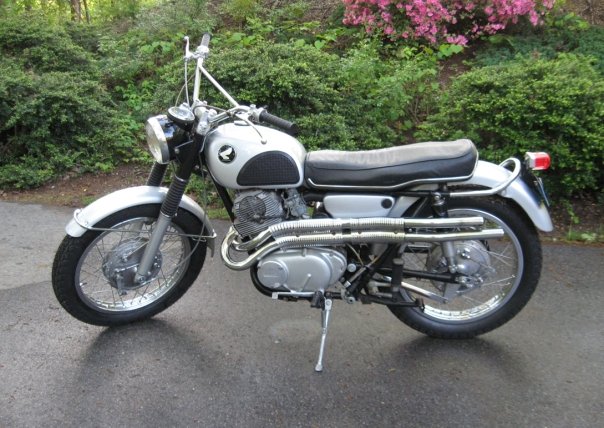
Honda CL77
The Honda CL77, often called the Scrambler 305, represents a landmark in mid-1960s motorcycle engineering. It marries the smooth, twin-cylinder engine of the CB77 with rugged styling cues aimed at light off-road use. Enthusiasts value its blend of reliability, performance, and distinctive “scrambler” aesthetic. This article explores every facet of the CL77, from chassis geometry to electrical details, with a deep dive into its technical specifications.
Historical Context
The mid-1960s saw a surge in demand for street-legal bikes capable of handling fire roads and mild trails. Honda answered the call by modifying its acclaimed CB77 Super Hawk platform. The CL77 arrived in 1965, sporting high-mounted exhausts, upswept handlebars, and dual rear shocks tuned for rougher terrain. Although only produced until 1966, its influence lives on in modern scrambler designs.
Chassis and Geometry
Honda engineered the CL77 chassis to balance road stability with nimble handling off pavement. A reinforced frame and adjusted suspension travel set it apart from its street-focused sibling.
Frame and Fork
- Steel duplex cradle frame with reinforced gussets for added rigidity
- Telescopic front fork with 130 mm travel and 32 mm chrome stanchions
- Raised fork gaiters for protection against dust and debris
Rear Suspension
- Twin shock absorbers with 105 mm travel, featuring adjustable preload
- Chrome-plated springs and damping tuned for mixed-surface comfort
- Dual shock mounting points on swingarm for optimal wheel control
Dimensions and Weight
| Specification | Measurement |
|---|---|
| Wheelbase | 1,345 mm |
| Seat Height | 780 mm |
| Ground Clearance | 150 mm |
| Rake (Caster) | 30° |
| Trail | 98 mm |
| Dry Weight | 143 kg |
Engine and Powertrain
At the heart of the CL77 lies a high‐revving 305 cc parallel-twin with distinctive hemispherical combustion chambers. Its design emphasizes broad torque and spirited acceleration.
Engine Architecture
- Air-cooled, 4-stroke, SOHC parallel-twin
- Bore × Stroke: 60 mm × 54 mm
- Compression Ratio: 9.5 : 1
- Hemispherical combustion chambers with centrally-located spark plugs
Carburation and Induction
- Dual Keihin CV (constant-velocity) carburetors, 24 mm throat diameter
- Filtration via foam socks on each intake for improved off-road reliability
- Cable-type throttle linkages for precise throttle control
Performance Figures
- Maximum Power: 28 hp at 9,000 rpm
- Peak Torque: 2.5 kg·m at 7,500 rpm
- Redline: 10,000 rpm
- 0–60 mph (0–97 km/h): Approximately 5.8 seconds
Transmission and Final Drive
The CL77’s gearbox and final drive gear ratios support both quick acceleration and relaxed cruising speeds.
Gearbox
- 4-speed constant-mesh transmission
- Close-ratio gearing for rapid acceleration between shifts
- Foot-shift lever with positive detents
Final Drive
- #520 O-ring chain
- Front Sprocket: 18 teeth
- Rear Sprocket: 42 teeth
- Chain guard integrated into swingarm for debris protection
Brakes, Wheels, and Tires
Stopping power and wheel/tire assembly were selected for reliable performance on mixed terrains.
Braking System
- Front: Single 150 mm drum brake
- Rear: Single 130 mm drum brake
- Leading-trailing shoe design for consistent modulation
Wheels and Tires
- Front Wheel: 19-inch steel rim, 1.60-inch width
- Rear Wheel: 18-inch steel rim, 2.15-inch width
- Original Tires: 3.00-19 front, 3.50-18 rear, bias-ply construction
- Optional knobby tread patterns available for enhanced off-road grip
Electrical System and Lighting
Honda equipped the CL77 with a straightforward 6-volt electrical system that balances simplicity and reliability.
Ignition and Charging
- Points-type ignition with manual advance/retard lever on left grip
- 6-volt, 15-amp generator mounted on alternator end-cover
- 6-volt, 5 Ah lead-acid battery beneath the seat
Lighting and Instrumentation
- Headlight: 6V, 45/40W multi-reflector sealed unit
- Taillight: 6V, 5W incandescent lamp with integrated reflector
- Speedometer: 140 km/h maximum indication
- No tachometer fitted; riders relied on the engine’s distinctive character to judge revs
Ergonomics and Rider Interface
Every control and contact point on the CL77 was crafted for a blend of off-road poise and street comfort.
Handlebar and Controls
- Raised, swept-back alloy tubular handlebar for upright posture
- Twist-grip throttle, clutch and front brake levers calibrated for light action
- Left grip housing engine start/stop and advance/retard controls
Seat and Footpegs
- Flat, 2-person seat with textured vinyl covering for grip
- Fold-down footpegs with rubber inserts to damp vibration
- Passenger grab strap integrated into seat cover
Fuel Capacity and Range
The CL77’s modest fuel tank prioritizes weight distribution and handling agility.
- Tank Capacity: 10 liters (2.6-liter reserve)
- Fuel Economy: Approximately 25 km/L at cruising speeds
- Theoretical Range: Up to 240 km per full tank
Customization and Legacy
Aftermarket support for the CL77 has thrived for decades. Riders often fit high-clearance skid plates, upswept pipes, and modern electronics to preserve the Scrambler spirit while enhancing usability. The CL77’s DNA lives on in today’s resurgence of retro scrambler builds.
Conclusion
The Honda CL77 Scrambler 305 remains an icon of 1960s adventure motorcycling. Its blend of lightweight agility, dual-purpose styling, and a spirited twin-cylinder engine set a template for scramblers that endures to this day. For collectors and custom builders alike, the CL77 represents both a nostalgic treasure and a versatile platform for creative transformation.
