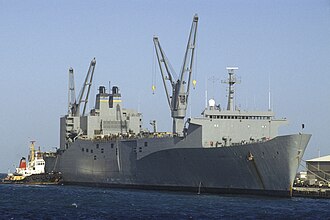
A Star-Named Giant of American Sealift
Among the many unusual ships operated in support of United States military logistics, few are as fascinating as SS Denebola (T-AKR 289). Unlike traditional warships designed to carry missiles, guns, or aircraft, Denebola represented a different kind of military power: the ability to rapidly move enormous quantities of equipment, vehicles, and supplies across the world’s oceans. Her importance was not measured by weapons systems, but by speed, cargo capacity, and the strategic flexibility she provided during periods of international crisis.
Denebola belonged to the Algol-class fast sealift ships, a unique group of vessels that combined commercial high-speed container ship technology with military logistics requirements. These ships were among the fastest large cargo vessels ever placed into service, capable of speeds approaching those of many naval combatants. Originally built for commercial shipping, Denebola was later transformed into a specialized military vehicle transport capable of carrying hundreds of tanks, trucks, helicopters, and other heavy Army equipment.
The ship’s story began far from American naval bases. Launched in Rotterdam, Netherlands, in 1973 as SS Sea-Land Resource, she was part of a new generation of high-speed container ships developed during a period when global commerce was rapidly changing. However, the very characteristics that made her impressive in commercial service—extreme speed and powerful propulsion—also made her expensive to operate. This eventually opened the door for her acquisition by the United States government and her second career as a military sealift vessel.
Named after Denebola, the bright star marking the tail of the constellation Leo, the ship followed the naming tradition of the Algol class, whose vessels were named after prominent stars. Her name reflected both the class identity and the ambitious role these ships were expected to play: serving as rapid-response transportation assets capable of moving critical military forces anywhere in the world.
The Origins of SS Denebola: From Commercial Speedster to Military Asset
The Sea-Land Resource Era
Before becoming Denebola, the ship was known as SS Sea-Land Resource. She was constructed by Rotterdamsche Droogdok Maatschappij (Rotterdam Dry Dock Company) in the Netherlands for Sea-Land Service, Inc., one of the pioneers of modern container shipping. She was launched on November 1, 1973, and entered commercial service later that year.
The vessel was part of Sea-Land’s ambitious SL-7 program. These ships were designed around one central idea: speed. During the early years of containerization, companies believed that faster ships could provide major advantages by reducing transit times and improving schedule reliability. The SL-7 vessels were therefore built with extremely powerful propulsion plants compared with ordinary cargo ships of similar size.
Denebola’s original commercial configuration was very different from her later military role. She was designed as a high-speed container carrier, optimized for moving standardized cargo containers rather than armored vehicles or military equipment. Her powerful engines allowed her to maintain speeds far beyond typical merchant ships of the era, but this performance came with a major drawback: fuel consumption and operating expenses were exceptionally high.
As fuel prices increased during the 1970s, particularly after the global energy crises, operators found that maintaining such fast commercial ships was financially challenging. The same qualities that made the SL-7 ships technologically impressive also limited their profitability in normal cargo service.
This situation attracted attention from the U.S. government. Military planners had long recognized the need for a rapid sealift capability. The ability to quickly transport heavy military formations from North America to distant theaters was a crucial element of American defense strategy, especially during the Cold War. Ships like Sea-Land Resource offered a rare combination of speed and capacity that conventional cargo ships could not match.
Acquisition by the United States Navy
A New Mission Under Military Sealift Command
On October 27, 1981, the U.S. Navy acquired Sea-Land Resource and renamed her USNS Denebola (T-AK-289). Instead of serving as a traditional commissioned warship, she became part of the Military Sealift Command (MSC), the organization responsible for operating many U.S. government-owned support vessels using civilian mariners.
The acquisition reflected a broader strategic effort to improve American sealift capabilities. During a major conflict, the United States would need to transport not only troops but also the enormous quantities of equipment required to sustain modern mechanized forces. Tanks, armored personnel carriers, fuel trucks, engineering vehicles, helicopters, and spare parts all required transportation from the continental United States to overseas locations.
Traditional cargo ships could perform this mission, but they lacked the speed necessary for rapid reinforcement. Denebola and her sister ships filled this gap by offering a fast-response transportation capability.
However, simply purchasing the ship was not enough. A container ship designed for commercial cargo was not suitable for military vehicles. A major conversion project was required to transform Denebola into a specialized roll-on/roll-off vehicle cargo ship.
The Major Conversion: Creating a Fast Military Vehicle Carrier
Transformation at Pennsylvania Shipbuilding
Conversion work began on November 22, 1983, at Pennsylvania Shipbuilding Corporation in Chester, Pennsylvania. The project fundamentally changed the ship’s internal arrangement and transformed her from a container vessel into a military logistics platform.
The most important modification involved redesigning the cargo spaces. Instead of carrying stacked containers, Denebola’s internal areas were rebuilt into multiple vehicle decks connected by ramps. This allowed military vehicles to be driven directly into and out of the ship, greatly reducing loading and unloading times.
This roll-on/roll-off capability was one of Denebola’s greatest advantages. During a military emergency, time is often as important as cargo capacity. A ship that can arrive at a port and quickly discharge hundreds of vehicles provides commanders with much greater operational flexibility.
The conversion also added heavy lifting equipment. Four cranes were installed: two located amidships capable of lifting approximately 35 tons and two located aft capable of lifting approximately 50 tons. These cranes allowed Denebola to operate in ports where specialized cargo-handling equipment might not be available.
After conversion, Denebola was delivered to the Military Sealift Command on October 10, 1985, officially beginning her career as one of America’s most capable fast sealift ships. (Wikipedie)
Engineering and Design Philosophy
Speed as a Strategic Weapon
The defining characteristic of Denebola was speed. At approximately 33 knots, she was dramatically faster than conventional cargo ships. Her propulsion system consisted of two Foster-Wheeler boilers powering two General Electric MST-19 steam turbines, producing around 120,000 shaft horsepower. (navysite.de)
For comparison, many large commercial cargo ships of the era operated at speeds closer to 15–20 knots. Denebola could cover enormous distances significantly faster, allowing military planners to move critical equipment ahead of slower logistics vessels.
This speed was particularly valuable during crises where forces needed reinforcement quickly. A mechanized division depends on thousands of vehicles and vast quantities of equipment. Without ships capable of moving that equipment rapidly, even highly trained military units could not be deployed effectively.
The Algol-class ships were therefore not simply cargo vessels; they were strategic mobility assets. Their mission was to reduce the time between a political decision to intervene and the physical arrival of military capability.
SS Denebola in Military Service: Proving the Value of Fast Sealift
After her conversion into a military vehicle transport, SS Denebola (T-AKR 289) became one of the most important vessels in the United States’ strategic sealift fleet. Her mission was straightforward but essential: move large quantities of heavy military equipment across oceans as quickly as possible.
Unlike combat ships that operate at the front lines, Denebola represented a different dimension of military capability. Modern armed forces depend on logistics, and logistics depend on transportation. A tank unit without tanks, a helicopter squadron without aircraft, or an engineering battalion without construction equipment cannot operate effectively. Ships like Denebola provided the bridge between military planning and actual battlefield capability.
During the final decades of the Cold War, the United States maintained a global military presence that required rapid reinforcement capabilities. Potential conflicts in Europe, Asia, and the Middle East demanded the ability to move large amounts of Army and Marine Corps equipment quickly. The Fast Sealift Ships, including Denebola, were designed specifically for this purpose.
Their unique combination of speed, cargo capacity, and flexibility gave military planners an option between slower commercial shipping and expensive air transportation. Aircraft could move personnel and small amounts of urgent cargo quickly, but only ships could transport the massive quantities of armored vehicles, fuel equipment, and supplies required for sustained operations.
Role During Operation Desert Storm
Supporting the Gulf War Logistics Effort
One of the most significant chapters in Denebola’s career came during the Gulf War in 1990–1991. Following Iraq’s invasion of Kuwait in August 1990, the United States launched Operation Desert Shield, a massive military buildup designed to defend Saudi Arabia and prepare for potential combat operations.
The deployment required an enormous logistical effort. Hundreds of thousands of personnel, thousands of armored vehicles, aircraft, and millions of tons of supplies had to be transported from the United States and other allied locations to the Persian Gulf region.
Denebola played a role in this massive sealift operation by transporting military equipment needed for the buildup. Her ability to carry large quantities of vehicles while maintaining high speeds made her particularly valuable during the early stages of the crisis.
The Gulf War demonstrated an important lesson in modern warfare: strategic mobility could determine the success of military operations. The United States could deploy highly advanced forces, but only because it possessed the transportation infrastructure necessary to move and sustain them.
Fast sealift ships like Denebola were critical parts of that infrastructure.
The Importance of the Fast Sealift Ship Concept
Why Speed Mattered
At first glance, a cargo ship capable of traveling more than 30 knots may seem excessive. Commercial shipping usually prioritizes fuel efficiency over speed, and slower ships can transport goods economically. However, military transportation operates under different priorities.
A military crisis often develops faster than traditional logistics systems can respond. A ship that arrives days or weeks earlier can make a significant difference in a developing conflict.
For example, moving armored brigades requires not only personnel but also thousands of vehicles, maintenance equipment, ammunition-handling systems, fuel trucks, and support vehicles. Airlifting this equipment would be extremely expensive and often impossible on a large scale. Sea transport remains the only practical method for moving heavy forces across oceans.
Denebola’s speed allowed commanders to reduce the time required for strategic deployment. She could arrive ahead of slower sealift ships, delivering critical equipment while larger but slower vessels followed behind.
Life as Part of the Military Sealift Command Fleet
Civilian Crews Supporting Military Missions
Like many Military Sealift Command vessels, Denebola was operated by civilian mariners rather than active-duty Navy crews. These professionals were responsible for navigation, engineering, maintenance, and ship operations.
The Military Sealift Command model allowed the Navy to maintain a large logistics capability without assigning military personnel to every support vessel. Civilian crews provided specialized maritime expertise while maintaining the readiness required for national defense missions.
During normal periods, vessels like Denebola could remain inactive or operate with reduced staffing. When needed, they could be activated and prepared for deployment.
This approach formed the foundation of the United States’ strategic sealift system. Instead of maintaining every logistics ship at sea continuously, the government maintained a reserve fleet capable of rapid activation during emergencies.
The Ready Reserve Force and Strategic Reserve Role
Maintaining Readiness for Future Conflicts
After decades of service, Denebola eventually became associated with the Ready Reserve Force (RRF), a fleet maintained by the U.S. government to provide additional sealift capacity during national emergencies.
The Ready Reserve Force exists because commercial shipping alone may not provide enough capacity during a major conflict. A large-scale military operation can require hundreds of ships, and relying entirely on commercial operators could create significant risks.
Ships in the reserve fleet are maintained in varying states of readiness. Some can be activated within days, while others require longer preparation periods. The goal is to provide a flexible transportation reserve that can expand rapidly during wartime or humanitarian emergencies.
Denebola’s presence in this system reflected the continuing importance of her original mission. Even decades after construction, a fast vehicle transport remained valuable because the fundamental challenge of moving heavy military equipment across oceans had not changed.
Design Features That Made Denebola Unique
Cargo Capacity and Vehicle Transport Capability
Following her conversion, Denebola was optimized for military vehicle transportation. Her internal decks allowed her to carry a wide range of equipment, including:
- Main battle tanks
- Armored vehicles
- Trucks
- Engineering equipment
- Helicopters
- Military support vehicles
- Containers containing supplies and spare parts
Her roll-on/roll-off configuration allowed vehicles to be driven directly onto the ship through ramps. This eliminated much of the slow crane-based loading process used by traditional cargo ships.
For military logistics, this capability was revolutionary. A ship arriving in a foreign port could quickly unload operational equipment and allow forces to move inland without waiting for extensive port infrastructure.
Propulsion System and Performance
The most remarkable engineering feature of Denebola remained her propulsion system.
Originally designed as a commercial high-speed container ship, she retained a propulsion plant far more powerful than typical cargo vessels. Two General Electric steam turbines produced approximately 120,000 shaft horsepower.
This enormous power output allowed Denebola to reach speeds of roughly 33 knots, making her one of the fastest large cargo ships ever built.
However, this performance came at a cost. High-speed steam propulsion consumed significant amounts of fuel, which was one reason the SL-7 commercial ships struggled economically. In military service, however, speed was considered worth the expense because operational effectiveness mattered more than commercial efficiency.
Challenges and Limitations
The Cost of Maintaining a High-Speed Giant
Although Denebola was strategically valuable, operating a ship of her type presented challenges.
The same characteristics that made her impressive also made her expensive. Large steam turbines, specialized machinery, and high fuel consumption required significant maintenance resources.
As commercial shipping technology evolved, newer container ships became larger, more fuel-efficient, and economically superior. The market moved away from extremely fast vessels like the SL-7 class.
Military requirements were different, but budget pressures remained a concern. Maintaining aging ships with unique engineering systems became increasingly difficult compared with operating newer, more efficient vessels.
Retirement and Final Years
The End of a Remarkable Career
After decades of service, Denebola eventually reached the end of her operational life. Like many large ships, age became a major factor. Maintaining a vessel built in the early 1970s became increasingly challenging as replacement parts became harder to obtain and operating costs increased.
The ship was eventually removed from active service and retired from the U.S. maritime fleet. Her career represented a unique period in naval logistics history when speed was considered one of the most important qualities for strategic transportation.
Although she was not a warship in the traditional sense, Denebola contributed directly to American military capability by ensuring that combat forces could receive the equipment necessary to operate.
Legacy of SS Denebola
A Symbol of Strategic Mobility
The legacy of SS Denebola extends beyond her individual service record. She represented an important idea in military planning: mobility is power.
The ability to rapidly move forces around the globe remains a central requirement of modern defense strategy. Aircraft carriers, submarines, and aircraft may receive more public attention, but logistics ships often determine whether military operations can be sustained.
Denebola and her sister ships demonstrated that commercial maritime technology could be adapted to serve national security needs. They combined civilian engineering with military requirements to create a unique class of strategic transportation vessels.
The Fast Sealift Ships remain an important example of how transportation technology can influence military strategy. Their history shows that a nation’s ability to project power depends not only on weapons but also on the ability to move, supply, and support those weapons wherever they are needed.
Technical Specifications of SS Denebola (T-AKR 289)
| Specification | Details |
|---|---|
| Ship Name | SS Denebola |
| Military Designation | T-AKR 289 |
| Class | Algol-class Fast Sealift Ship |
| Former Name | SS Sea-Land Resource |
| Builder | Rotterdamsche Droogdok Maatschappij (Rotterdam Dry Dock Company), Netherlands |
| Launched | November 1, 1973 |
| Entered U.S. Military Service | October 27, 1981 acquisition; converted and delivered in 1985 |
| Operator | Military Sealift Command |
| Ship Type | Fast Roll-on/Roll-off Vehicle Cargo Ship |
| Length | Approximately 946 feet (288 meters) |
| Beam | Approximately 105 feet (32 meters) |
| Draft | Approximately 35 feet (10.7 meters) |
| Displacement | Approximately 55,000 tons full load |
| Propulsion | Two General Electric steam turbines |
| Boilers | Two Foster Wheeler boilers |
| Shaft Horsepower | Approximately 120,000 shp |
| Propellers | Two shafts |
| Maximum Speed | Approximately 33 knots |
| Crew | Civilian merchant mariners |
| Cargo Capability | Military vehicles, containers, heavy equipment, helicopters, supplies |
| Cargo Handling | Roll-on/Roll-off ramps and onboard cranes |
| Cranes | Four cranes (two approximately 35-ton, two approximately 50-ton capacity) |
| Primary Mission | Rapid transport of military equipment and vehicles |
| Major Operations | Operation Desert Shield / Desert Storm support |
| Final Role | Strategic sealift reserve asset |
| Class Sisters | Other Algol-class Fast Sealift Ships |
Conclusion: The Ship That Turned Speed Into Military Capability
SS Denebola was a remarkable example of how a commercial vessel could be transformed into a strategic military asset. Built during the experimental era of high-speed container shipping, she found a second life serving the United States’ global defense logistics network.
Her story reflects a broader truth about military power: victory often depends on the ability to move resources as much as the ability to fight. While Denebola never carried missiles or participated in naval battles, she played a vital supporting role by ensuring that the machines of war could reach distant theaters.
The ship’s combination of extraordinary speed, enormous cargo capacity, and strategic flexibility made her one of the most distinctive logistics vessels of the modern era. SS Denebola remains remembered as a symbol of American sealift capability and as an example of how engineering innovation can serve national security far beyond the battlefield.
