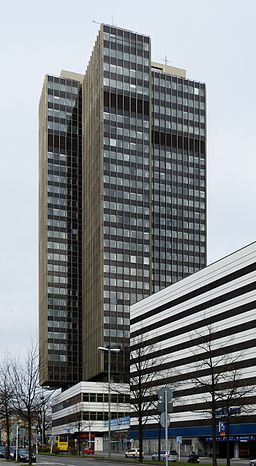
Steglitzer Kreisel
The Steglitzer Kreisel, once a symbol of bureaucratic ambition and urban stagnation, has undergone a dramatic transformation into one of Berlin’s most intriguing examples of adaptive reuse. Located in the Steglitz district of southwest Berlin, this high-rise structure has evolved from a controversial office tower into a modern residential and commercial hub. Its journey reflects both the challenges and possibilities of repurposing large-scale urban infrastructure.
Historical Background and Urban Context
Origins and Initial Purpose
Construction of the Steglitzer Kreisel began in 1968 and was completed in 1980. Originally intended as a government office complex, the building was plagued by delays, cost overruns, and technical complications. Its brutalist design, characterized by raw concrete and rigid geometries, stood in stark contrast to the surrounding low-rise residential neighborhoods.
Urban Integration
The tower is situated at the intersection of Schloßstraße and the Bundesstraße B1, one of Berlin’s busiest commercial corridors. Its location offers strategic connectivity to public transport, including the U-Bahn station Rathaus Steglitz, which is integrated directly into the building’s base.
Structural and Technical Parameters
Building Dimensions
- Height: 118,5 meters (roof height), making it one of Berlin’s tallest buildings outside the city center.
- Floors: 32 above ground, plus 3 basement levels.
- Gross Floor Area: Approximately 55,000 m².
- Usage Distribution (Post-Renovation):
- Residential: ~25,000 m²
- Office and commercial: ~20,000 m²
- Public amenities and infrastructure: ~10,000 m²
Structural System
- Core Construction: Reinforced concrete core with shear walls and elevator shafts.
- Floor Slabs: Precast concrete panels with post-tensioning for load distribution.
- Column Grid: 6.0 x 6.0 meter spacing, allowing modular interior layouts.
- Wind Load Management: Designed to withstand wind pressures up to 1.2 kN/m², typical for Berlin’s climate zone.
Foundation and Substructure
- Foundation Type: Deep pile foundation with reinforced concrete caissons reaching depths of 25–30 meters.
- Basement Use: Includes parking, technical rooms, and access to the U-Bahn station.
Facade and Envelope Engineering
Original Facade
- Material: Exposed concrete panels with minimal thermal insulation.
- Glazing: Single-pane windows with poor energy performance.
Renovated Facade
- Cladding: Aluminum composite panels with integrated insulation layers.
- Glazing: Triple-glazed units with low-E coatings and acoustic lamination.
- Thermal Performance: Achieved U-values of 0.85 W/m²K, compliant with EnEV and KfW efficiency standards.
Mechanical, Electrical, and Plumbing (MEP) Systems
HVAC Systems
- Heating: District heating connection with smart thermostatic controls in residential units.
- Cooling: Split-system air conditioning in commercial zones; natural ventilation in residential areas.
- Ventilation: Mechanical ventilation with heat recovery units (HRUs) and humidity sensors.
Electrical Infrastructure
- Power Supply: Upgraded medium-voltage grid connection with emergency backup systems.
- Lighting: LED fixtures with motion sensors and daylight-responsive dimming.
- Smart Controls: Building-wide automation system for energy monitoring and tenant customization.
Plumbing and Water Management
- Water Supply: Pressure-regulated systems with anti-legionella protocols.
- Sanitary Systems: Gravity drainage with backflow protection and greywater reuse for irrigation.
- Stormwater Management: Green roof systems and permeable paving around the base for runoff control.
Adaptive Reuse and Sustainability
Conversion Strategy
The transformation of Steglitzer Kreisel from office tower to mixed-use development required extensive structural retrofitting. Key interventions included:
- Removal of asbestos-containing materials.
- Reinforcement of load-bearing elements to accommodate residential occupancy.
- Reconfiguration of vertical circulation systems, including new elevator banks.
Sustainability Features
- Energy Efficiency: Achieved KfW 55 standard for residential units.
- Renewables: Rooftop solar panels generating up to 15% of building electricity.
- Material Reuse: Salvaged concrete and steel reused in interior partitions and landscaping.
- Mobility Integration: Bicycle storage, EV charging stations, and direct access to public transit.
Vertical Transportation and Accessibility
Elevator Systems
- Total Elevators: 8 passenger elevators and 2 service elevators.
- Speed: Up to 2.5 m/s, with zoning to reduce travel times.
- Accessibility: All elevators equipped with tactile buttons, voice guidance, and emergency communication.
Fire Safety and Egress
- Sprinkler Systems: Full coverage in residential and commercial areas.
- Smoke Control: Pressurized stairwells and mechanical smoke extraction.
- Evacuation Routes: Dual staircases with fire-rated enclosures and refuge floors every 10 levels.
Public Infrastructure and Connectivity
Transport Links
- U-Bahn Integration: Rathaus Steglitz station directly accessible from the building’s base.
- Bus and Road Access: Adjacent to major bus lines and Bundesstraße B1.
- Parking: Underground garage with 400 spaces, including car-sharing and disabled-access zones.
Digital Infrastructure
- Telecommunications: Fiber-optic backbone with high-speed internet in all units.
- Smart Building Features: IoT sensors for predictive maintenance and energy analytics.
Conclusion
The Steglitzer Kreisel stands as a testament to Berlin’s capacity for architectural reinvention. Once a symbol of dysfunction, it now represents a forward-looking approach to urban sustainability, adaptive reuse, and integrated living. Its technical upgrades and design innovations make it a model for transforming aging infrastructure into vibrant, multifunctional spaces that meet the demands of contemporary urban life.
