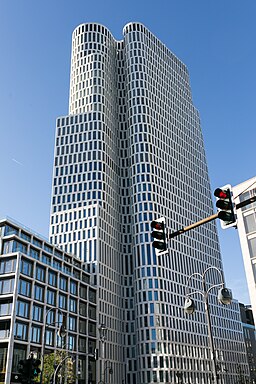
Upper West
Rising prominently at the intersection of Kurfürstendamm and Breitscheidplatz, Upper West is one of Berlin’s most striking high-rise buildings. Completed in 2017, this architectural marvel redefines the skyline of western Berlin, blending commercial functionality with aesthetic innovation. As a symbol of the city’s post-reunification urban resurgence, Upper West is not only a visual icon but also a technical feat of engineering and sustainable design.
Architectural Vision and Urban Context
Strategic Location
Upper West is situated in the heart of Berlin’s City West, directly opposite the historic Kaiser Wilhelm Memorial Church and adjacent to the iconic Bikini Berlin complex. This location places it at a nexus of commerce, culture, and tourism, making it a focal point for both locals and international visitors.
Design Philosophy
Designed by Christoph Langhof, the building embodies a dynamic interplay of verticality and rhythm. Its white aluminum facade, punctuated by horizontal bands of glazing, creates a wave-like visual effect that contrasts with the more rigid geometries of neighboring structures. The design aims to evoke movement and lightness, despite the building’s substantial mass.
Structural and Technical Parameters
Building Dimensions and Layout
- Height: 118 meters (roof height), making it one of the tallest buildings in Berlin.
- Floors: 33 above ground, plus 3 basement levels.
- Gross Floor Area: Approximately 53,000 m².
- Usage Distribution:
- Office space: ~35,000 m²
- Hotel (Motel One): ~18,000 m²
- Retail and gastronomy: ~2,000 m²
Structural System
- Core Construction: Reinforced concrete core housing elevators, stairwells, and service shafts.
- Load-Bearing Elements: Composite steel-concrete columns and floor slabs with post-tensioning for long-span flexibility.
- Wind Resistance: Tuned mass dampers and aerodynamic facade design to mitigate wind-induced sway.
Foundation and Substructure
- Foundation Type: Deep pile foundation with bored piles reaching up to 30 meters into Berlin’s sandy subsoil.
- Basement Levels: Include parking, technical rooms, and service access, with waterproofing systems designed for high groundwater levels.
Facade Engineering and Materials
Curtain Wall System
- Material: Powder-coated aluminum panels with integrated thermal breaks.
- Glazing: Triple-glazed units with low-emissivity coatings and solar control films.
- U-Value: Approx. 0.9 W/m²K for facade elements, exceeding German EnEV standards.
Solar and Light Management
- Orientation Strategy: Facade geometry optimized for daylight penetration while minimizing glare.
- Shading Devices: External louvers and fritted glass sections on sun-exposed elevations.
Mechanical, Electrical, and Plumbing (MEP) Systems
HVAC and Climate Control
- Heating: District heating connection with condensing boilers for peak load support.
- Cooling: Chilled beam systems in office areas; VRF systems in hotel zones.
- Ventilation: Demand-controlled mechanical ventilation with CO₂ sensors and heat recovery units.
Electrical Systems
- Power Supply: Dual-feed medium-voltage grid connection with emergency backup generators.
- Lighting: LED-based smart lighting with daylight harvesting and occupancy sensors.
- Building Automation: Integrated BMS (Building Management System) controlling HVAC, lighting, and security.
Plumbing and Water Management
- Water Supply: Pressure-regulated systems with leak detection sensors.
- Sanitary Systems: Vacuum drainage in select areas to reduce water usage.
- Rainwater Harvesting: Collection and filtration for irrigation and greywater reuse.
Sustainability and Energy Performance
Certifications and Ratings
- DGNB Certification: Gold standard for sustainability in design, construction, and operation.
- Energy Efficiency: Primary energy demand reduced by over 30% compared to baseline EnEV requirements.
Green Features
- Green Roofs: Extensive green roof systems on podium levels for biodiversity and stormwater retention.
- Material Selection: Low-VOC finishes, recycled content in concrete and steel, FSC-certified wood.
- Mobility Integration: Bicycle parking, EV charging stations, and proximity to public transport hubs.
Vertical Transportation and Accessibility
Elevator Systems
- Total Elevators: 12 high-speed elevators, including dedicated hotel and office lifts.
- Speed: Up to 3.5 m/s, with intelligent dispatching to reduce wait times.
- Accessibility: All elevators equipped with tactile controls, voice guidance, and emergency intercoms.
Fire Safety and Egress
- Sprinkler Coverage: Full building coverage with zoned fire suppression.
- Smoke Extraction: Pressurized stairwells and mechanical smoke vents.
- Evacuation Routes: Dual staircases with fire-rated enclosures and refuge areas on intermediate floors.
Integration with Urban Infrastructure
Transport Connectivity
- Public Transit: Direct access to U-Bahn (Kurfürstendamm station) and regional bus lines.
- Parking: Underground garage with 300+ spaces, including car-sharing and disabled-access spots.
- Pedestrian Flow: Designed to accommodate high foot traffic with wide sidewalks and retail frontage.
Digital Infrastructure
- Telecom: Fiber-optic backbone with redundant routing.
- Smart Building Features: IoT sensors for predictive maintenance, energy analytics, and tenant customization.
Conclusion
Upper West Berlin is more than a high-rise—it is a statement of architectural ambition and technical excellence. From its sculptural facade to its advanced building systems, it reflects the evolving identity of Berlin as a global city. By harmonizing aesthetics, sustainability, and urban integration, Upper West sets a benchmark for future developments in dense metropolitan environments.
